With the collapse of the last major US–Russia treaty, a new phase of nuclear competition is emerging—faster, broader, and harder to control.
On February 5, 2026, the New START Treaty expired—quietly, but with global consequences. For the first time in over half a century, there are no legally binding limits on the world’s two largest nuclear arsenals.
For decades, treaties like New START capped deployed strategic warheads at 1,550 each for the United States and Russia, while also enabling inspections and data sharing. That system is now gone.
António Guterres called it a “grave moment.” He wasn’t exaggerating. Without verification mechanisms, both sides are effectively operating in the dark—an environment where assumptions replace evidence, and mistakes become more likely.
From Cold War to “Third Nuclear Age”
Experts are calling this shift the “third nuclear age”—a period defined not by two superpowers, but by multiple competing nuclear states, evolving technologies, and fewer rules.
During the Cold War, nuclear strategy was brutal but structured. Today, it’s fragmented.
- The United States is modernizing nearly every part of its nuclear arsenal.
- Russia is upgrading systems and signaling readiness to respond in kind.
- China is expanding rapidly, changing the strategic balance.
Instead of a two-player game, this is becoming a three-body problem—and those are notoriously unstable.
The U.S. Rebuilds Its Nuclear Backbone
The United States currently maintains around 3,700 nuclear warheads, but the bigger story is how it plans to use them.
A sweeping modernization program is underway:
- New intercontinental ballistic missiles (Sentinel)
- Next-generation submarines (Columbia-class)
- Advanced stealth bombers (B-21)
- Updated warheads and sea-launched cruise missiles
The strategy is shifting toward flexibility and survivability—being able to respond across a range of scenarios, not just all-out war.
There’s also renewed debate around resuming nuclear testing, something not seen since the late 20th century. Even discussing it signals a changing mindset.
Russia Holds the Largest Arsenal
Russia still possesses the world’s biggest nuclear stockpile, estimated at over 5,400 warheads.
Under Vladimir Putin, the country continues to:
- Develop new missile systems
- Maintain forward-deployed nuclear capabilities
- Signal willingness for negotiations—but with conditions
Moscow has proposed temporary limits, but without a formal agreement, these remain political gestures, not enforceable constraints.
China: The Fastest-Rising Nuclear Power
The most significant shift isn’t in Washington or Moscow—it’s in Beijing.
China has expanded its arsenal from roughly 260 warheads in 2015 to around 600 today, with projections exceeding 1,000 by 2030. This includes:
- New missile silo fields
- Submarine-launched ballistic missiles
- Diversified delivery systems
Unlike the U.S. and Russia, China has historically kept a smaller, deterrence-focused arsenal. That is changing.
Beijing has resisted joining formal arms control agreements, but its rapid buildup is now forcing the issue. Any future treaty without China risks being strategically incomplete.
More Players, More Risk
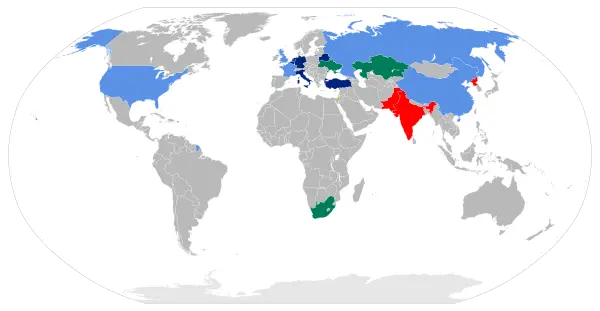
Beyond the big three, other nuclear-armed states are also moving:
- France is expanding its arsenal for the first time in decades
- The UK, India, Pakistan, and North Korea are upgrading capabilities
- Israel remains opaque but active
At the same time, new countries are inching closer to nuclear capability.
South Korea and Saudi Arabia are exploring advanced nuclear technologies. Iran remains a persistent flashpoint, even as talks continue.
The barrier to entry is no longer just political—it’s increasingly technical and economic, and those barriers are slowly eroding.
Technology Is Complicating Everything
Modern nuclear strategy isn’t just about warheads anymore.
New technologies are blurring the lines:
- Hypersonic missiles reduce response time
- AI systems influence decision-making
- Precision weapons make conventional strikes more dangerous
These systems create a dangerous overlap: a conventional attack could be mistaken for a nuclear one, triggering escalation before intent is clear.
Why This Matters Now
For nearly 35 years, global nuclear stockpiles were trending downward. That trend may be reversing.
Without new agreements:
- Warhead numbers could increase
- Transparency will decline
- Miscalculations become more likely
This isn’t just about weapons—it’s about predictability. And right now, predictability is fading.
Is There a Way Back to Control?
There are still diplomatic openings.
The U.S. has pushed for a broader agreement that includes both Russia and China. Informal talks are ongoing. Even Donald Trump has expressed interest in a new framework—though with stricter terms.
Civil society groups are also pushing back, highlighting a consistent public view: nuclear weapons don’t make the world safer—they make it more fragile.
But designing a new system won’t be easy. A bilateral model no longer fits a multipolar reality.
The Bottom Line
The end of New START didn’t just remove a treaty—it removed a system of trust, verification, and restraint built over decades.
What replaces it is still unclear.
For now, the world is entering a phase where nuclear powers are building, modernizing, and watching each other more closely—but with fewer rules than ever before.
That combination has a track record. And it isn’t a comforting one.
Disclaimer: This article is based on publicly available information, expert reports, and ongoing developments reported across multiple credible sources. While every effort has been made to ensure accuracy, some details may evolve over time or be subject to interpretation. Readers are encouraged to consult primary sources and official statements for the latest updates.