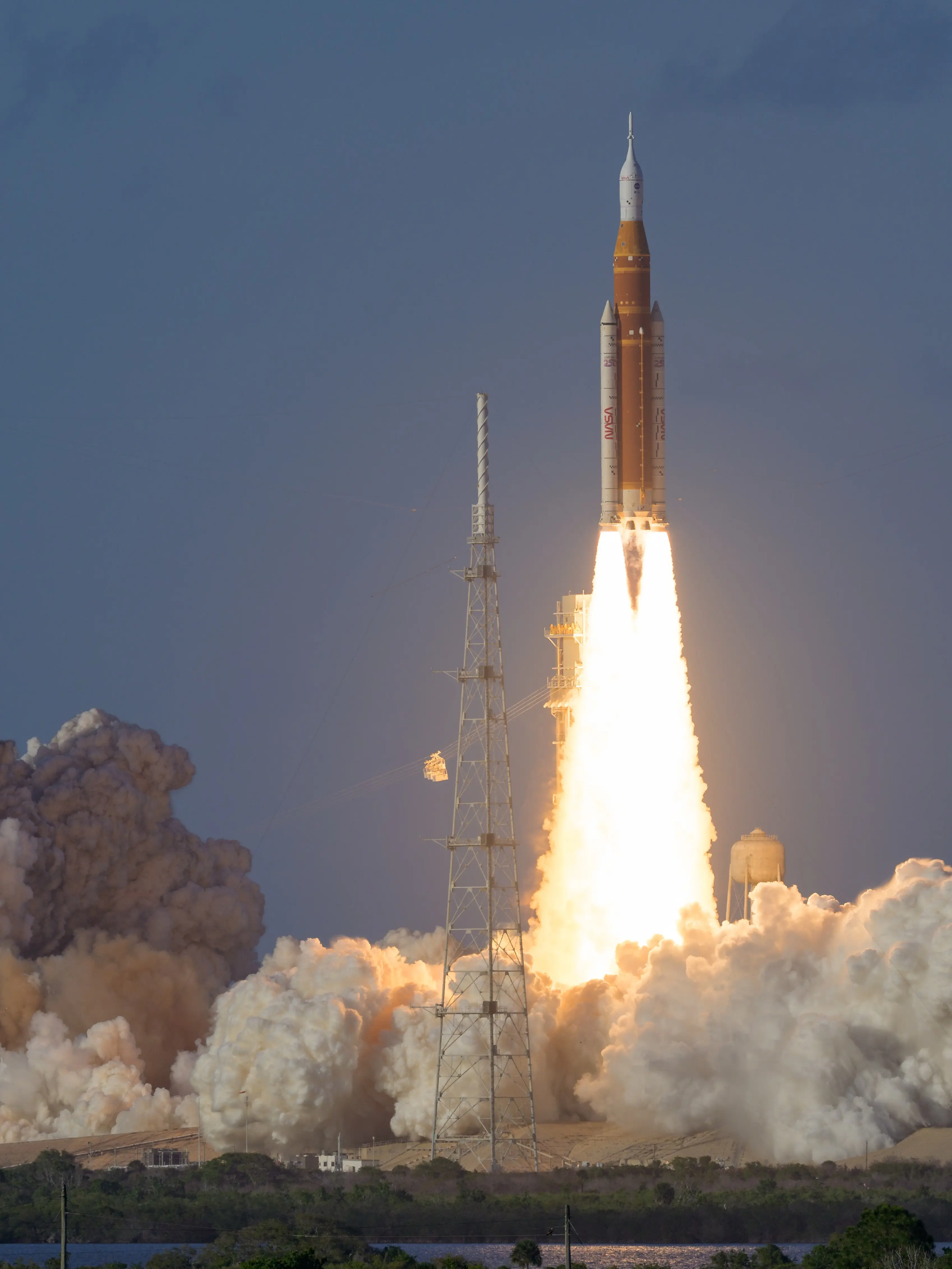
More than five decades after Apollo 17 closed the first chapter of lunar exploration, humans are once again traveling toward the Moon. On April 1, 2026, NASA launched Artemis II—not to land, but to answer a more fundamental question: can modern systems safely carry humans through deep space and back?
This mission is not about spectacle. It is about validation. Every system on board is being tested under real conditions that future lunar and Mars missions will depend on.
A Mission Built to Prove, Not Just to Fly
Artemis II is the first crewed flight of NASA’s new deep-space architecture. It launched aboard the Space Launch System, carrying the Orion spacecraft—a capsule designed specifically for missions beyond Earth’s immediate orbit.
The flight is expected to last around ten days, ending with a controlled splashdown in the Pacific Ocean. Unlike past lunar missions that focused on reaching orbit or landing, Artemis II is structured as a full-system rehearsal. Every phase—from launch and propulsion to life support and reentry—is being evaluated with a human crew on board.
The spacecraft’s service module, developed by the European Space Agency, highlights the program’s international foundation. Artemis is not a single-agency effort; it is a distributed system of engineering, logistics, and expertise.
The People Inside the System
The four astronauts aboard Artemis II are not passengers. They are active operators inside an experimental environment.
Commander Reid Wiseman leads the mission, supported by pilot Victor Glover and mission specialists Christina Koch and Jeremy Hansen. Hansen’s presence marks the first time a Canadian astronaut has been assigned to a lunar mission, reinforcing the multinational nature of Artemis.
Their role goes beyond observation. They are manually flying the spacecraft, testing navigation systems, and interacting directly with onboard hardware. In deep space, autonomy matters. Communication delays and system uncertainties mean crews must be capable of independent decision-making.
The Flight Path: Engineering Safety Into Trajectory
Rather than entering lunar orbit, Artemis II follows a free-return trajectory—a path that loops around the Moon and naturally brings the spacecraft back to Earth.
This approach serves two purposes. First, it reduces propulsion requirements, making the mission more efficient. Second, it builds redundancy into the mission design. If critical systems fail, gravity alone can guide the spacecraft home.
During the mission, Orion will travel roughly two million kilometers and pass about 6,400 kilometers beyond the far side of the Moon. This will place the crew farther from Earth than any humans in history. The distance is not symbolic; it exposes the spacecraft to the true conditions of deep space, including radiation and thermal extremes.
How the Spacecraft Is Being Tested
Artemis II is essentially a moving laboratory where engineering assumptions meet reality.
Inside Orion, life-support systems are maintaining air quality, pressure, and temperature in an environment where failure is not an option. Even routine systems—like waste management—are being tested under operational stress, with early minor issues already identified and resolved.
Navigation and control systems are another critical focus. The crew is executing manual maneuvers, validating that the spacecraft can be flown without full reliance on ground control. This is essential for future missions where real-time guidance from Earth is not feasible.
Propulsion systems are being tested through a sequence of orbital adjustments, including perigee and apogee raise burns. These maneuvers ensure that Orion can precisely control its trajectory across vast distances.
Communication systems are also under scrutiny. Maintaining stable data links over deep-space distances is a non-trivial problem, and Artemis II is validating the infrastructure needed to keep crews connected.
What Changed Since Apollo
The comparison with Apollo is unavoidable, but the differences are more important than the similarities.
Apollo missions were short, high-risk demonstrations driven by geopolitical urgency. Artemis is structured for continuity. Systems are designed to be reusable, scalable, and compatible with future infrastructure such as lunar stations and surface habitats.
Orion itself reflects this shift. It carries advanced avionics, improved radiation protection, and a heat shield capable of withstanding higher-energy reentries. The integration with the European service module adds another layer of capability, particularly in propulsion and power generation.
In practical terms, Artemis is not trying to repeat Apollo—it is trying to build on it.
The Roadblocks Before Launch
The path to launch was not linear. Artemis II faced several technical challenges that delayed its timeline.
Engineers dealt with hydrogen leaks during fueling tests, irregularities in helium flow, and a misleading battery temperature reading in the launch abort system. Each issue required investigation, testing, and verification before the mission could proceed.
These delays are not signs of failure. In aerospace systems, iteration is part of the process. The objective is not to avoid problems, but to identify and resolve them before they become mission-critical.
Where the Mission Stands Now
As of April 2, 2026, Artemis II is in active flight. The crew has completed initial maneuvers and begun system testing. Communication with mission control remains stable, and onboard operations are proceeding as planned.
Small issues—such as the early toilet malfunction—are being handled in real time, providing valuable data on how systems behave under actual mission conditions.
This phase of the mission is less visible than launch, but it is where most of the meaningful validation occurs.
Why This Mission Matters Now
Artemis II sits at a critical point in the broader Artemis program. Its success will directly determine the readiness of Artemis III, the mission intended to return humans to the lunar surface.
More importantly, it tests whether human spaceflight can move beyond short-term missions into sustained operations. Living and working in deep space requires systems that are reliable over time, not just functional for a single mission.
The technologies being validated—life support, navigation, radiation protection—are the same ones that will be required for missions to Mars. Artemis II is not a distant precursor; it is a direct step toward that capability.
What Comes Next
If Artemis II meets its objectives, the next phase will shift from testing to execution. Artemis III aims to land astronauts near the Moon’s south pole, a region believed to contain water ice and other resources critical for long-term exploration.
Between now and then, data from this mission will be analyzed in detail. Every system, every maneuver, and every anomaly will feed into the design and planning of future flights.
The larger question remains open: how do humans operate reliably beyond Earth?
Artemis II does not answer that question completely—but it is the first mission in decades designed to answer it systematically.
Photo: Artemis II Launch (NASA/Bill Ingalls)





Co-Founder & Chief Editor of Everyman Science. I view science not just as a collection of facts, but as the ultimate guide for human survival. From medical breakthroughs to the logistics of space exploration, I am dedicated to documenting how scientific reasoning uplifts the human spirit and provides the blueprints to save our planet. I believe that by unleashing the power of nature through disciplined inquiry, we can secure a sustainable future for humanity.