How Hayabusa2 Tapped an Asteroid with Light
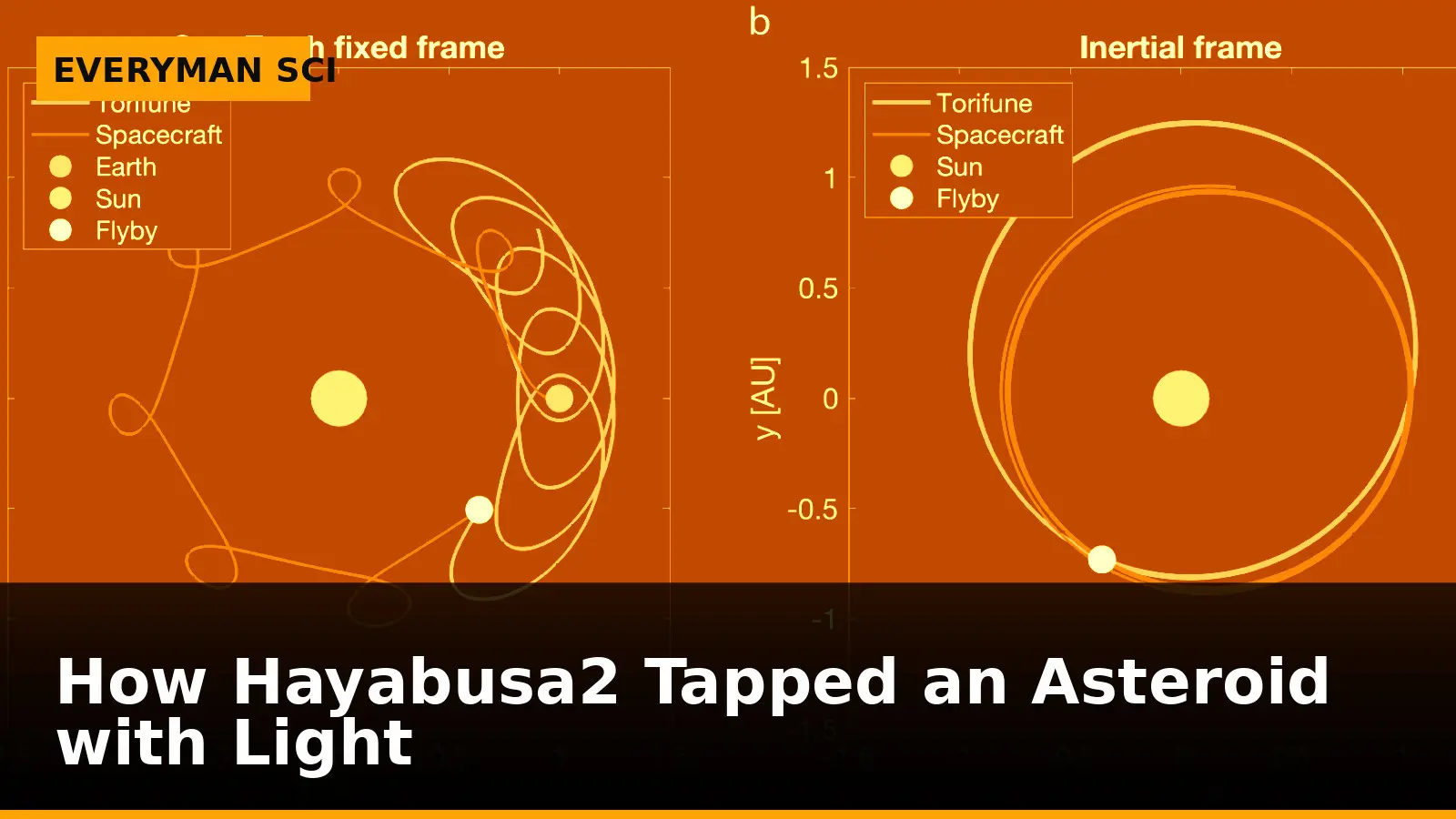
Fifty‑seven seconds out from a flyby, when an asteroid still fills only a corner of the camera frame, there isn’t time for do‑overs. On its extended mission, Japan’s Hayabusa2 spacecraft fired its laser twice at asteroid Torifune—at 56.5 and 57.5 seconds before closest approach—scoring the first successful laser‑ranging experiment during an asteroid flyby.
Those shots came from about 20 and 15 kilometers away while the spacecraft was moving at 5.3 km/s, and each beam struck a patch of ground tens of meters across. The instrument behind it, a laser altimeter known as LALT, had already been central to Hayabusa2’s navigation. This time it did something no probe had done before during a high‑speed pass.
Why this is in the news now
Japan’s space agency, JAXA, reported the achievement as a milestone of Hayabusa2’s extended mission: the first‑ever laser ranging with an asteroid during a flyby of Torifune. The laser was successfully fired twice, seconds before closest approach, at ranges of roughly a dozen to a few dozen kilometers.
JAXA also underlined what makes the feat useful beyond bragging rights: it shows spacecraft can gather crucial information on celestial objects even while traveling very fast. The team is now analyzing where, exactly, each pulse hit Torifune’s surface.
Laser ranging, from intuition to reality
If you’ve ever clapped your hands in a canyon and counted the echo, you already grasp the basic idea. Laser ranging sends out a pulse of light and times how long a reflection takes to return; timing translates into distance. Where the analogy breaks down is that sound bounces in air and slows down with wind and temperature, while the laser’s “echo” is light, racing through space and reflecting off an irregular, moving target.
On a fast flyby, there’s no time to sweep a grid or pause for multiple tries. Each pulse is a snapshot of distance to a tiny spot on the surface. Stack those snapshots beside the spacecraft’s own motion, and you start to build a geometric picture: where the asteroid was when the light left, and where the spacecraft was when the light returned.
The shot size tells you the challenge
Hayabusa2’s pulses hit areas only about 30 and 23 meters across (100 and 75.5 feet). That’s the footprint on the ground—small enough that a slight mispointing would miss entirely, large enough to include rocks, shadows, and texture the instrument can’t choose between.
Hitting a spot like that while closing at 5.3 km/s is like tagging a street sign from a moving car—except the sign is also moving and you get two squeezes of the trigger. This is where LALT’s previous role in navigation paid off: the spacecraft already knew how to hold itself steady and aim.
Why fire twice, seconds apart?
Two pulses, close in time but at different distances—about 20 km and 15 km—give two anchor points as the spacecraft streaks by. That pairing helps separate what changes because you moved from what changes because you measured a different patch of ground.
It also proves repeatability under pressure. One lucky return could be dismissed as a fluke. Two, at slightly different geometries, show the system is doing what it’s supposed to while everything is in motion.
What this unlocks for future flybys
Flybys are cheap in fuel and rich in targets, but they’re stingy with time. Demonstrating that a probe can take precise laser snapshots during a brief pass means more missions can choose fast encounters and still bring back hard distance data.
It’s a capability upgrade for reconnaissance: map a few precise ranges on approach, refine navigation in real time using an instrument already in the loop, and leave with more than pictures. JAXA explicitly points to the value of gathering crucial information at high velocity.
The deeper cut
Time‑of‑flight in a moving geometry
Laser altimetry reduces to time‑of‑flight: d = c·Δt/2 for a static, normal‑incidence shot, where Δt is the round‑trip travel time and c is the speed of light. A flyby breaks the static assumptions. The emitter and receiver share a moving frame with non‑zero radial velocity relative to the target, so the transmit point and receive point are separated in space, and the illuminated surface patch is not the same as the one normal to the beam at closest approach. In practice you solve the light‑time equation with the spacecraft’s state vector at transmit and receive epochs and a ray‑surface intersection in a shape model, then iterate. The two Torifune shots—separated by ~1 s and ~5 km of spacecraft motion—sample different look angles and ranges, which helps disambiguate range bias from pointing bias. The spot sizes (tens of meters) imply a beam divergence and/or ranging gate chosen to balance signal return against background and pointing error. The dominant error terms in this regime are clock jitter, attitude knowledge, and surface bidirectional reflectance variations within the footprint; radial velocity (km/s) does not directly corrupt range because c ≫ v, but it couples into geometry through light‑time and pointing as the line‑of‑sight slews during the pulse window.
Failure modes, and what happens when you miss
With a footprint only a few dozen meters wide, a miss means no useful return—no timing, no distance—just background. Even a hit on a very dark or angled patch can yield a weak reflection that’s hard to distinguish from noise.
That’s why navigation‑grade stability matters. LALT wasn’t a bolt‑on science toy; it had already been doing work to keep Hayabusa2 where it intended to be. Using it in a flyby ranging role leverages that steadiness when seconds count.
What we still don’t know yet
JAXA’s team is conducting a detailed analysis to pinpoint the exact locations where the two laser pulses struck Torifune’s surface. Until that’s nailed down, the shots prove the ranging worked at speed, but not which specific boulders or patches returned the light.
Two shots that change how we plan passes
A first‑ever is only worth celebrating if it buys capability. Here, the gain is clear: Hayabusa2 showed that a spacecraft can fire, range, and learn while racing past an asteroid. That’s a tool future mission designers can plan around instead of planning without.
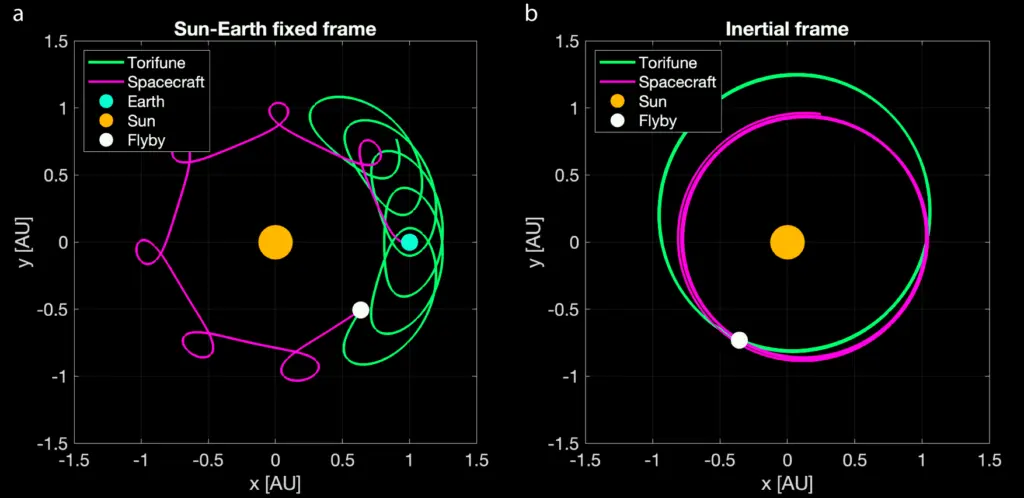
Sources: Japan's Hayabusa2 achieves first-ever laser ranging experiment with an asteroid (phys.org)
Images: Cover: Everyman Science (illustration); Figure 1: Original by Hirabayashi et al. 2026, modified by Nrco0e / Wikimedia Commons (CC BY 4.0)
How this article was made: Everyman Science uses AI tools to structure, format and optimise its articles, and occasionally to produce illustrations where no free photograph exists. The reporting these articles are based on is human-produced and cited above. Spotted an error? Write to [email protected] and we will correct it. — The editors How we work.





Science desk team of Everyman Science, curating and reporting on the day’s most significant developments in research, space exploration, and technology.