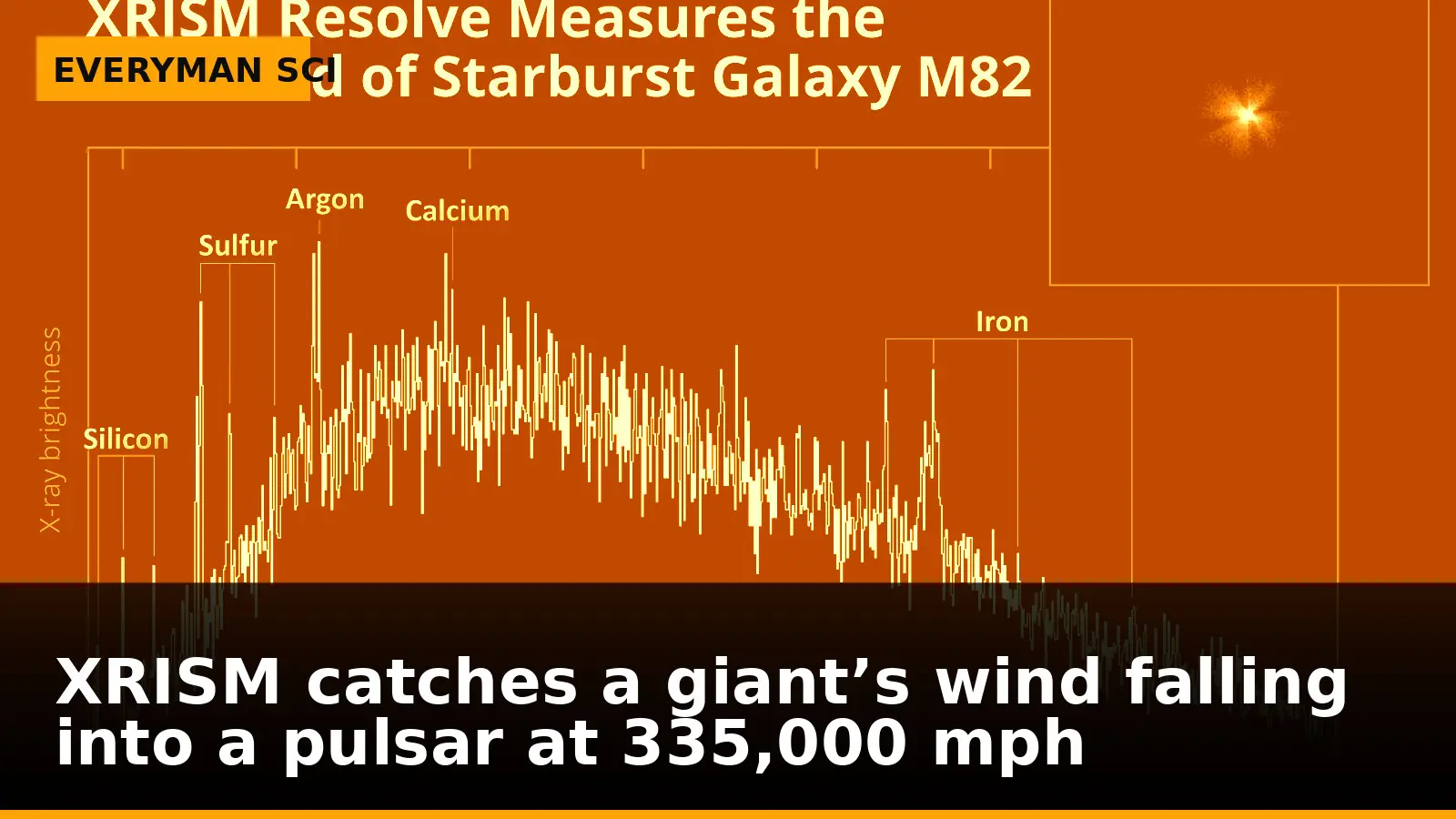
XRISM catches a giant’s wind falling into a pulsar at 335,000 mph
Near the end of a stronger flare in a far‑southern patch of sky, an X‑ray heartbeat spun every 11 minutes. On Feb. 1, 2025, the Japan‑led XRISM observatory turned its Resolve spectrometer toward BP Crucis and caught something astronomers had long chased but not seen this cleanly: a giant star’s wind plunging toward a compact neighbor.
“The observations were groundbreaking,” said Roi Rahin, a researcher involved in the work. The claim wasn’t hyperbole. The spectra showed a telltale fingerprint—iron absorption lines shifted to lower energies—revealing gas not just hot and ionized, but moving, fast, toward a hungry pulsar.
A heavyweight pairing built for drama
BP Crucis sits about 13,000 light‑years away. Its primary, Wray 977, is a blue hypergiant roughly 40 times the Sun’s mass and about 60 times its size—so luminous and hot that ionized gas constantly streams from its surface as a stellar wind.
Its companion is the opposite kind of extreme: a neutron star called GX 301‑2 that squeezes more than the Sun’s mass into a sphere only about 20 kilometers across. It is a pulsar, rotating every 11 minutes, and it traces a 41.5‑day path around its giant partner.
Resolve reads the wind’s speed and aim
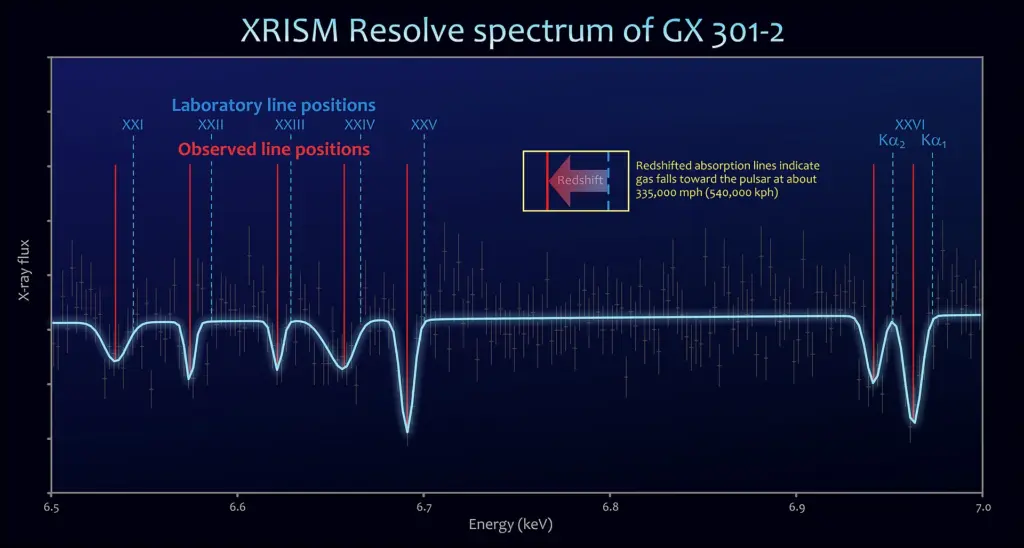
XRISM’s Resolve instrument captured high‑detail X‑ray spectra on Feb. 1, 2025. In those data, absorption lines from highly ionized iron appeared at lower energies than the same transitions measured in a laboratory. That displacement signaled motion away from us—meaning the plasma was headed inward toward the pulsar’s gravity well.
From the degree of that shift, Rahin and colleagues inferred a speed of about 335,000 miles per hour (540,000 kilometers per hour). The direction and the clocked velocity together tie the X‑ray flare’s power to wind material actually falling toward the compact object, rather than merely blowing past it.
A stream the pulsar takes days to cross
The team’s picture includes a dense stream within the broader outflow from Wray 977. The neutron star does not cross it in an instant. The transit takes about four days—long enough for the flow to change character as the pulsar plows through different parts of the stream.
That crossing time frames when and how the pulsar can capture matter. It also sets the stage for interpreting which spectral features belong to inflowing gas close to the compact object and which come from the surrounding wind farther out.
Why this system, and why now
“The BP Crucis system is an ideal laboratory for studying wind‑fed pulsar accretion,” said Brian Williams, XRISM’s project scientist at NASA Goddard. Wray 977’s powerful wind and GX 301‑2’s slow, clock‑regular spin make a clean test bench for mapping inflow against orbital phase and flare behavior.
Williams added that XRISM’s sensitive, high‑resolution Resolve spectrometer is “an ideal instrument for advancing our understanding of the processes involved.” The instrument’s ability to separate crowded X‑ray lines turns motion into a measurable shift, letting astronomers read the wind like a speed gun.
What we still can’t pin down from one look
One observation, however revealing, can’t settle the full geometry of the flow. The team’s analysis reads the redshifted iron lines as gas headed inward, and the measured transit time points to a focused stream within the wind. But how that stream changes across the 41.5‑day orbit remains to be traced in detail.
What follows are obvious next steps: repeat Resolve pointings at different phases and flares, and compare how often the lines look as they did on Feb. 1, 2025. Those sequences will sharpen where the densest wind sits and how efficiently the pulsar captures it.
The deeper cut
From shifted iron to an inflow speed
In X‑ray spectroscopy of hot plasmas, iron is the workhorse. Highly ionized Fe produces strong, narrow absorption features that, in a static gas, land at well‑known energies. When Resolve finds those lines displaced to lower energies, the simplest read is a line‑of‑sight redshift. In the geometry of BP Crucis, where the absorber sits close to GX 301‑2, a redshift means the absorbing gas is moving away from us on its way down the pulsar’s gravitational gradient. The amount of the shift encodes the radial component of the velocity. That’s how the team translates the spectra into an inflow of roughly 335,000 mph (540,000 kph). Instrumentally, this hinges on Resolve’s ability to distinguish neighboring iron features from different charge states: confusing, say, Fe XXV with Fe XXVI would masquerade as a velocity. The temporal variability seen alongside the shifts helps: if the centroid of the same identified transition slides coherently over time while the flare evolves, that argues for Doppler motion rather than misidentification. In a system built of a 20‑kilometer neutron star in a 41.5‑day orbit, even modest changes in viewing angle and local flow density can produce measurable line‑of‑sight velocity components across a four‑day transit.
A small object, a big effect
The scale mismatch is the point. A 20‑kilometer object with more than a Sun’s mass can impose order on a wind born from a star 60 solar diameters across and about 40 solar masses heavy. The iron lines’ motion shows that the pulsar’s gravity doesn’t just stir the wind—it drags part of it inward fast enough to light up in X‑rays.
That makes BP Crucis more than a curiosity. With a distance of about 13,000 light‑years and a pulsar that rotates every 11 minutes, it’s a nearby, periodic laboratory for testing how compact objects feed on stellar outflows—one where a single well‑timed observation has already changed what could be measured.
What this unlocks for the next round of questions
Seeing inflow directly means observers can now target phases of the 41.5‑day orbit most likely to reveal capture, then watch how the spectral lines shift across the roughly four days it takes GX 301‑2 to cross the stream. That turns a qualitative story about “wind‑fed accretion” into a set of timings and velocities that other systems can be checked against.
The promise here is practical: when is the gas moving inward, how fast, and how much? With BP Crucis declared an ideal lab and Resolve an ideal tool, XRISM has put answers to at least two of those questions on the record—direction and speed—with the rest now within reach.

Related research: Direct spectroscopic observation of matter falling onto a compact stellar object (Science Advances, 2026)
Sources: NASA-JAXA XRISM Mission Sees Pulsar Gathering Companion’s ‘Wind’ (www.nasa.gov)
Images: Cover: Everyman Science (illustration); Figure 1: NASA's Scientific Visualization Studio – NASA’s Goddard Space Flight Center, JAX / Wikimedia Commons; Figure 2: NASA's Scientific Visualization Studio – NASA’s Goddard Space Flight Center Conc / Wikimedia Commons
How this article was made: Everyman Science uses AI tools to structure, format and optimise its articles, and occasionally to produce illustrations where no free photograph exists. The reporting these articles are based on is human-produced and cited above. Spotted an error? Write to [email protected] and we will correct it. — The editors How we work.





Science desk team of Everyman Science, curating and reporting on the day’s most significant developments in research, space exploration, and technology.