Roman lifts off to map 20 billion Milky Way stars
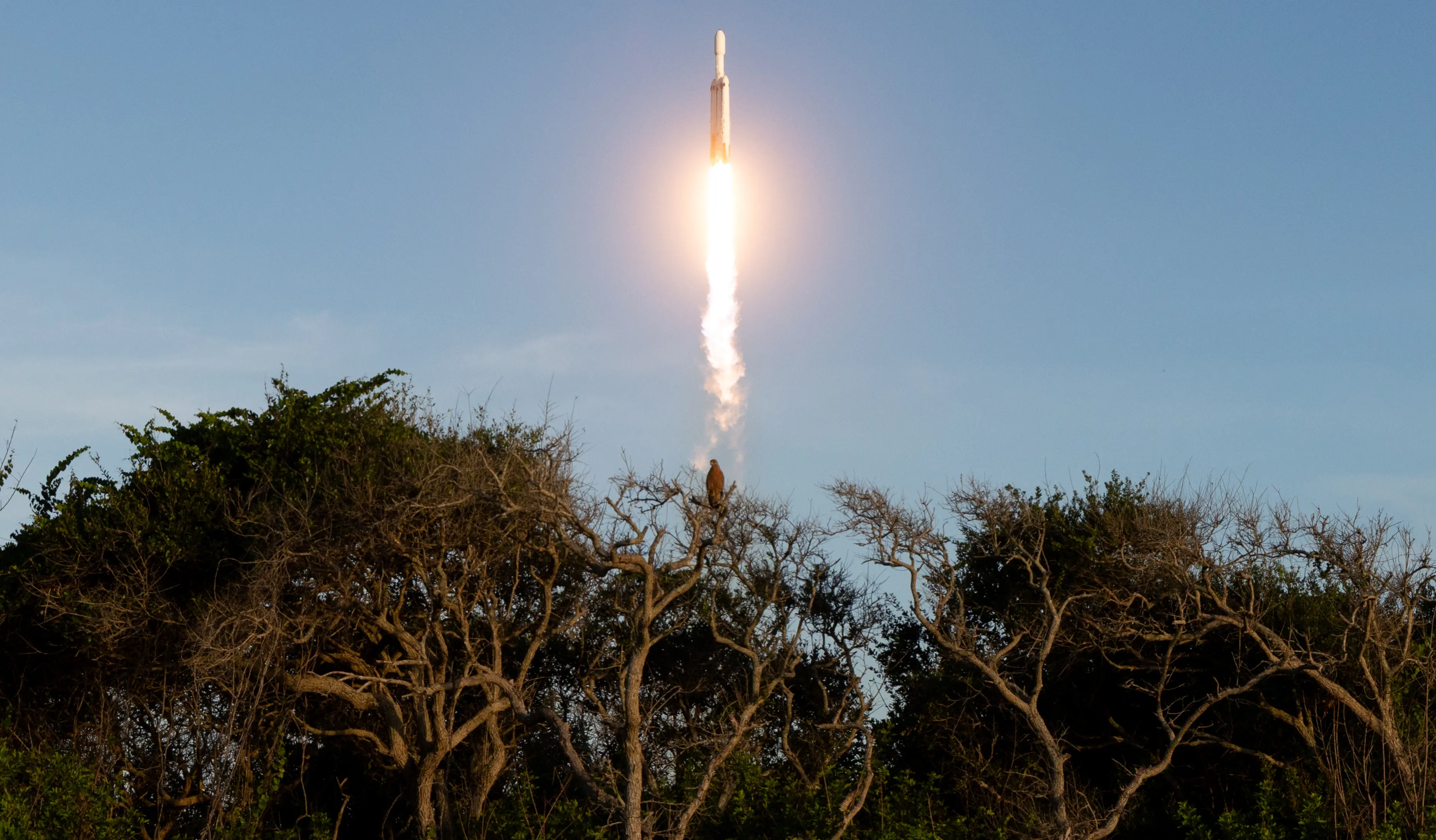
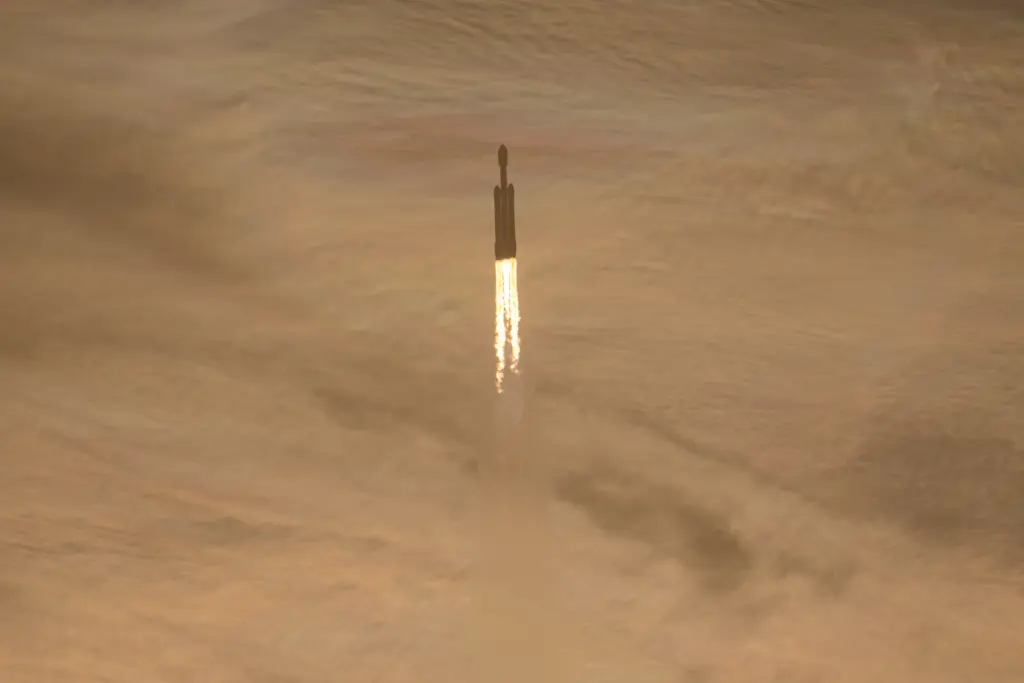
The roar came first, then the promise. At 7:26 a.m. EDT on Sunday, NASA’s Nancy Grace Roman Space Telescope left Earth’s grip on a Falcon Heavy, beginning a mission built around quantity as much as quality: more sky at once, more stars in the ledger, more data every day.
Roman is pitched as a survey machine. Where Hubble and the James Webb Space Telescope (JWST) linger for detail, Roman will sweep: its images will span 100 times Hubble’s field of view, and its observing plan is engineered to move a thousand times faster than Hubble’s. That speed and breadth are what give its numbers their bite.
The speed advantage, in two multipliers
NASA characterizes Roman’s survey design as “a thousand times faster than Hubble.” Speed here isn’t about a single exposure; it’s about how quickly an observatory can tile the sky to a given depth. Pair that with Roman’s 100-times-wider views than Hubble’s, and you get a telescope that can build vast datasets in timeframes that previously took careers.
This is why cosmologists are excited about Roman’s role in mapping large-scale structure and time-domain events. Faster, wider surveys mean more supernovae spotted early and more complete galaxy samples across cosmic neighborhoods—inputs that let models of dark energy be tested against the sky rather than assumptions.
A Milky Way census at unprecedented scale
Dominic Benford, Roman’s program scientist at NASA, says the mission will map an unprecedented 20 billion stars in the Milky Way. That’s not a slogan; it’s a workload. A dataset of that size changes what questions are statistically sensible to ask about our galaxy’s structure and stellar populations.
The payoff isn’t just a bigger catalog. With billions of stars spread across the disk and the dust-obscured center, Roman’s star map can trace how the Milky Way is put together, and how its components move. A survey that size also sets the stage for planet hunting by spotting the subtle signals that betray exoplanets against a crowded stellar background.
Planet hunting, scaled up
Space.com’s coverage was blunt: Roman is “about to take planet-hunting to the next level.” That confidence rests on two design choices already named—speed and field of view—because the more often and more widely you can watch, the more likely you are to catch transient fingerprints of planets, from brief brightenings to tiny dips.
The expectation isn’t only numbers for their own sake. A uniform, all-sky approach complements JWST’s deep, targeted characterization by finding the systems worth that expensive attention in the first place.
A data firehose by design
Roman will send back 1.4 terabytes of data every day. That figure isn’t a brag about bandwidth; it’s a statement of intent. A mission built on wide, frequent imaging lives or dies by how much sky it can turn into numbers, night after night.
NASA anticipates that machine learning, artificial intelligence, and even citizen scientists will help triage that torrent—flagging the needles worth threading with follow-up. The largest of Roman’s surveys is slated to run for over a year, a marathon that rewards automated vigilance as much as optics.
Where Roman differs—and where it doesn’t
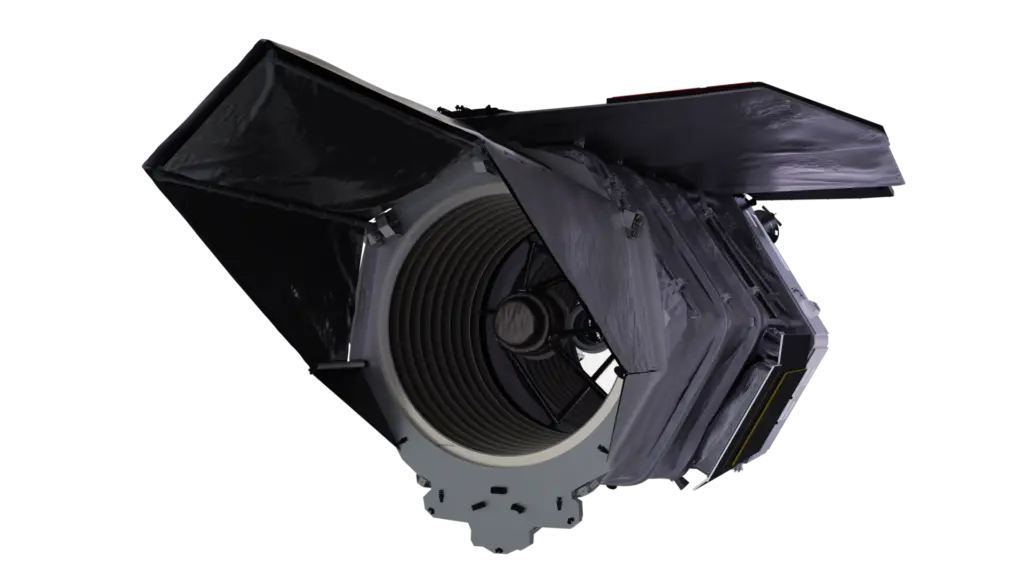
Nature notes one structural edge: Roman’s primary mirror is bigger than Euclid’s. That, together with its infrared emphasis, positions Roman among a trio of surveyors alongside Euclid and the Rubin Observatory. Each trades off field of view, resolution and wavelength coverage; Roman’s niche is frequent, deep infrared imaging at scale.
Institutionally, Roman is managed at NASA’s Goddard Space Flight Center with participation by the Jet Propulsion Laboratory—an arrangement that mirrors other flagship astrophysics efforts and matters because it shapes how archives, pipelines and follow-up support get built.
What’s on the clock
Timelines matter for planning follow-up. NASA expects Roman’s first images by early 2027, after commissioning and survey configuration. Launch is now behind it; the observatory joined a short list as the fourth primary NASA mission to ride a Falcon Heavy.
That cadence—launch now, first light in the beginning months of 2027—frames expectations for when the first big maps and catalogs start landing in public archives and, inevitably, in astronomers’ proposals for JWST time.
The deeper cut
Why “100 times wider” changes statistics
Survey yield scales with area and cadence. If Roman’s Wide Field Instrument covers 100× Hubble’s area per pointing at comparable depth, then for any class of transient with a surface event rate R (events per square degree per unit time), the expected raw discovery rate scales ∝ 100R before accounting for cadenced revisits. For cosmological probes like Type Ia supernovae, the improvement is multiplicative when paired with a cadence that resolves light-curve shapes: more sky means more supernovae at a given redshift slice, which reduces shot noise in distance–redshift relations and tightens constraints on dark-energy parameters when combined with external priors. For Milky Way structure, the benefit is in phase-space sampling. With 20 billion stars measured, even rare populations (10−4 of the disk) yield million-object samples, enabling precise distribution functions and revealing substructure in action-angle space that would be invisible at Gaia-like sizes in dust-obscured regions. The design choice to prioritize field of view and survey speed is thus not just operational—it changes the statistical regime from detection-limited to systematics-limited, where calibration, selection functions and completeness dominate the error budget.
One thing we can’t settle yet
NASA and Space.com both peg “first images” to early 2027, but neither source specifies the exact targets, depths, or which survey will run first. Those choices will determine how quickly Roman’s headline numbers—100× field of view in practice, the first billion-pixel mosaics, the first tranche of the 20‑billion‑star map—show up in public.
Sources: NASA’s Dark Universe-Seeking Nancy Grace Roman Space Telescope Launches (www.nasa.gov); APOD: 2026 August 31 – Launch of the Roman Space Telescope (www.nasa.gov); Lift-off! NASA launches Roman Space Telescope to tackle dark-energy mysteries (www.nature.com); Liftoff! NASA's Roman Space Telescope soars to the stars on a SpaceX Falcon Heavy rocket in spectacular launch (video) (www.space.com)
Images: Cover: NASA/Joel Kowsky; Figure 1: NASA/John Kraus; Figure 2: NASA / Wikimedia Commons
How this article was made: Everyman Science uses AI tools to structure, format and optimise its articles, and occasionally to produce illustrations where no free photograph exists. The reporting these articles are based on is human-produced and cited above. Spotted an error? Write to [email protected] and we will correct it. — The editors How we work.





Science desk team of Everyman Science, curating and reporting on the day’s most significant developments in research, space exploration, and technology.