BVR-19 builds itself in water—then makes hydrogen from light
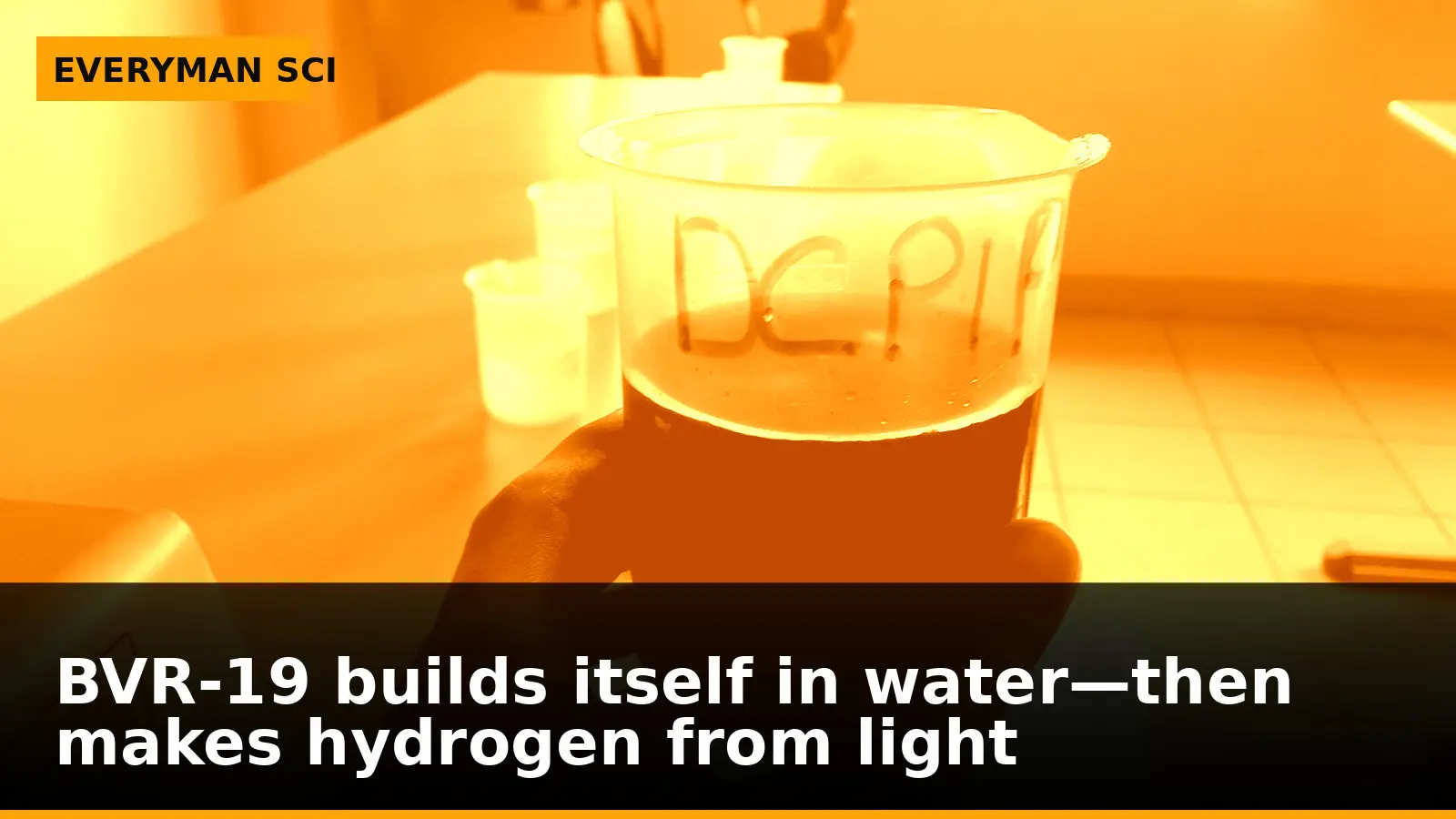
A beaker of water under a lab lamp doesn’t look like an energy device. But in a Corvallis lab, chemists at Oregon State University say they’ve built a material that soaks up light and uses it to split water, releasing hydrogen—the clean-burning fuel you can see powering vehicles and feeding ammonia plants today.
That new class of light-activated materials, led by Kyriakos Stylianou at OSU’s College of Science, is the news hook. The stakes are larger: hydrogen is already central to fuel cells for vehicles and to making ammonia, refining metals and manufacturing plastics, and the way we make it now mostly starts with natural gas. If more of it could come straight from water under light, the climate math looks better.
Why this is in the headlines this week
Researchers at Oregon State University report they’ve created a new class of materials that use light to produce hydrogen from water. The project was led by Kyriakos Stylianou at OSU. It focuses on a particular metal–organic framework—known to chemists as a MOF—that the team calls BVR‑19.
From “a catalyst speeds things up” to “a photocatalyst does it with light”
A catalyst is a helper molecule: it lets a reaction happen faster without being used up. A photocatalyst is the same idea with a twist—it has parts that absorb photons and move electrons into positions where difficult chemistry, like taking water apart, can happen more readily. The intuition is a solar panel glued to a catalyst; the real thing is one molecule doing both jobs. The analogy breaks because a solar panel just makes electricity, while a photocatalyst must also choreograph charges at molecular distances so the right bonds break and form.
MOFs: Lego sets at atomic scale
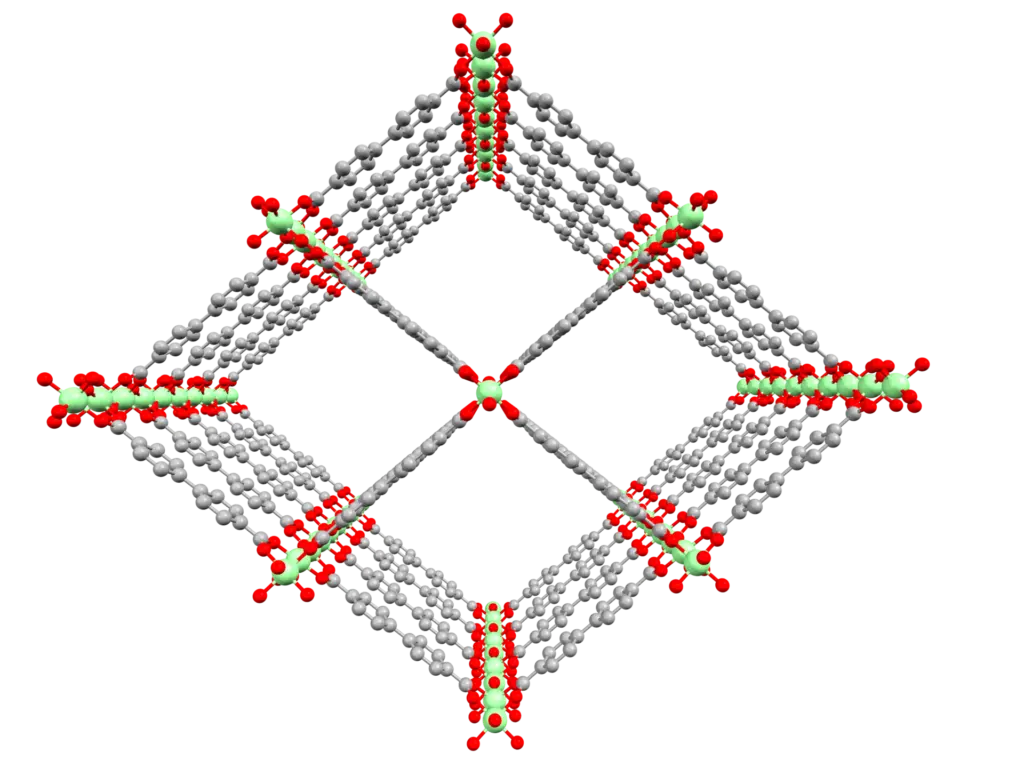
Metal–organic frameworks are crystalline scaffolds built from metal ions and carbon‑based linkers, forming porous architectures chemists can tune. Millions of different MOF structures are theoretically possible; nearly 100,000 have already been synthesized in the lab, and the properties of roughly another half‑million have been predicted. That design space matters for photocatalysis: you can adjust where and how a MOF absorbs light and how charges move through it by changing metals, linkers, or layout.
What’s special about BVR‑19, in practical terms
Beyond the headline claim—using light to make hydrogen—BVR‑19 has a manufacturing perk: it forms spontaneously in water at room temperature. That kind of self‑assembly lowers the energy you need just to make the material in the first place, which can be a quiet but crucial factor when you scale from grams to kilograms.
Why we care about the price tag
Right now, the dominant industrial route to hydrogen starts with natural gas, in a process that releases carbon dioxide. It delivers hydrogen for about $1.50 per kilogram. “Green” hydrogen, made without fossil fuels, is roughly $5 per kilogram. That gap is why materials matter: as Stylianou puts it, this line of work offers a blueprint for designing better materials that can push the cost of green hydrogen down.
What happens inside a light‑driven catalyst
When a photocatalyst absorbs light, parts of the material jump to a higher energy state and can shuffle electrons and “holes” (the positive counterparts electrons leave behind). To turn water into hydrogen, those charges have to be delivered to the right molecular sites in the right order. MOFs offer places to do this: metals can host reactive spots; organic linkers can act like tiny antennas; pores can bring water molecules close. Think of a well‑designed factory where raw materials, tools and workers are placed so the job flows—except here the “workers” are charges that vanish if they don’t find their stations quickly.
The deeper cut
A chemist’s view: why MOF design space matters
Photocatalytic water splitting demands simultaneous satisfaction of several constraints: light absorption in the relevant spectrum; sufficiently long-lived excited states to allow charge separation; and redox-active sites whose potentials straddle the water reduction and oxidation half-reactions. In MOFs, these knobs separate: linker choice tunes frontier orbital energies and oscillator strengths; metal nodes set local coordination environments and redox accessibility; topology governs exciton migration and surface accessibility. That decoupling is why an enormous combinatorial space—millions of structures in principle, with ~10^5 synthesized and ~5×10^5 property-predicted—matters practically: it raises the odds of orthogonally optimizing absorption, transport and catalysis in one lattice. BVR‑19’s appeal, as reported, includes aqueous, room‑temperature self-assembly, which is nontrivial for preserving crystallinity while embedding light-harvesting motifs. For scale-up, low-temperature, water-based synthesis reduces embodied energy and eases impurity control (fewer high-boiling solvents and decomposition pathways). The remaining materials challenge is integrating charge generation and selective active sites while keeping recombination rates down within a porous, often insulating host—tasks MOF chemists attack via mixed-linker strategies, node doping, and post-synthetic modifications.
What we don’t know yet
Key numbers are missing from public summaries: how fast hydrogen is produced under standard conditions, how efficiently light is converted to fuel, and how long BVR‑19 stays active before it degrades. We also don’t have details on how it behaves outside a laboratory beaker—under outdoor light, in impure water, or when built into a device.
If it works, where could it fit?
Hydrogen already feeds fuel cells in some vehicles and underpins big industrial chemistry. A photocatalyst that runs directly on light and water could be paired with sunlight at point of use, or with centralized light sources in a plant. The promise, as framed by the OSU team, is not a gadget you buy tomorrow but design rules—ways to pick metals and linkers in MOFs more intelligently—so the next generation of materials closes the price gap.
Who backed the lab work
The Murdock Charitable Trust, the National Science Foundation and the OSU College of Science supported this research effort.
Related research: Intraligand Charge
Transfer in Metal-Organic Frameworks
Facilitates Radical Anion-Mediated Hydrogen Evolution (Journal of the American
Chemical Society, 2026)
Sources: Scientists just found a new way to make hydrogen from water (www.sciencedaily.com)
Images: Cover: Everyman Science (illustration); Figure 1: Canucksplayer (talk) / Wikimedia Commons
How this article was made: Everyman Science uses AI tools to structure, format and optimise its articles, and occasionally to produce illustrations where no free photograph exists. The reporting these articles are based on is human-produced and cited above. Spotted an error? Write to [email protected] and we will correct it. — The editors How we work.





Science desk team of Everyman Science, curating and reporting on the day’s most significant developments in research, space exploration, and technology.