Three meters of warning: Switzerland’s ice is slipping away fast
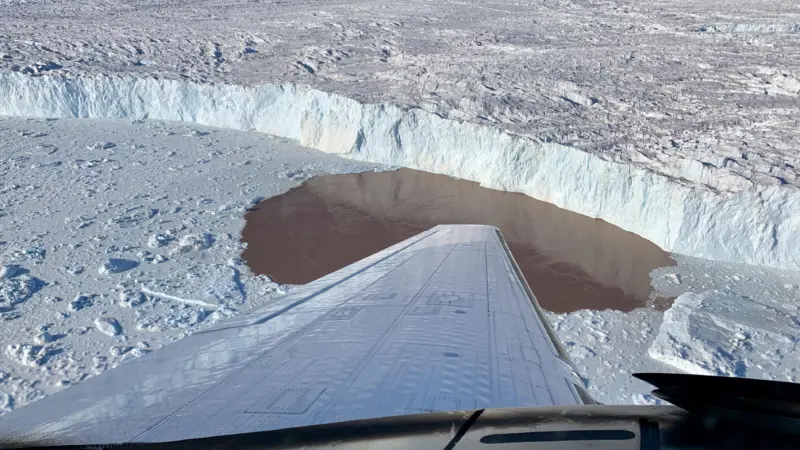
By late summer, more than three meters of an aluminum stake stuck up from a gray, pitted glacier surface in Switzerland. The stake had been fully embedded when it went in. Matthias Huss, who leads the Glacier Monitoring in Switzerland network, pointed to that bare length of metal and called 2026 “a catastrophic year.”
He followed the observation with a blunt horizon line. “There will be probably no ice in 10 or maybe 15 years,” he said. In the numbers GLAMOS compiled this season, the warning in that exposed stake is scaled up across the country.
A summer that left no room for recovery
June, July and August 2026 were each the hottest ever recorded in Switzerland since measurements began in 1864, according to the Swiss Federal Office of Meteorology and Climatology. Against that backdrop, experts said 2026 registered the second-biggest melt on record.
GLAMOS reports that Swiss glaciers shed 5.5% of their volume this year. The drop is not just a bad year on a long decline; it sits atop an accelerated slide that monitors say has shifted what counts as “normal.”
The numbers, stacked year on year
Experts said Swiss glaciers have lost nearly 20% of their mass in five years. GLAMOS describes the period between 2022 and 2026 as “more than twice as high” in melt rate as any previously monitored five-year span, with an ice-volume loss of almost 20% since 2021.
Those percentages land differently when put side by side with earlier decades. The GLAMOS report notes 10% of Swiss ice volume disappeared between 1990 and 2000, while 27% was lost in the past 10 years.
| Period | Reported loss | Attribution |
|---|---|---|
| 1990–2000 | 10% | GLAMOS report, via phys.org |
| Past 10 years | 27% | GLAMOS report, via phys.org |
| Since 2021 | almost 20% | GLAMOS report, via phys.org |
| 2026 (this year) | 5.5% | GLAMOS, via phys.org |
What vanished this summer is measurable in meters—and trillions of liters
GLAMOS says the average ice thickness of some glaciers decreased by 2.5 to 4.0 meters this year, with exposed glacier tongues losing up to 10 meters over the summer. Huss’s mid-season stake now standing more than three meters above the surface is a single, vivid data point in that larger pattern.
Between July and September, Swiss glaciers lost around 2.2 trillion liters of water, according to GLAMOS. That is more than four times the annual freshwater consumption of Swiss households.
An acceleration decades in the making
The GLAMOS report’s framing—“more than twice as high” a melt rate in the last five years than in any earlier monitored five-year span—captures a change in tempo. A 10% loss across the 1990s and 27% in the last decade are not just bigger numbers; together with the almost-20% loss since 2021, they describe a system moving faster out of balance.
Although experts said this year’s melt was the second-biggest on record, GLAMOS also records that many glaciers saw higher average ice-thickness losses than in typical years. The combination leaves little slack for seasonal recovery.
The deeper cut
Percent, rate, and what “twice as high” actually means
GLAMOS reports several kinds of quantities that can sound interchangeable but aren’t. A “5.5%” loss this year refers to volume change over one season. The “almost 20% since 2021” aggregates multiple seasons into a short, recent span. And the phrase “more than twice as high as in any previously monitored five-year period” is a rate comparison: it says the average annual loss across 2022–2026 exceeds, by a factor greater than two, the average annual loss in any earlier five-year block in the monitoring record. That comparison is independent of absolute glacier size; it is about proportional change per year.
Reading the decade-scale figures alongside the 1990–2000 “10%” and the “27% in the past 10 years” highlights acceleration. If losses were steady, five-year and ten-year percentages would scale linearly. Instead, a recent ten-year loss nearly triples the 1990s figure, while an “almost 20% since 2021” appears within half a decade. None of these imply simple compounding across the whole country; different glaciers respond differently. But taken together, the quantities GLAMOS cites are consistent with a shift from gradual shrinkage to rapid ablation dominating mass balance.
What we don’t yet know—and what to watch next
The figures here do not specify how much Swiss glaciers will contribute to global sea level, nor do they resolve how the timing of future heat waves or snowfall will shape next year’s melt. They also do not pin down which individual valleys will see the tightest squeeze on summer water supply.
For now, the signposts are trend lines and thresholds: percentages that have jumped, meters of thickness gone in a single season, and a recent summer that set heat records month after month.
A human voice in a year of hard numbers
Huss’s assessment of the season—“a catastrophic year”—runs through the data. The average ice thickness on some glaciers is down by meters; more than three meters of his stake now hangs in the alpine air; and the melt since 2021 is already approaching a fifth of the country’s ice.
The projection he offered—“There will be probably no ice in 10 or maybe 15 years”—is not a flourish. It is a way to think about the slope all these figures lie on, from the record-hot Swiss summer of 2026 to GLAMOS’s accounting of a melt rate in the past five years that outstrips any earlier span they have monitored.
Sources: 'Catastrophic': Swiss glaciers lose fifth of mass in five years (phys.org)
Images: Cover: Everyman Science (illustration)
How this article was made: Everyman Science uses AI tools to structure, format and optimise its articles, and occasionally to produce illustrations where no free photograph exists. The reporting these articles are based on is human-produced and cited above. Spotted an error? Write to [email protected] and we will correct it. — The editors How we work.





Science desk team of Everyman Science, curating and reporting on the day’s most significant developments in research, space exploration, and technology.