A light switch for neurons, now Nobel‑recognized
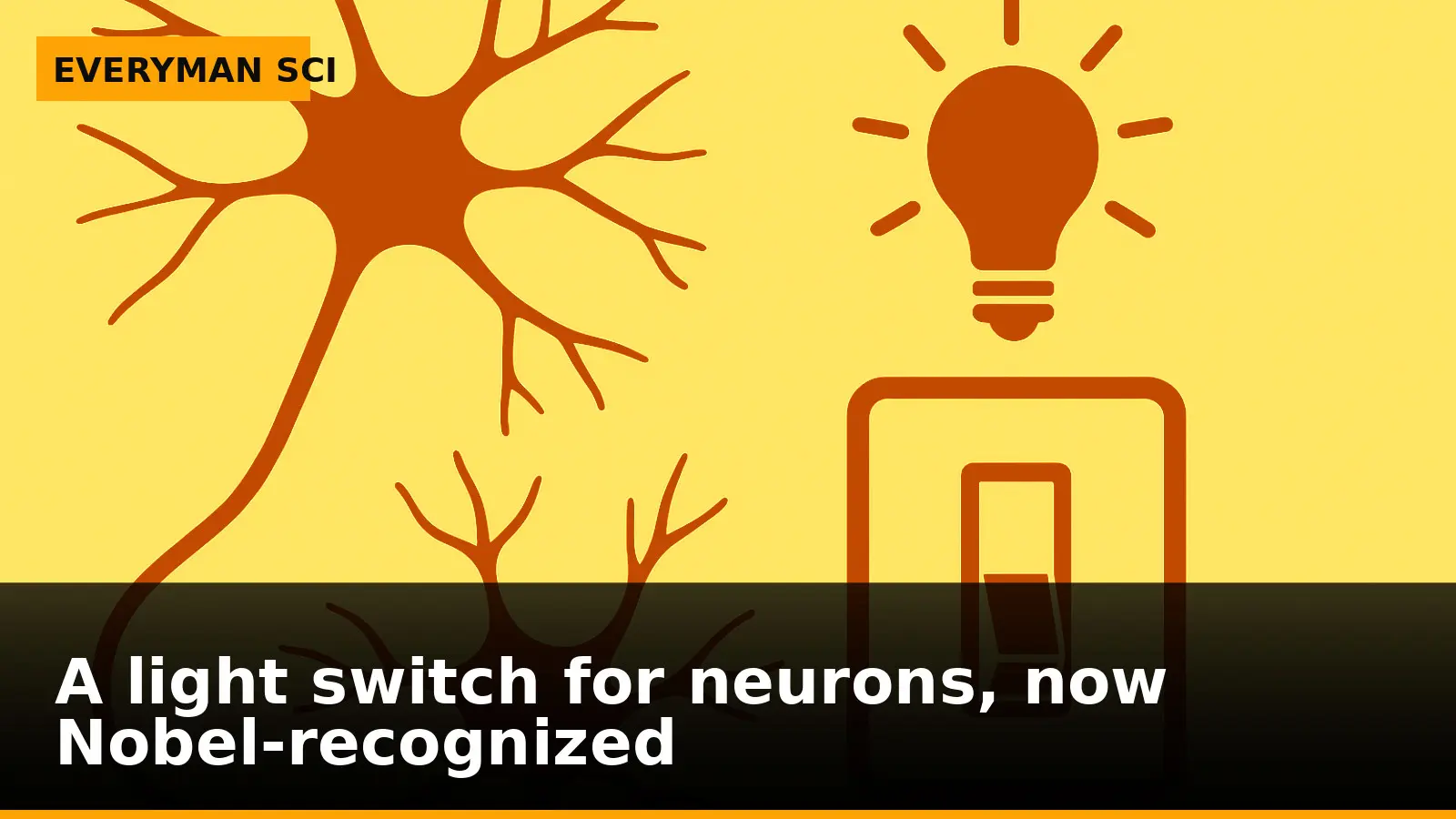
Can a flash of light make a brain cell fire on cue—and let scientists test what each cell actually does? And if you can flip those switches at will, can you repair circuits when disease scrambles them?
Those are the questions at the heart of optogenetics, the light‑based control of neurons. A Nature report on 5 October details the award of the 2026 Nobel Prize in Physiology or Medicine to three of its pioneers, recognizing a tool that many neuroscientists now use to probe cause and effect in the brain.
Who did what, and where this was published
The study, reported in Nature, notes that the 2026 Nobel in medicine was awarded on 5 October to three scientists. U.S. neurologist Karl Deisseroth, and German scientists Peter Hegemann and Georg Nagel, share the honor for work that, as multiple researchers told phys.org, has transformed how the brain is studied by allowing neurons to be controlled with pulses of light.
In a type of green algae, Hegemann and Nagel discovered a light‑sensitive protein they dubbed channelrhodopsin. Deisseroth then introduced it genetically into a cell and stimulated it with light, triggering a nerve signal in rats and mice. That sequence—discover the switch, wire it into neurons, and flip it with light—is the core of optogenetics as recognized by the Nobel.
How the technique actually works in the lab
Optogenetics, as described by phys.org, lets researchers switch a neuron’s signal on or off using pulses of light. By controlling the light, experimenters can time these on/off commands with minute precision. Deisseroth’s early demonstrations showed that when the protein found by Hegemann and Nagel is genetically placed in neurons, a light stimulus can trigger a nerve signal in rodents.
Armed with that control, scientists can turn off some neurons and observe others, tracking which areas affect particular functions. Abdel El Manira, introducing the prize, said the work has shed light on behaviors and drives ranging from parental behavior and aggression to anxiety, fear, thirst and water intake. That’s the key methodological leap: instead of only watching correlations, you can intervene and see what changes.
What the results show, in plain terms
Three laureates were honored on 5 October for enabling researchers to control neurons with light. In rats and mice, light stimulation after genetic introduction of the protein triggered nerve signals. Researchers report that, by selectively switching neurons on or off, they can test how defined populations contribute to behaviors and physiological drives spanning parental behavior, aggression, anxiety, fear, thirst and water intake, as stated by El Manira.
Beyond mapping circuits, teams have begun to push toward treatments. Simon Schultz said his groups have used optogenetics as a closed‑loop treatment for memory disorders by lengthening the pulses that help the brain store memories, and he added that the next step is to demonstrate improved learning and memory in complex tasks. Jose‑Alain Sahel reported promising trials using optogenetics to treat a degenerative disease: gene therapy introduced the protein into defective eye cells, and light projected through special goggles successfully activated retinal cells.
Where medicine might feel it first
Vision restoration is probably the most fertile ground for relatively rapid medical advances, said Marco Tripodi, who also emphasized optogenetics as a discovery tool to reveal new therapeutic targets for neurological and psychiatric disease. He pointed to epilepsy and Parkinson’s disease as obvious examples where precise control of defined neuronal populations could ultimately be valuable.
Jorge Brotons Mas said the prizewinning research could help scientists understand what goes wrong in diseases such as Alzheimer’s and epilepsy. Several scientists noted efforts also aimed at depression and anxiety disorders, and Christopher Rowlands highlighted nascent trials looking to use optogenetics to treat conditions such as post‑traumatic stress disorder and addiction.
What this doesn’t tell us (yet)
No one is claiming this tool solves the brain. El Manira was explicit that it does not, for now, help us understand what consciousness is. Schultz’s own projection sets a tangible bar: to show that learning and memory improve in complex tasks.
Clinical work remains early. Sahel described promising trials in a degenerative eye disease with retinal activation through gene therapy plus light‑projecting goggles, and Rowlands characterized psychiatric applications as nascent trials. Tripodi’s assessment of vision as the most fertile near‑term field also implies that other indications may take longer to translate.
The deeper cut
From flipping cells to testing causality
Optogenetics’ power, as presented by the prize introducers and researchers interviewed, is intervention at defined points in a circuit: switch some neurons off, watch what others do, and observe the behavioral or physiological consequence. That logic tackles a major statistical pitfall in systems neuroscience: inference from correlation. If activity in region A rises whenever behavior B appears, one cannot tell whether A drives B, responds to B, or co‑varies with some hidden C. The light‑based method changes the game by perturbing A on command and looking for a change in B.
Precision matters. The statements highlighted here emphasize timing with minute control and the ability to target defined populations. That combination lets experimenters ask questions like: does silencing a set of neurons at the moment a memory would normally consolidate alter later recall, and does lengthening the pulses that support storage improve performance? As Schultz noted, closing the loop between measured brain activity and contingent light stimulation creates a testbed for such hypotheses. The same paradigm extends to drives such as thirst and water intake or states like anxiety and fear, as listed by El Manira: impose a brief, cell‑specific change and see what shifts. The answers may not explain consciousness, but they can carve crisp causal edges into the brain’s otherwise tangled map.
Why scientists are excited, but cautious
Phys.org’s reporting captures a mood: transformational for basic research and a potential pathfinder for therapies. Tripodi’s framing of optogenetics as a discovery tool sits alongside clear medical ambitions in epilepsy, Parkinson’s disease, Alzheimer’s, depression, anxiety, post‑traumatic stress disorder and addiction. Those are heterogeneous conditions, and the researchers quoted are careful to cast these as examples, targets, or early trials—not yet established treatments.
Even so, one practical success stands out in the comments: Sahel’s team activated retinal cells in a person’s defective eye cells using gene therapy and special goggles. It’s a concrete demonstration of the basic mechanism at work in a human context—introduce the protein, apply light, get cells to respond—while leaving open the larger questions about function restored and durability.
The bottom line
On 5 October, the Nobel committee recognized a deceptively simple idea: wire a light switch into neurons and see what happens when you flip it. Hegemann and Nagel found the switch in algae; Deisseroth put it into neurons and showed that light could trigger signals in rodents. Abdel El Manira summed up the payoff so far—new causal insight into behaviors and drives—and several researchers outlined where it might go next, from memory interventions to vision restoration and beyond.
It’s not a theory of mind. But as a way to ask tractable questions about brains, with pulses of light and precisely chosen cells, it has already changed the kinds of answers neuroscientists can reach.
The paper: Medicine Nobel awarded for brain ‘switch’ that controls neurons with light (Nature, 2026)
Related research: Channelrhodopsin-1: A Light-Gated Proton Channel in Green Algae (Science, 2002); Channelrhodopsin-2, a directly light-gated cation-selective membrane channel (Proceedings of the National Academy of Sciences, 2003); Millisecond-timescale, genetically targeted optical control of neural activity (Nature Neuroscience, 2005)
Sources: Medicine Nobel awarded for brain ‘switch’ that controls neurons with light (www.nature.com); Switching on brain cells: The Nobel-winning science of optogenetics (phys.org)
Images: Cover: Everyman Science (AI illustration)
How this article was made: Everyman Science uses AI tools to structure, format and optimise its articles, and occasionally to produce illustrations where no free photograph exists. The reporting these articles are based on is human-produced and cited above. Spotted an error? Write to [email protected] and we will correct it. — The editors How we work.





Science desk team of Everyman Science, curating and reporting on the day’s most significant developments in research, space exploration, and technology.