A thorium nuclear clock ran itself for a day
Sometime after midnight, the lab lights were off but one rhythm didn’t slip. A laser beat held steady against the whisper of a nuclear transition, and the clock it anchored ticked through the night without anyone touching a dial. By morning, the team could say something no one had before: the world’s first self‑stabilizing nuclear clock had run on its own.
That claim is the core result of a Nature study reporting a thorium‑based optical nuclear clock with a feedback loop. Scientists say it is the first nuclear clock that can maintain its stability without leaning on a conventional atomic clock. Researchers also report it can operate steadily for more than 24 hours without intervention.
Why point a laser at a nucleus at all?
Atomic clocks keep time by tuning a laser to a precisely known jump between electron energy levels in atoms and counting the ticks. Nuclear clocks shift the reference deeper inside the atom, to the nucleus itself. Thorium is the outlier that makes this thinkable: scientists report two of its nuclear energy states are separated by an unusually small gap, small enough that laser light can drive the transition.
That oddity matters because it lets a laser manipulate a nucleus in a controlled, repeatable way—rare in nuclear physics. A nucleus is also tiny compared with the full atom. As Thorsten Schumm puts it, atomic nuclei are more than 10,000 times smaller than atoms. That smallness means far less sensitivity to stray electric and magnetic fields that can nudge electron transitions and smear out time.
From a long‑sought transition to a working clock
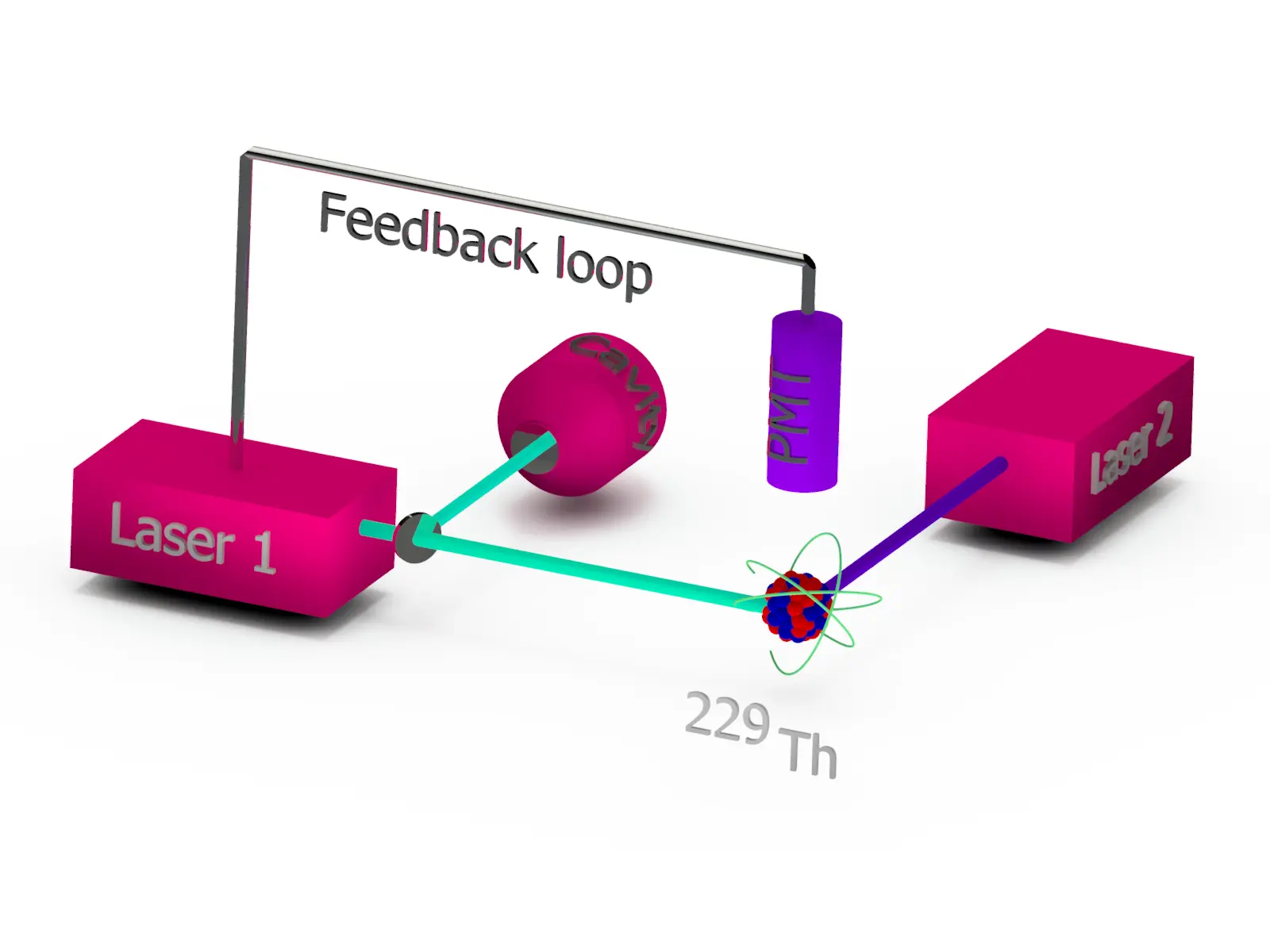
The keystone was experimental: Prof. Thorsten Schumm and his team demonstrated for the first time that laser beams could excite thorium nuclei. Researchers then connected their thorium excitation apparatus to a conventional optical atomic clock to show the nuclear line could serve as a precise reference.
But a true clock has to hold itself steady. The study’s finding is that the thorium signal can do just that: the nuclei absorb laser light only at the right frequency, so any drift shows up as a change in absorption. The system senses that change and automatically corrects the laser, closing a feedback loop. Scientists describe this as the first self‑regulating nuclear clock that can function independently.
How precise is “precise”?
Measured over the course of a day, researchers report a relative precision of approximately 10 to the power of minus 15—about one second of error over 30 million years. That back‑of‑the‑envelope translation is a way to feel the scale; it doesn’t mean anyone actually waited millions of years. It does mean the early prototype is already in elite territory for instruments that measure anything at all.
Even so, Thorsten Schumm is clear: this is not yet at the level of the world’s best optical atomic clocks. The researchers believe their nuclear clock has considerable room for improvement and point to stronger lasers and better thorium crystals as likely routes to higher precision.
What a nuclear clock buys you, in principle
The promise sits at the intersection of stability and insensitivity. Because nuclei are shielded and extremely small, they offer a reference that external disturbances jostle less. Researchers describe the achievement as an important advance in precision measurement—metrology—not just for telling time but for any physical quantity that depends on an exquisitely stable tick.
In practice, better timekeeping is leverage. With a steadier laser locked to a sharper reference, you can compare intervals more finely, test symmetries more cleanly, and sense smaller shifts in frequency that encode changes in other quantities. That is why a clock is never just a clock in the lab.
The deeper cut
Inside the lock: turning absorption into control
At heart, the feedback loop builds an error signal from the thorium absorption profile. You dither the interrogation laser frequency—probe alternately a hair above and below the nuclear line—and measure the differential absorption. The sign and magnitude of that differential is the discriminator: positive drives the servo to pull the laser down, negative to push it up, with a gain chosen to keep the loop stable. Because the nuclear transition only absorbs at a sharply defined frequency, changes in environmental conditions show up as a dispersive slope around line center that the loop can track. The clock’s short‑term stability will be bounded by photon shot noise and the slope (Hz per fractional shift) of the nuclear line; long‑term stability will lean on how flat the nuclear transition is against temperature, strain, and fields inside the host crystal. Using nuclei instead of electrons suppresses many Stark and Zeeman shifts simply by geometry and shielding, but it does not eliminate line‑pulling, finite linewidth, or servo bandwidth limits. The reported day‑scale operation indicates the loop stayed locked without an external reference, meaning the absorption‑derived error signal had enough signal‑to‑noise to ride out drift in the laser cavity and the crystal’s environment.
What we don’t know yet
No one can yet say how far and how fast performance will climb. The study‑level figures establish day‑long autonomous operation and roughly 10^−15 precision; how much headroom stronger lasers and higher‑quality thorium crystals will actually unlock, and whether nuclear clocks will surpass the very best optical atomic clocks in practice, remains to be shown.
A step that puts the endgame in sight
The nuclear approach is no longer a concept in search of closure; it is a working system that holds itself on the line. Researchers emphasize that it ran independently for more than a day and reached about one‑second‑in‑30‑million‑years precision. The next iterations will decide whether “in principle” advantages of nuclei translate to a new standard in the lab.
The metrologist’s patience pays off
Scientists have chased this for decades because a cleaner tick sharpens every comparison you can make in physics. With a self‑stabilizing nuclear clock now demonstrated, metrology gains a new tool. If its room for improvement is realized, today’s prototype could become tomorrow’s baseline.
The paper: A thorium-229 optical nuclear clock with feedback loop (Nature, 2026)
Sources: Scientists build a nuclear clock that could make atomic clocks obsolete (www.sciencedaily.com)
Images: Cover: LarsvdW / Wikimedia Commons (CC BY-SA 4.0); Figure 1: Ciacho5 / Wikimedia Commons (CC BY-SA 4.0)
How this article was made: Everyman Science uses AI tools to structure, format and optimise its articles, and occasionally to produce illustrations where no free photograph exists. The reporting these articles are based on is human-produced and cited above. Spotted an error? Write to [email protected] and we will correct it. — The editors How we work.





Science desk team of Everyman Science, curating and reporting on the day’s most significant developments in research, space exploration, and technology.