After the flames, ozone takes a second bite—cutting Amazon carbon uptake by about 24% of fire emissions
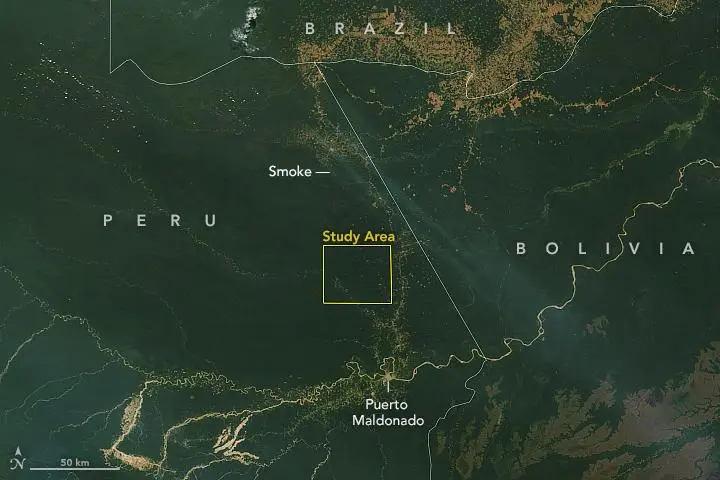
The flames make the news. The unseen harm arrives later. In the dry belt where farms push into forest—the Arc of Deforestation—researchers say the air left behind by Amazon fires is laced with ozone that quietly knocks back the living forest’s ability to draw carbon out of the atmosphere.
That second hit is not small. In an analysis reported via Communications Earth & Environment, researchers from the University of Exeter, ETH Zurich and James Cook University estimate that fire‑driven ozone damage has reduced the Amazon’s carbon uptake by an amount equivalent to around 24% of the carbon the fires themselves released.
A double climate impact, quantified
Wildfires are a direct source of carbon dioxide as biomass burns. The new analysis adds up a subtler bill: the post‑fire ozone that weakens surviving trees’ capacity to keep absorbing CO2. The reported estimate—about a quarter of the fires’ own emissions—puts a number on that hidden loss, making it part of the Amazon’s carbon ledger rather than an afterthought.
The team’s warning is timely. With forecasters reporting that a strong El Niño is already developing this year, the ingredients that coincided with record damage in 2024 are lining up again.
Drought years leave a fingerprint—and El Niño has been in the frame
The researchers note that three of the most extreme Amazon droughts of the past three decades—1997/98, 2015/16 and 2023/24—occurred during El Niño events. In those years, the region’s atmosphere and ecology were primed for outsized impacts.
Within that history, 2023/24 stands out. According to ETH Zurich’s Dr. Flossie Brown, ozone damage during the 2023/24 drought nearly doubled compared with the average of the previous decade, and the droughts the team examined each left a distinct signature rather than a single repeating pattern.
Where the hit is heaviest—and why prevention matters
Professor Stephen Sitch of the University of Exeter points to geography: the worst ozone damage is concentrated in the Arc of Deforestation, where the expanding frontier of cleared land abuts standing forest. That clustering matters because it identifies a practical lever.
Sitch also argues that the extra ozone damage described here is largely preventable. And as James Cook University’s Dr. Alexander Cheesman puts it, policies that tackle deforestation and degradation do double duty: they address the CO2 released directly by fires and the ozone pollution that quietly erodes what’s left of the forest’s capacity to soak it back up.
How the picture was assembled
The team reported its findings via Communications Earth & Environment. Rather than a single bad season, they drew a line through nearly three decades of observations and paired it with a global vegetation model to track how ozone damage shifted from 1997 to 2024 alongside fire activity and drought.
That long view lets short, dramatic spikes sit in context. It also ties the 24% figure to a period when drought extremes and land‑use pressures have both been on the rise, helping to separate pattern from noise.
The deeper cut
What “24%” actually compares
The 24% headline number is a ratio: the modelled reduction in net ecosystem carbon uptake attributable to ozone injury, divided by the carbon directly emitted by the fires themselves, over the same time frames. It is not a claim that any single stand or season lost a quarter of its capacity, nor that ozone’s effect persists uniformly. The researchers combined multi‑year observational inputs with a global vegetation model to isolate the ozone term from co‑varying stressors—most notably drought and heat—whose signals are partially correlated with fire seasons. In practice, that means driving the model with meteorology and fire activity while toggling the ozone damage pathway on and off and comparing the resulting net ecosystem exchange. Because El Niño years alter both fire regimes and atmospheric chemistry, the counterfactual matters: the denominator (fire emissions) and the numerator (ozone‑induced uptake loss) both swell in those episodes, and their ratio can sharpen even when absolute values change. Interpreting the 24% as an integrated, basin‑scale burden—rather than a plot‑level constant—guards against over‑reading it when thinking about local management or species‑specific sensitivity.
What we don’t know yet
A strong El Niño developing now raises the risk of another year when ozone damage surges, but how it will play out is not yet knowable. Droughts the researchers examined each left a distinct signature, and the 2023/24 spike nearly doubled the previous decade’s average—signals that underscore variability as much as trend.
The 24% figure is an estimate drawn from observations and modelling over decades. As with any such estimate, the exact burden in a coming season will depend on how drought, fire activity and atmospheric conditions line up.
The stakes for climate and living systems
An Amazon that absorbs less carbon tightens the global carbon budget. The damage described here is not a distant prospect; it is already part of the arithmetic researchers use to describe the basin’s role in the climate system.
That is why the Arc of Deforestation looms so large in the story. If the worst ozone damage clusters where forest gives way to cleared land, the choices made at that edge will determine whether the next El Niño‑tilted dry season delivers another hidden shock—or less of one.
A preventable piece of the problem
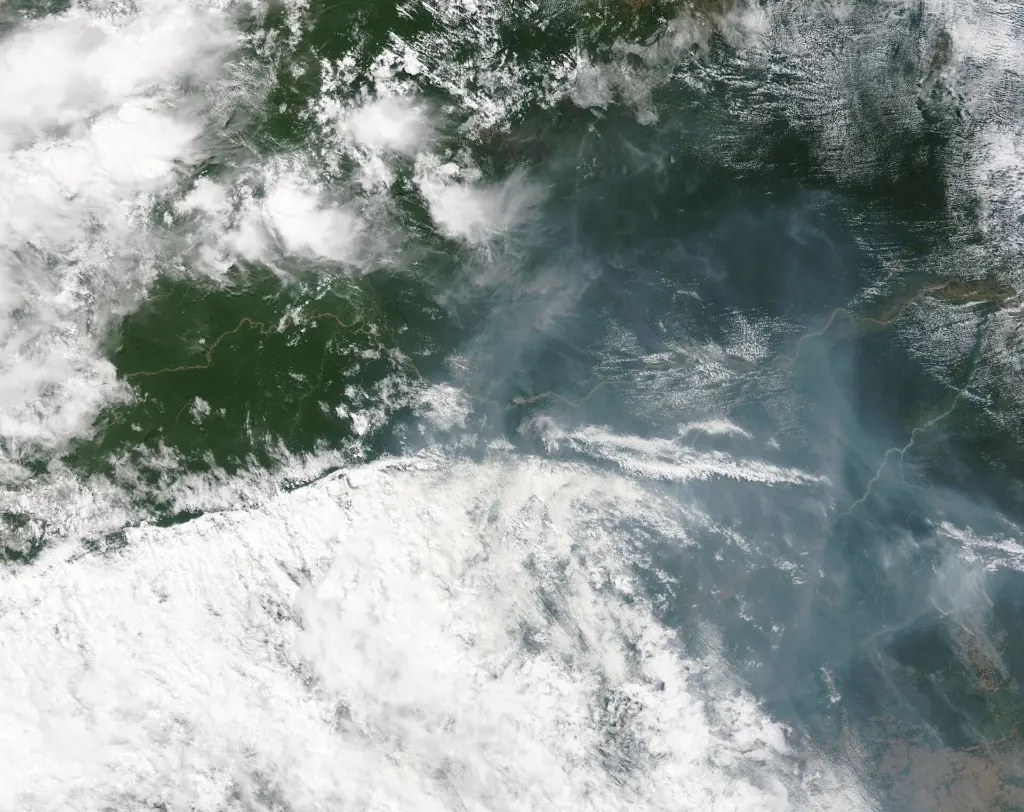
Researchers and co‑authors on the analysis say the extra ozone damage is largely preventable, and that policies aimed at deforestation and degradation cut in two directions at once: fewer direct fire emissions, and less ozone pollution eroding the forest’s remaining carbon uptake. In a region primed for El Niño‑linked extremes, that double gain is a rare clarity.
It reframes the fire season as more than an emergency of flames. What follows in the air can sap the forest’s strength for months—unless the conditions that make those fires likely are tackled at their source.
Sources: Amazon wildfires are generating ozone that weakens surviving trees' carbon uptake (phys.org)
Images: Cover: NASA/JPL; Figure 1: MODIS Land Rapid Response Team, NASA GSFC / Wikimedia Commons
How this article was made: Everyman Science uses AI tools to structure, format and optimise its articles, and occasionally to produce illustrations where no free photograph exists. The reporting these articles are based on is human-produced and cited above. Spotted an error? Write to [email protected] and we will correct it. — The editors How we work.





Science desk team of Everyman Science, curating and reporting on the day’s most significant developments in research, space exploration, and technology.