A tiny metal room made a reaction run 10,000 times faster
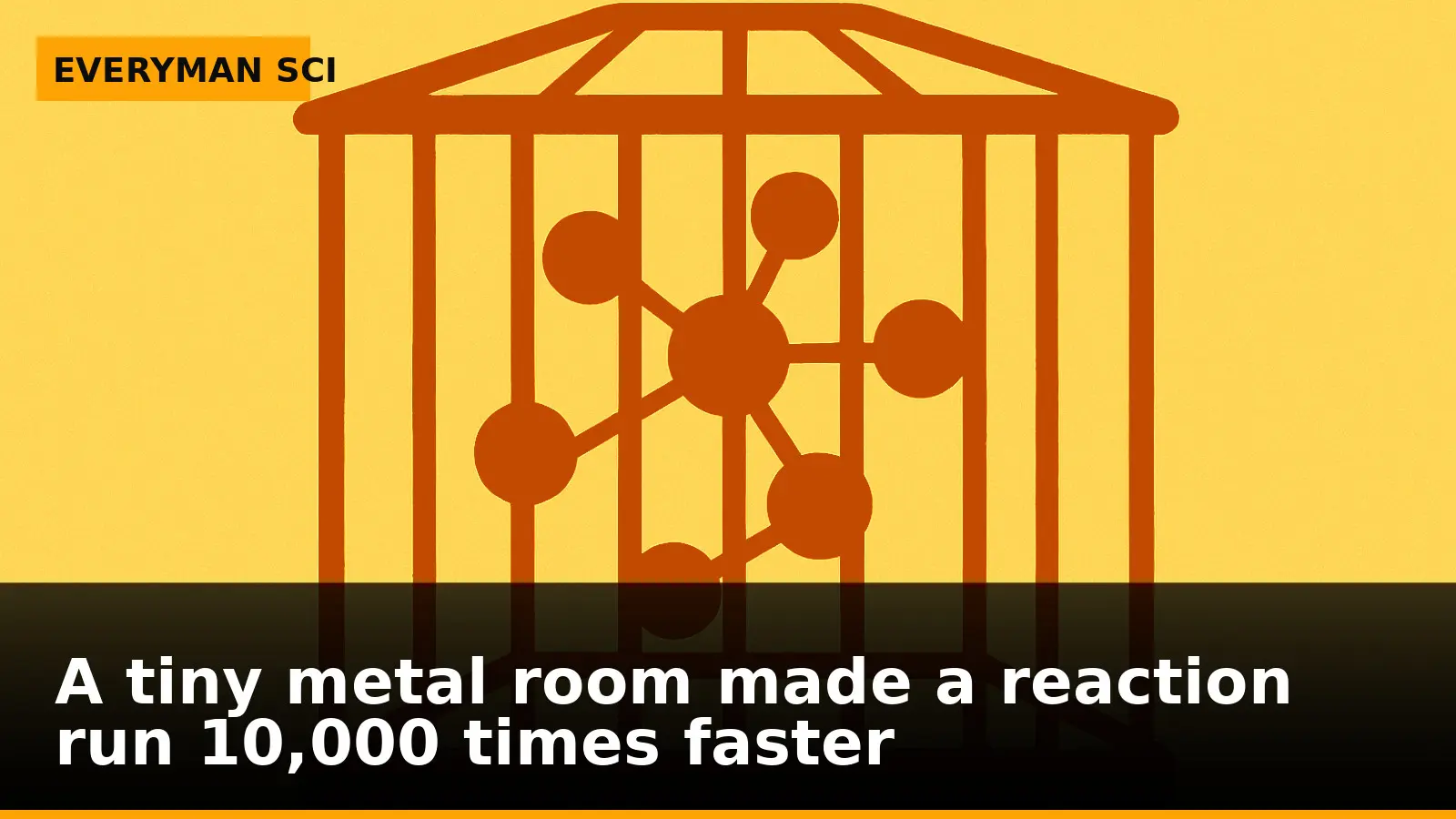
Imagine a reaction happening inside a miniature room—walls close enough to nudge molecules together, corners lined with charge, a doorway that fits only the right guests. Turn that mental picture up or down a notch and the reaction either sprints or crawls. In a recent burst of work, researchers found that some of these “molecular rooms”—cage-like catalysts—ran the same reaction more than 10,000 times faster than others built from similar parts.
That scale of difference is not a rounding error; it’s the difference between an industrial step humming along at modest heat and pressure, and one that needs punishing conditions to budge. It’s also a clue that what matters most is not only what the catalyst is made of, but the room it makes for chemistry to happen.
Why this is being asked now
A research team led by Professor Paul Lusby reported a rapid way to assemble and assess molecular cages in solution, then used it to look at 30 distinct palladium-based cage structures at once. The cages showed enormous performance differences, with the best catalysts more than 10,000 times more active than the least effective ones. Researchers then analyzed the measured reaction rates with machine learning to see which structural features tracked with reactivity.
Dr. Laura Bickerton, who led the experimental component, said the method lets them access and investigate a wide range of cages that are hard to isolate by traditional routes. Dr. Tomasz Piskorz said that describing cages by physically motivated features—shape, size, volume and electrostatics—lets machine learning correlate those features with reactivity and yield a model with remarkable accuracy.
An enzyme’s pocket, rebuilt in metal and ligands
If you’ve met enzymes before, you already know the gist: a structured pocket binds molecules in a way that lowers the energy cost of the reaction. Molecular cages mimic that behavior. They are hollow, nanoscopic frameworks that can trap reactants inside a defined space and accelerate a reaction happening within. The enzyme analogy is helpful because both use shape and charge to pre‑organize chemistry—but it breaks down because cages do not have the flexible, living scaffolds and dynamic conformational changes that proteins deploy.
Why would a cage help? Confinement raises the effective concentration of reacting partners, orients them, and bathes them in tailored electrostatics. A good cage can stabilize the fleeting, high‑energy transition state more than it stabilizes the starting materials, tipping the balance toward product formation.
Which features actually matter in a cage
In the analysis researchers reported, the features that described cages were intentionally physical: overall shape, cavity size, internal volume, and electrostatics. Machine learning can correlate such features with reactivity, producing an accuracy good enough to trust design hints. Crucially, this is not a black box inventing chemistry; it is pattern‑matching between measurable geometry/charge descriptors and observed rates.
This approach provides a route to designing such catalysts more efficiently: make cages that put reactants close, orient key bonds, and stabilize the right charges at the right spots. It’s design by constraint, not by brute‑force enumeration.
Screening fast, not one‑by‑one
Traditionally, chemists would prepare and purify each candidate cage, then test it—a slow march through chemical space. Instead, the team assembled cages and assessed them immediately in solution, avoiding a lot of bench‑time friction. That enabled a single pass over 30 distinct palladium-based cages, revealing just how wide the activity spread can be.
The point of speed is not only convenience. When you can compare dozens of closely related structures under the same conditions, real structure–activity relationships emerge. As Dr. Bickerton noted, this access to a wide range of otherwise awkward cages opened the door to those insights.
Why a 10,000× swing happens
Inside a cage, a reaction feels a different world: reactants are pre‑organized, solvent is partially excluded, and charges are curated. Make the cavity slightly too tight and you strain the transition state; slightly too loose and you lose the entropic and orientational edge. Move charges a few angstroms and you either stabilize the buildup of positive or negative character—or you don’t. Small geometric and electrostatic tweaks compound into big kinetic payoffs, which is why the best and worst cages can be separated by more than four orders of magnitude in rate.
The deeper cut
Free‑energy bookkeeping in confinement
Rate differences translate into differences in activation free energy: ΔΔG‡ ≈ −RT ln(k2/k1). A 10,000× boost at room temperature implies roughly an 5.5–6 kcal·mol⁻¹ lowering of ΔG‡. That’s within reach for modest changes in effective molarity, orientational entropy, or electrostatic stabilization. Confinement increases effective molarity EM by limiting translational freedom; classical treatments put EM in the 10¹–10⁶ M range for well‑designed hosts, which maps onto several kcal·mol⁻¹ entropy gains. Electrostatics inside a low‑dielectric pocket can preferentially stabilize charge buildup in the transition state; even a few kcal·mol⁻¹ from favorable Coulombic interactions is enough to explain order‑of‑magnitude swings in k. The trick is balance: if the host over‑stabilizes the ground state (tight binding of reactants), you pay it back in a higher barrier unless there is even stronger TS binding. Cavity geometry also gates solvent reorganization energy; partial desolvation inside a cage can lower λ for polar reactions, but steric strain penalties can offset it. Structure–activity maps that encode cavity volume, mouth size, and internal potential reflect these competing contributions without having to compute full potential energy surfaces for every variant.
From benchtop cages to factory pipes
Catalysts are essential to modern manufacturing; they enable about 90% of all chemical manufacturing processes worldwide. That includes the places where better performance pays off quickly: medicines, fuels, fertilizers, plastics and more. More efficient catalysts can reduce energy consumption, improve yields and decrease waste production—practical levers for net‑zero and sustainability goals.
If machine learning can reliably flag promising cages before synthesis, development cycles compress. Researchers say the work provides a route to designing such catalysts more efficiently. That’s the difference between a nice mechanism on paper and a pipeline of better catalysts pointed at high‑impact steps.
What we still don’t know from this work
The public reports do not specify which exact geometric or electrostatic thresholds separate winners from also‑rans, nor do they give the numerical accuracy of the machine‑learning model. Costs, lifetime under continuous operation, and how easily these palladium-based cages scale or recycle in process conditions are not detailed. Those practicalities will decide where cages first matter outside the lab; for now, the clear result is that cage structure can swing rates by orders of magnitude and that rapid screening plus machine learning can find the good ones much faster.
If a cage fails, what happens?
When a cage is poorly matched to a reaction, it can bind starting materials too tightly, throttle product release, or simply fail to stabilize the right transition state—slowing the process instead of speeding it. Those failure modes are the flip side of the design knobs that make cages powerful: cavity size, mouth opening, and internal charge layout. Rapid, side‑by‑side screening is how chemists learn which way to turn those knobs next.

Related research: Expanding Chemical Space Enables Data–Driven
Structure–Activity Relationships in Cage Catalysis (Journal of
the American Chemical Society, 2026)
Sources: Why molecular cage catalysts show enormous differences in performance (phys.org)
Images: Cover: Everyman Science (AI illustration); Figure 1: Royal Society uploader / Wikimedia Commons (CC BY-SA 4.0)
How this article was made: Everyman Science uses AI tools to structure, format and optimise its articles, and occasionally to produce illustrations where no free photograph exists. The reporting these articles are based on is human-produced and cited above. Spotted an error? Write to [email protected] and we will correct it. — The editors How we work.





Science desk team of Everyman Science, curating and reporting on the day’s most significant developments in research, space exploration, and technology.