Built from each tumor, an mRNA vaccine plus immunotherapy cut melanoma’s return‑or‑death risk 42%
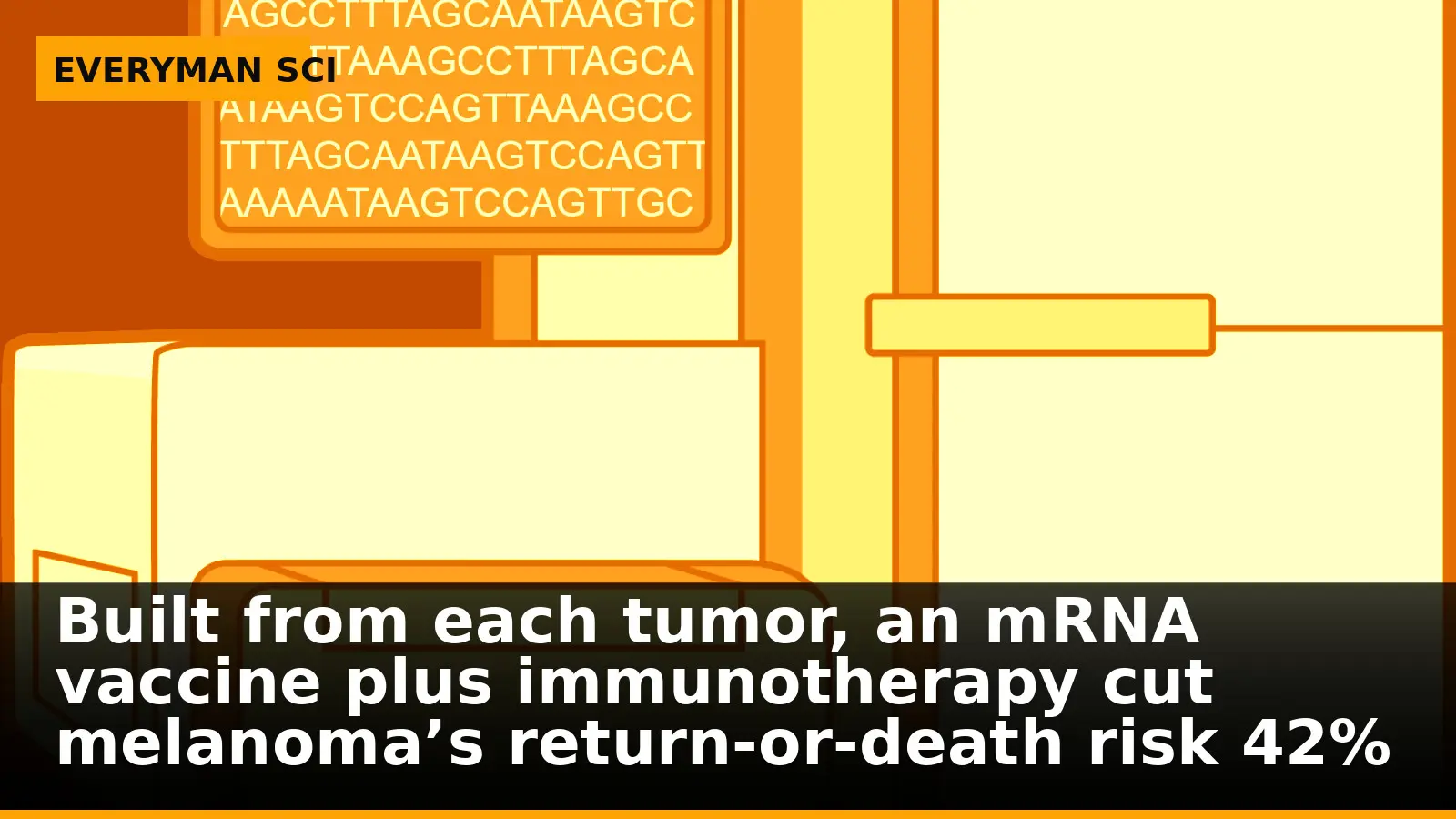
The question was simple and high‑stakes: if you rebuild a vaccine from each person’s own tumour, can you keep melanoma from coming back after surgery? And if you can, by how much?
A study reported via Nature found that a personalized mRNA vaccine, given after tumour removal, reduced the combined risk of melanoma returning or the recipient dying by 42%. That number, not the headlines, is the point.
Who did this, and where it lands
The finding comes from a phase III trial of a personalized mRNA vaccine known as intismeran, with results reported via Nature and slated for presentation at the European Society for Medical Oncology (ESMO) meeting in Madrid on 24 October. The companies involved released the key results on 22 October after a leak prompted early disclosure.
How the trial actually worked
The intismeran trial enrolled 1,137 people with moderate to advanced melanoma across 157 centres. Participants have so far been followed for around 25 months, with longer monitoring planned to see whether the vaccine improves overall survival, according to trial leader Georgina Long.
To build each person’s vaccine, Long and colleagues sequenced DNA from a sample of the participant’s tumour to identify mutations in the cancer cells. These mutations can give rise to proteins called neoantigens, which help to distinguish cancer cells from healthy ones. The vaccine is tailored to this personal mutation and neoantigen profile.
What the numbers say—no adjectives needed
Headline result: a 42% reduction in the risk of the cancer returning or the recipient dying when the vaccine was used alongside an immunotherapy drug. Oncologists regard a risk reduction of 10% as substantial, says Kristen Radford; Seth Cheetham adds that more than 40% “would send many researchers over the Moon.” The therapy did not result in any major harmful side effects, according to Long, though some people did not respond to the vaccine, as Jessamy Tiffen notes.
Why this matters in melanoma today
Melanoma care has changed dramatically: roughly 15 years ago, people with advanced disease typically survived for only months. Today, nearly 55% are effectively cured with targeted drugs or immunotherapies, says Long. A 42% additional reduction in recurrence or death risk, in people already treated surgically and at risk of relapse, is why many in the field are paying attention.
| Measure | Value / Source |
|---|---|
| Participants enrolled | 1,137 people (intismeran trial) |
| Trial centres | 157 (intismeran trial) |
| Follow‑up to date | ≈25 months (Georgina Long) |
| Primary reported outcome | 42% reduction in recurrence-or-death risk (study) |
| Major harmful side effects | None reported (Georgina Long) |
| Non‑responders | Present (Jessamy Tiffen) |
| Context: effective cures today | Nearly 55% with targeted drugs or immunotherapies (Georgina Long) |
| Phase III data presentation | 24 Oct, ESMO Madrid |
| Key results released | 22 Oct (the companies) |
What isn’t known yet—once, clearly
Participants have only been followed for around 25 months so far, and the trial will continue for several years to measure overall survival. Some people did not respond to the vaccine, and Long’s team will conduct a statistical analysis to identify who is most likely to benefit. As Jessamy Tiffen cautions, only time will tell how effective the treatment is beyond two years.
The market’s whiplash isn’t the science
After data leaked online on 22 October, the companies released the key results. Moderna’s stock price had been rising since August but dropped by around 25% after the leak, according to Evan Seigerman at BMO Capital Markets. He told Forbes the swing likely reflected inflated expectations ahead of the full data release rather than an indictment of the therapy’s efficacy. The biology does not move with the ticker.
The deeper cut
Interpreting a 42% risk reduction without fooling yourself
The reported 42% figure covers a composite endpoint: melanoma returning or the recipient dying. It is a relative reduction against the control arm over the current follow‑up window, not an absolute drop in percentage points. Without the control event rate or hazard ratio in hand, you can’t translate that into “X fewer recurrences per 100 people,” and you shouldn’t try. What you can say is that, over roughly 25 months, the rate of those bad outcomes in the vaccine arm was 0.58 times the rate in the comparison arm. That’s the plain reading of a 42% relative reduction. It’s sizeable in any adjuvant setting.
Two guardrails matter when reading early adjuvant cancer data. First, follow‑up length: adjuvant curves often separate early, then drift as biology and treatment adherence play out across years. Second, heterogeneity of benefit: the trialists will run a statistical analysis to see who benefits most. Given the vaccine is built from each tumour’s mutations, any signal enrichment by mutation load or neoantigen profile (the team sequenced tumour DNA for this purpose) would be clinically useful. Until the subgroup work lands, resist both the “works for everyone” and the “works for no one” temptations.
Method, revisited: why personalization is the point
To develop intismeran, the team sequenced DNA from each participant’s tumour to identify mutations, then targeted the resulting neoantigens—features that help mark cancer cells as distinct from healthy ones. The logic is straightforward: build the vaccine from what the tumour shows you.
Where this goes next
Long says her team will conduct a statistical analysis to identify who is most likely to benefit. The phase III data are being presented at ESMO on 24 October, and long‑term follow‑up is underway. Those two facts—who benefits most, and how durable the effect remains over years—will decide how widely this approach is used.
The paper: Moderna mRNA vaccine almost halves the risk of skin cancer returning (Nature, 2026)
Sources: Moderna mRNA vaccine almost halves the risk of skin cancer returning (www.nature.com)
Images: Cover: Everyman Science (illustration)
How this article was made: Everyman Science uses AI tools to structure, format and optimise its articles, and occasionally to produce illustrations where no free photograph exists. The reporting these articles are based on is human-produced and cited above. Spotted an error? Write to [email protected] and we will correct it. — The editors How we work.





Science desk team of Everyman Science, curating and reporting on the day’s most significant developments in research, space exploration, and technology.