Protonic fuel cells work better when their layers actually touch
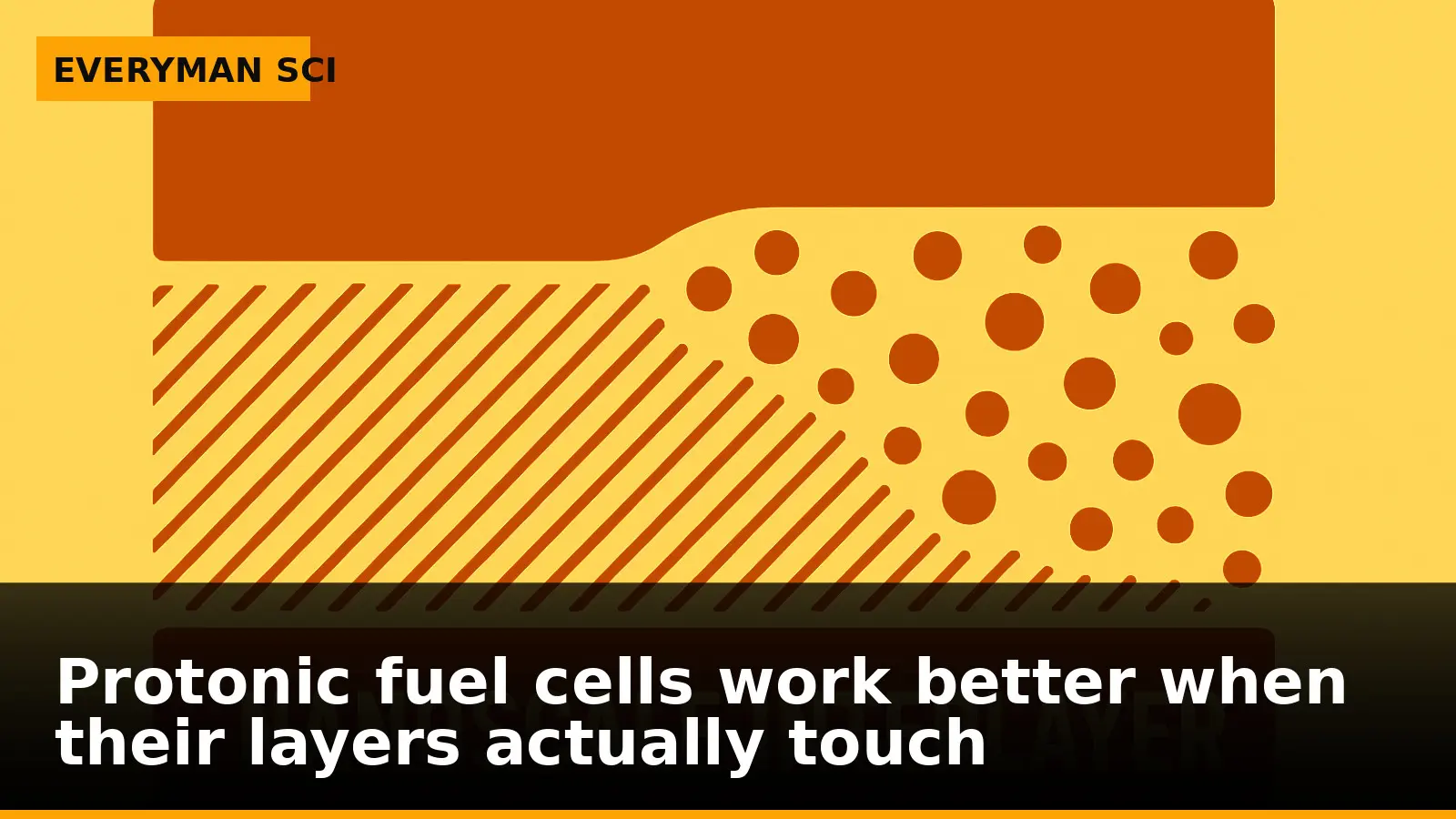
If a fuel cell is a sandwich of ceramic layers, the bite that matters most is where they actually touch. This study set out to answer two linked questions: how much does the real contact area at that buried interface throttle performance, and can a wafer-thin interlayer fix it without a complete redesign?
A team led by Wonyoung Lee at Sungkyunkwan University reports that the answer to both is “a lot.” In Nature Communications, the group shows that dialing up the microscopic “contact coverage” between electrode and electrolyte in protonic ceramic electrochemical cells (PCECs) cuts the interface’s electrical drag and, with a nanoscale coating, delivers sturdier, more efficient cells. The paper appears as Hyun Sik Yoo et al., Interface-driven boost in the performance and stability of protonic ceramic electrochemical cells.
Who did this and why PCECs are different
PCECs are a class of hydrogen devices that can both generate electricity from hydrogen and split water to make it. They already have one big advantage: they can run efficiently at lower temperatures than conventional devices, which makes materials problems easier—if the interfaces cooperate.
According to Lee’s team, one interface in particular—the smooth, dense electrolyte pressed against a porous electrode—often fails to make full physical contact. That incomplete mating creates interfacial contact resistance, an internal bottleneck that limits how well the cell can perform in either mode.
Method, in plain terms: build the interface you want
The researchers’ core move was process, not chemistry. They used electrostatic spray deposition (ESD), which uses an electric field to atomize a liquid into charged microdroplets that land and dry as a film. With ESD they laid down a thin, dense interlayer—measured in nanometers—uniformly across the electrolyte surface before bringing the electrode into contact.
That interlayer acts like a conformal shim at the nanoscale, increasing the fraction of the electrode and electrolyte that are truly touching—what the team calls the contact coverage. They identify that coverage as a key design parameter that governs cell performance.
What changed: the interface stopped fighting back
In the team’s analysis, interfacial resistance systematically decreased as contact coverage increased. That is, the more of the two surfaces that were actually in contact, the less electrical loss the junction imposed. Cells built with the ESD interlayer outperformed conventional cells in both power-generation and hydrogen-production modes.
Durability improved alongside efficiency. The group reports that cells with the nanolayer maintained stable operation under harsh conditions involving rapid temperature changes—stress that often peels layers apart—consistent with stronger adhesion at the interface. They also demonstrate that the same spray process can be applied uniformly to large-area substrates, a point in favor of scale-up.
Results without the hand-waving, and what we don’t know yet
The topline findings are specific: contact coverage is the controllable lever; higher coverage lowers interfacial resistance; an ESD-made, nanometer-scale interlayer raises performance and hardens stability; and the process scales to large areas. The lead author calls the work significant because it quantitatively defines microscopic contact behavior while maximizing both performance and durability using a scalable nano-process.
What this public summary does not include are the exact figures—a percentage drop in resistance, absolute power densities, time-on-stream, or error bars. Those numbers matter for comparing against incumbent systems, and they are in the journal paper. If you need the deltas and confidence intervals, follow the link to Nature Communications below.
Why this matters for hydrogen tech beyond the lab
Because PCECs operate efficiently at lower temperatures than conventional devices, squeezing out interfacial losses can unlock that advantage without exotic materials. A process tweak that improves both efficiency and thermal shock tolerance is valuable to manufacturers trying to build tougher stacks with fewer failures.
Lee expects the approach to be widely applicable—to large-scale clean energy power plants, hydrogen-powered vehicles, and eco-friendly energy storage systems. The fabrication angle also matters: the team emphasizes uniform coating on large-area substrates, a practical prerequisite for any technology that aims to leave the lab.
The deeper cut
What “contact coverage” changes in a fuel cell
Interfacial contact resistance in porous–dense junctions is dominated by constriction (spreading) resistance: current lines pinch through discrete microcontacts, each acting like a narrow aperture. If the true contact area A_true is a small fraction of the apparent area A_app, the effective resistivity at the interface scales inversely with A_true and depends on the local microtopography and hardness through the classic Holm contact model. Increasing coverage raises both the number and size of microcontacts, reducing the sum of constriction resistances in parallel. A conformal nanolayer can also smooth asperity height distributions, bridging valleys to turn near-contacts into load-bearing junctions. ESD is well-suited here because charged droplets can yield dense films with high coverage at low substrate temperatures, and the resulting interlayer can improve adhesion energy by increasing real area and introducing favorable interfacial chemistry—both of which blunt thermal-cycling delamination. From a stack-design perspective, lowering the interfacial area-specific resistance (ASR) at one junction linearly improves cell voltage at a given current density and reduces ohmic heating; that, in turn, widens the safe operating window during load transients and temperature ramps.
Limits and the next test that should happen
Two caveats frame these results. First, the performance gains and stability claims are reported qualitatively here; without the numerical deltas, it is hard to benchmark against today’s best PCECs. Second, identifying contact coverage as a governing parameter is powerful, but translating that into a factory control variable requires metrology that can see, or reliably infer, coverage in-line.
The obvious next steps are independent replication and head-to-head builds that report absolute and area-normalized performance, interfacial area-specific resistance before/after coating, adhesion energies, and cycling lifetimes—under the same protocols. The paper’s publication in Nature Communications marks peer review, and the process’s uniformity on large-area substrates is a promising sign for scale-up.
Where to read the primary study
The full report—by Hyun Sik Yoo and colleagues, led by professor Wonyoung Lee—is published in Nature Communications. The study details the ESD process, the nanometer-scale interlayer across the electrolyte surface, and the observed links between contact coverage and interfacial resistance, as well as the performance and stability outcomes in real PCECs.
The paper: Interface-driven boost in the performance and stability of protonic ceramic electrochemical cells (Nature Communications, 2026)
Sources: Nanoscale coating boosts hydrogen cell efficiency and durability by improving internal contact (phys.org)
Images: Cover: Everyman Science (AI illustration)
How this article was made: Everyman Science uses AI tools to structure, format and optimise its articles, and occasionally to produce illustrations where no free photograph exists. The reporting these articles are based on is human-produced and cited above. Spotted an error? Write to [email protected] and we will correct it. — The editors How we work.





Science desk team of Everyman Science, curating and reporting on the day’s most significant developments in research, space exploration, and technology.