Flip a single bone sensor, and even osteoporotic mice grow stronger bones
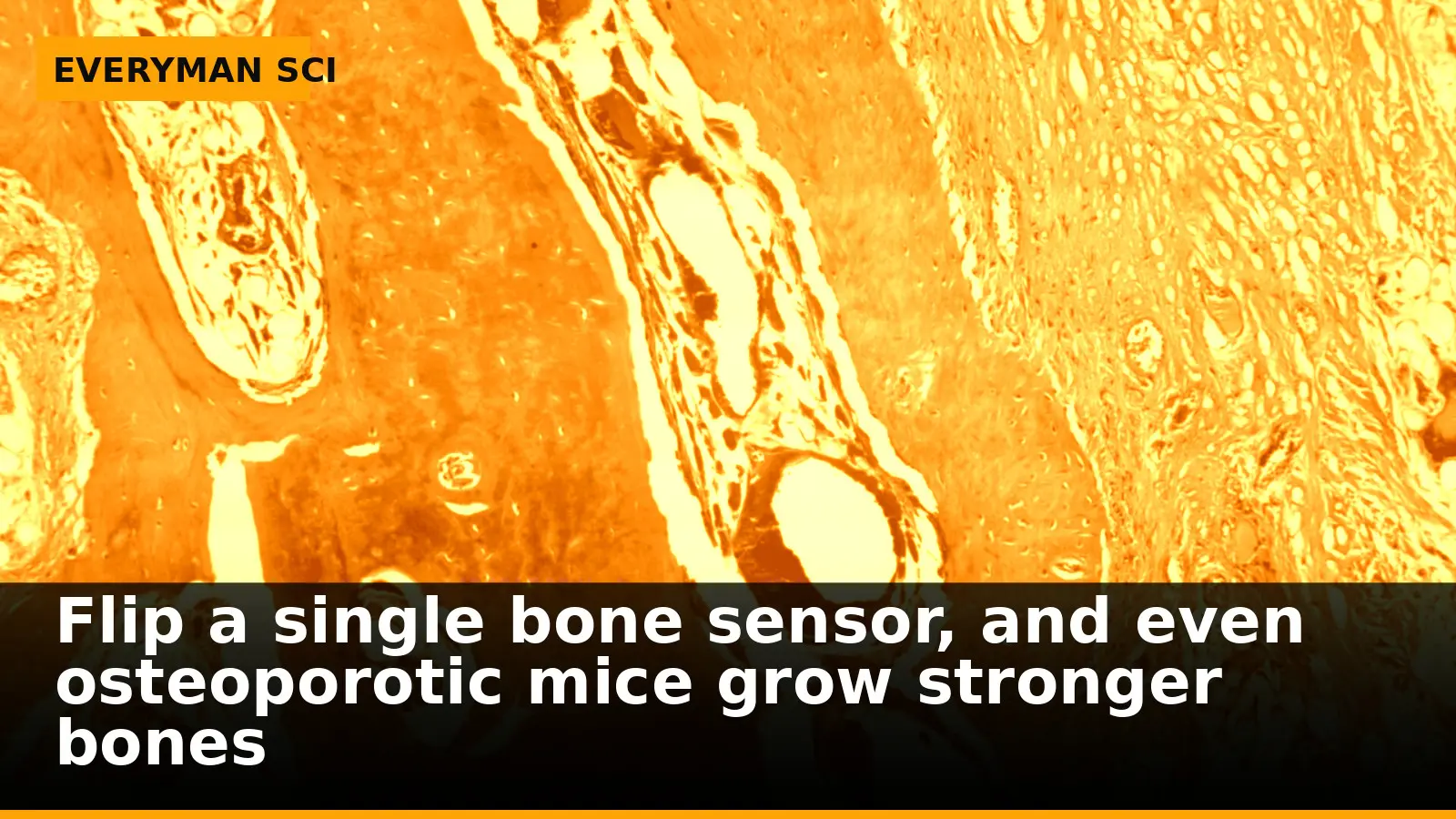
Bones aren’t static. They listen. The study asked a simple question: if you flip on one of the sensors bone cells use to feel their surroundings—GPR133—do bones build more and crumble less?
A second, tightly related question: can a small molecule, AP503, push that same sensor and make weak bones stronger?
Who did this and where it landed
The work comes from scientists at Leipzig University and is reported in Signal Transduction and Targeted Therapy (2025) as a study showing the mechanosensitive adhesion G protein‑coupled receptor GPR133 (also called ADGRD1) enhances bone formation. The paper is the basis for the findings described here.
The backdrop is large: in Germany alone, about six million people live with osteoporosis, most of them women. Safer, longer‑term options are badly needed.
What they actually did, in real terms
This was a mouse study focused on a single cell‑surface receptor, GPR133. The team examined what happens when the receptor is missing or impaired and when it is chemically stimulated. They used AP503, a compound recently identified via a computer‑assisted screen, to activate GPR133.
They assessed bone strength in two contexts: healthy mice and mice with osteoporosis‑like bone loss. The reporting does not specify the exact test modalities, sample sizes, or dosing schedules, but the comparisons are directly between treated and untreated animals within each condition.
What turned up when they flipped the switch
First, loss of GPR133 function matters: when this receptor is impaired by genetic changes, mice show early signs of bone density loss—similar to human osteoporosis. That pins GPR133 to the normal machinery that keeps skeletons sound.
Second, pushing the receptor helps. Stimulation of GPR133 with AP503 increased bone strength not only in healthy mice but also in mice with osteoporosis‑like bone loss. While the report does not provide a percentage increase or absolute values, the direction of effect is consistent across both groups.
How the receptor seems to work inside bone
GPR133 responds to physical forces and to the way neighboring bone cells interact. When activated, it tilts the balance between the two key cell types in bone remodeling: it encourages osteoblast activity (the builders) and reduces osteoclast activity (the breakers).
That shift—more building, less breaking—aligns with the observed strengthening. AP503 appears to imitate the natural process that turns GPR133 on, effectively nudging the system toward formation rather than resorption.
| Element | Detail |
|---|---|
| Receptor target | GPR133/ADGRD1 (mechanosensitive adhesion GPCR) |
| Model system | Mice (healthy and osteoporosis‑like bone loss) |
| Intervention | AP503 (small‑molecule stimulator identified via computer‑assisted screen) |
| Primary outcome | Increased bone strength in healthy and osteoporotic mice (no effect size reported) |
| Mechanistic readout | Activation increases osteoblast activity and reduces osteoclast activity |
| Physiology | GPR133 responds to physical forces and cell–cell interactions in bone |
| Additional context | Impairing GPR133 causes early bone density loss in mice |
| Potential application | Increase bone strength and help restore weakened bone |
Numbers, confidence, and what they mean
The central quantitative bottom line—by how much bone strength rose—is not reported in the summary. What we do have is a clear qualitative result: AP503‑driven activation of GPR133 strengthened bones in both healthy and osteoporotic‑like mice. In translational terms, that’s notable because many existing drugs primarily slow loss; doing that while boosting formation is harder.
The team’s own emphasis is that this “parallel strengthening of bone” underscores medical potential in aging populations, as noted by Dr. Juliane Lehmann.
The deeper cut
Mechanosensation, remodeling, and why a single switch can matter
Bone remodeling is a coupled dynamical system: osteoclasts excavate resorption pits while osteoblasts refill them. Mechanical loading skews the coupling—regions under higher strain typically favor formation over resorption. A mechanosensitive GPCR like GPR133 offers a conduit from extracellular forces (or cell–cell contacts transmitting those forces) to intracellular signaling states that bias lineage activity. If activation increases osteoblast output while attenuating osteoclast activity, the steady‑state balance of remodeling shifts toward net accrual. In simple terms, you raise the formation term F and lower the resorption term R in dB/dt = F − R, yielding positive bone balance.
The appeal of a receptor‑level lever is specificity: upstream of many late‑stage effectors, a receptor integrates multiple cues but yields a targetable node. A small molecule that mimics the endogenous activation context (as AP503 is reported to do) sidesteps the need to recreate complex mechanical stimuli. The persistent worry in the field is uncoupling—boosting formation without suppressing resorption can wastefully churn bone; suppressing resorption alone risks microdamage accumulation. A mechanism that addresses both sides in parallel is unusually attractive, provided systemic effects remain acceptable.
Limits you should keep in mind
These are mouse data. Osteoporosis is a human disease, and mouse bone biology, while informative, is not destiny. No human dosing, safety, or efficacy is reported here.
Key experimental details are not specified in the summary: sample sizes, dosing regimen, measurement techniques, time frames, and effect magnitudes. Without those, we can’t judge robustness, durability of the effect, or practical dosing windows.
What is not known (once, and plainly)
The numerical size of the bone‑strength gains, the specific assays used, how long benefits last after dosing stops, side‑effect profiles, and whether AP503 meaningfully reduces fracture risk in living animals, let alone people, remain unknown. It is also not yet clear how GPR133 activation interacts with standard osteoporosis therapies or with hormone changes at menopause beyond the conceptual rationale.
Why this matters beyond bones—and a caution
AP503’s reach may extend outside the skeleton: in earlier Leipzig work, activating GPR133 also strengthened skeletal muscle. For older adults who often lose bone and muscle together, a single pathway touching both tissues is intriguing.
But broader activity cuts both ways. System‑wide effects need careful mapping before any therapy moves forward. Leipzig University has made adhesion GPCRs a long‑term priority—through its Collaborative Research Center 1423—so expect deeper receptor biology and, hopefully, the missing quantitative details.
The paper: The mechanosensitive adhesion G protein-coupled receptor 133 (GPR133/ADGRD1) enhances bone formation (Signal Transduction and Targeted Therapy, 2025)
Sources: Scientists find a bone-building switch that could fight osteoporosis (www.sciencedaily.com)
Images: Cover: Everyman Science (illustration)
How this article was made: Everyman Science uses AI tools to structure, format and optimise its articles, and occasionally to produce illustrations where no free photograph exists. The reporting these articles are based on is human-produced and cited above. Spotted an error? Write to [email protected] and we will correct it. — The editors How we work.





Science desk team of Everyman Science, curating and reporting on the day’s most significant developments in research, space exploration, and technology.