In 3C 279, EHT finds a bending jet—and the brightest spot downstream
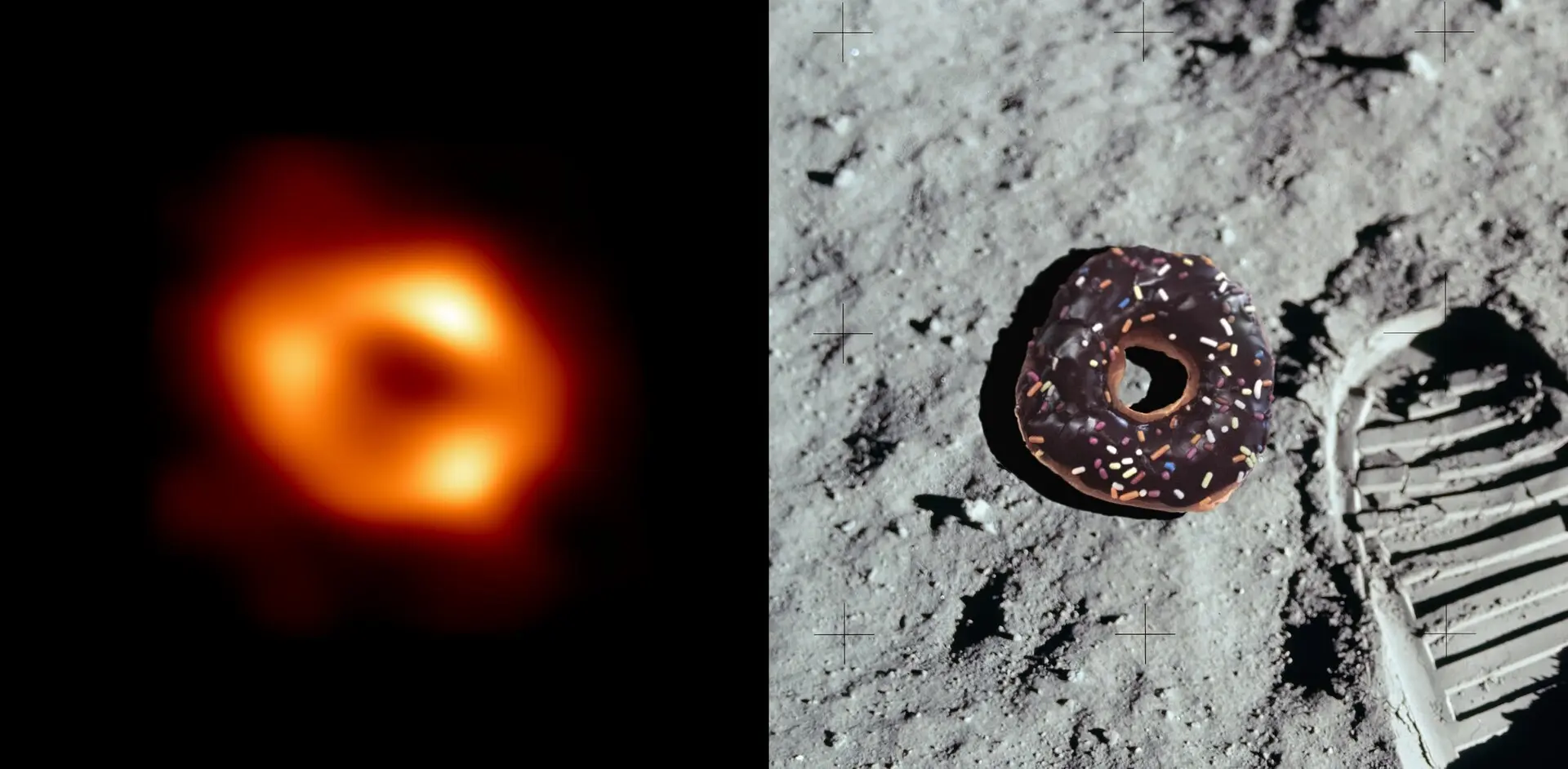
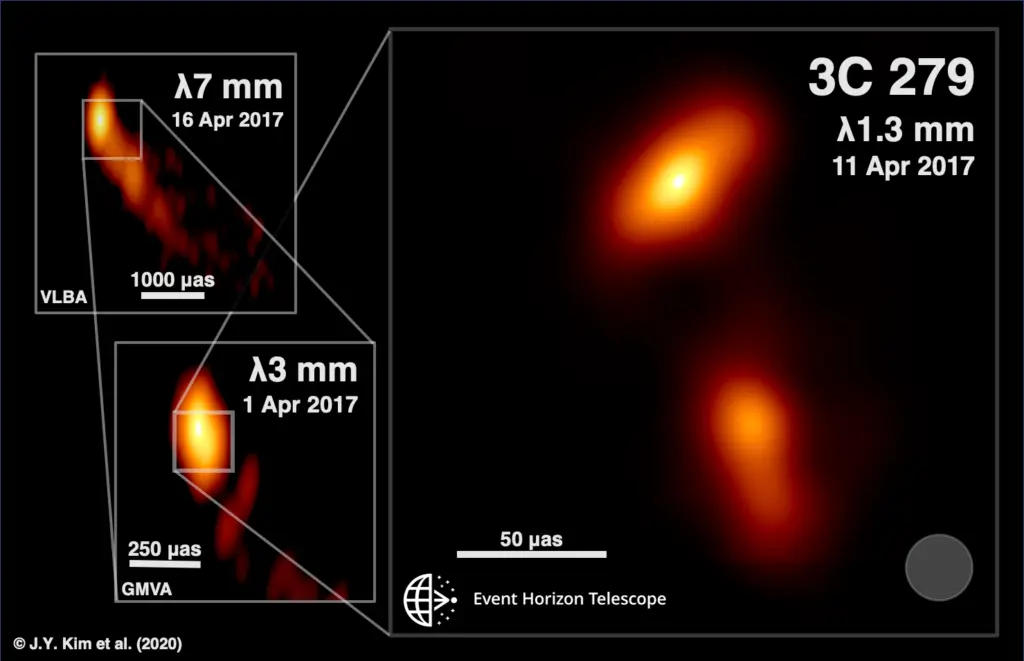
At first glance, the brightest spot ought to mark the monster itself. But in the Event Horizon Telescope’s latest look at the blazar 3C 279, the most intense glow sits farther down the line—away from the black hole—and the line itself doesn’t keep still. The images show the inner jet changing direction over time, a bend that shifts where the glare collects.
Those are the stand‑out clues from a 2021 observing push by the EHT that, in a study in Astronomy & Astrophysics, mapped the jet’s dynamics and geometry on sub‑parsec scales. The target, 3C 279, is powered by a supermassive black hole of about 800 million Suns—orders of magnitude heftier than the 4.3‑million‑solar‑mass object at the center of our own galaxy.
A telescope that keeps getting bigger—and sharper
The EHT is the same collaboration that delivered the first image of a black hole in M87* and, later, the first of Sagittarius A*. In 2021 it assembled its largest published array to date, adding two new radio sites to widen its reach.
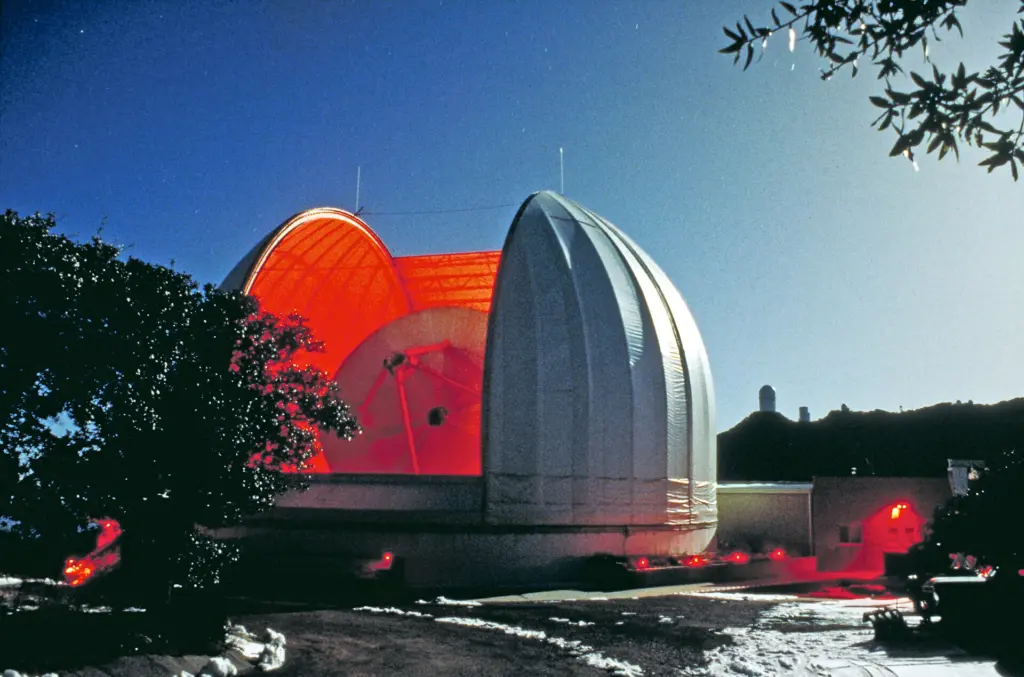
Those additions were specific and consequential: a 12‑meter dish at Arizona’s Kitt Peak National Observatory and the Northern Extended Millimeter Array (NOEMA) in the French Alps. According to the analysis reported by the team, these closely spaced stations were especially important to the 3C 279 campaign.
Why two new stations mattered to a bend in space
In very long baseline interferometry, the physical baseline—the separation between two antennas—sets the spatial scale that pair can resolve. You can think of it as dials on detail: different baselines sample different sizes in the sky, and more baselines fill in more of the picture.
Because Kitt Peak and NOEMA sit relatively near other EHT antennas, they supplied intermediate baselines the array had lacked. The study reports that this improved coverage helped probe both compact and more extended pieces of the jet, the mix you need if you want to follow how the inner structure bends and brightens downstream.
What the study actually saw in 3C 279
The EHT images show that the direction of the inner jet changes over time. The same analysis notes that the brightest spot in the image can be downstream from the black hole—consistent with a section of the jet turning more directly toward our line of sight and outshining the base.
Taken together with earlier EHT campaigns and other frequencies observed around the same epochs, the group argues these patterns point to a jet that bends on sub‑parsec scales. Importantly, the finding doesn’t require the flow to slow or speed up; geometry alone can shuffle what looks brightest and how motion appears on the sky.
A mystery with better constraints than before
Even for a blazar as well‑watched as 3C 279, the engine behind its central jet remains a mystery. Very few quasars have been studied in this much detail at such small scales, and that scarcity limits how confidently astronomers can generalize from one object to many.
The team emphasizes that more is coming. The collaboration expects a series of results from these data over the next few years as they combine multiple EHT observing years and coordinated, multi‑frequency snapshots to sort genuine changes in the jet from differences imposed by the observing band.
From M87* and Sagittarius A* to a subtler prize
The EHT’s fame rests on rings: the silhouettes of M87* and Sagittarius A*. But jets are the other half of the story. They carry energy and matter away from supermassive black holes, shaping their host galaxies over cosmic times. By pushing to resolve an inner jet like 3C 279’s, the array extends its remit from imaging horizons to tracking how black holes affect their surroundings.
That remit grows with the instrument. The collaboration is continuously adding telescopes, knitting new baselines that change what the array can see. In 2021, the Kitt Peak and NOEMA stations were singled out as especially important for the 3C 279 work.
The deeper cut
Baselines, uv-coverage, and why “intermediate” matters
EHT images are built in the Fourier domain: each pair of antennas samples a point in the uv-plane, the 2-D spatial frequency space conjugate to the sky brightness. Long baselines measure high spatial frequencies (fine detail at small angular scales); short baselines measure low spatial frequencies (broader structure). Sparse sampling yields ambiguity: many images are consistent with the same limited uv-coverage, and deconvolution or regularized maximum-likelihood imaging must impose priors. Intermediate baselines are the glue that ties scales together, constraining how flux is distributed between a compact core and surrounding emission. Without them, a bright knot downstream can be traded off against a fatter, dimmer core, and apparent bends can masquerade as artifacts of incomplete coverage. The 2021 array’s added stations supplied uv points at mid-range spacings relative to existing pairs—particularly between NOEMA and Pico Veleta, and between Kitt Peak and southwestern US sites—reducing degeneracy in model space. That makes it easier to test whether the peak brightness is truly offset from the base and whether a position angle change with radius is robust. While the study cross-checks reconstructions with multiple imaging approaches, the physical lever arm that matters most remains the distribution of baselines across scales.
How we got here—and what shifts next
The 3C 279 result sits in a lineage: the same collaboration first imaged M87*, then Sagittarius A*. Each step has required not only larger arrays but targeted choices about which baselines to add and why. The 2021 configuration was the largest published to date, and it paid off in the jet’s innermost reach.
Two expectations follow. First, as the array grows year by year, its ability to track changes in direction within jets should improve. Second, the downstream‑brightest signature flagged here will be tested across the few other quasars yet observed in comparable detail—slowly turning one enigmatic case into a class of behavior we can name.
One place to put ignorance—then move on
No one yet knows the mechanism that launches and accelerates 3C 279’s jet. The EHT team underscores that only a handful of quasars have been dissected so finely, and they expect a series of further results as more years and frequencies are analyzed together. That’s the honest edge of the field right now; everything else in this story is what the data do show.
The paper: Dynamics and geometry of the inner sub-parsec-scale jet in 3C 279 observed with the Event Horizon Telescope (Astronomy & Astrophysics, 2026)
Sources: Event Horizon Telescope views the dynamics and geometry of a black hole jet in extreme detail (phys.org)
Images: Cover: EHT Collaboration, ESO/M. Kornmesser, NASA, Lu Amaral / Wikimedia Commons (CC BY 4.0); Figure 1: KPNO/NOIRLab/NSF/AURA/P. Marenfeld / Wikimedia Commons (CC BY 4.0); Figure 2: Jae-Young Kim / Wikimedia Commons (CC BY-SA 4.0)
How this article was made: Everyman Science uses AI tools to structure, format and optimise its articles, and occasionally to produce illustrations where no free photograph exists. The reporting these articles are based on is human-produced and cited above. Spotted an error? Write to [email protected] and we will correct it. — The editors How we work.





Science desk team of Everyman Science, curating and reporting on the day’s most significant developments in research, space exploration, and technology.