
On Pluto’s heart-shaped plain, liquid nitrogen may have flowed up

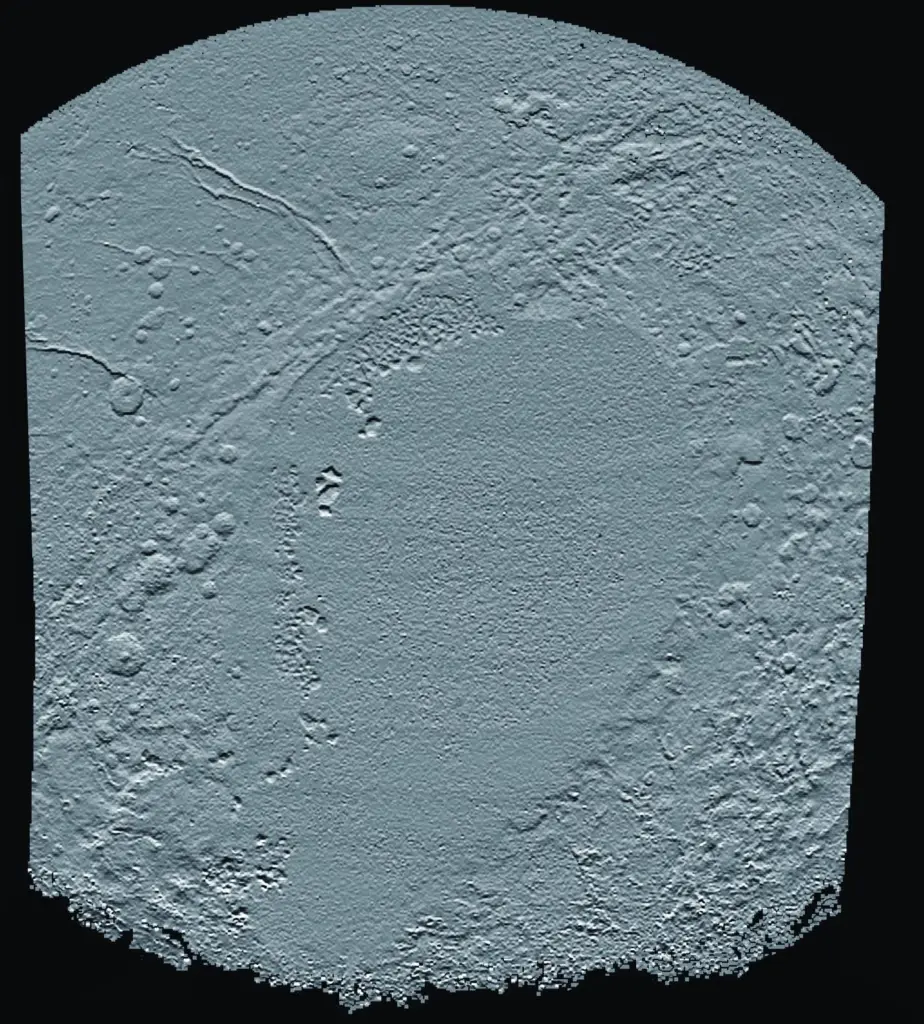
Stand on the rim of a basin bigger than Texas and Oklahoma, and imagine the ground under your boots isn’t rock but frozen nitrogen—a glacier of exotic ice. Now imagine that somewhere far below, that nitrogen briefly melts, squeezes into cracks, and seeps upward to the surface before skimming downslope. That is the picture researchers are building for Sputnik Planitia, Pluto’s bright, heart‑shaped plain.
Southwest Research Institute (SwRI) reports the first evidence that liquid has flowed on Pluto in relatively recent times, with liquid nitrogen likely moving upward through cracks and reaching the surface near the northern edge of Sputnik Planitia. The findings are published in the peer‑reviewed Planetary Science Journal, and the study ties its case together with spacecraft images and computer models.
Why this is news now
SwRI states that the analysis provides the first evidence of liquid flow on Pluto in the recent past, and that the work appears in The Planetary Science Journal. That makes the timing simple: this is the moment scientists are ready to argue for liquid nitrogen on present‑day Pluto—not as rainfall (which Pluto’s temperature and atmosphere can’t support), but as an underground melt that found paths to the light.
The everyday analogy—and where it breaks
If you’ve watched a temperate glacier in spring, you’ve seen meltwater run in blue channels, dive into crevasses, and reappear lower down. Sputnik Planitia is also a glacier, but made mostly of nitrogen, not water, and Pluto’s air and cold rule out nitrogen “rain.” The likeness helps picture flow along cracks, but it breaks down because Earth’s surface melt comes from sunlight and air warmth, while on Pluto the proposed liquid originates from melting deep under the ice.
Pluto’s heart is young and restless
SwRI notes that the surface of Sputnik Planitia is probably less than one million years old. On a world that formed billions of years ago, a surface that young signals ongoing reshaping. That youth matters: if the surface is being turned over on such timescales, any liquid‑made features there are not ancient fossils—they’re recent.
How do you melt nitrogen at −whatever? From the bottom up
The study’s models, led by researchers cited by SwRI, indicate that nitrogen ice at the bottom of Sputnik Planitia—which is several kilometers deep—can melt and produce liquid nitrogen. In that scenario, liquid accumulates at the base, then takes advantage of fractures and narrow channels to rise toward the surface. SwRI also reports that rain is ruled out by Pluto’s conditions, so cracks provide the plumbing the atmosphere cannot.
Why the liquid goes up instead of down
In a familiar lava tube, molten rock can move long distances inside a rigid shell. The study proposes a related idea: once liquid nitrogen exists at depth, buoyancy or pressure from below can push it into upward‑reaching pathways. The analogy to lava flows is useful for picturing guided motion inside solid walls, but it breaks because lava is hot rock in air, whereas here the liquid and the “walls” are the same substance—nitrogen—behaving under Pluto’s gravity and cold.
What breaks, what clogs, what keeps flowing
Cracks and narrow channels are both opportunity and risk. They can link deep melt to the surface, but they can also freeze shut. The modeling result SwRI highlights is simply that basal melting can occur and that there’s a mechanically plausible route for liquid to reach the surface near Sputnik Planitia’s northern edge. That is enough to make the dark‑versus‑bright textures there worth a second look with better imaging.
The deeper cut
Basal melt in nitrogen ice: a modeling note
Basal melting in Sputnik Planitia’s nitrogen glacier hinges on the thermomechanical feedbacks that glaciologists normally discuss for water ice, transposed to N2. In the models summarized by SwRI, several‑kilometer thicknesses matter because overburden pressure and internal deformation work can concentrate heat at the bed, while the temperature gradient to Pluto’s interior is nonzero. If the basal temperature crosses the N2 solid–liquid phase boundary locally, a thin layer of melt can form. Once present, basal liquid reduces effective normal stress on the bed and can localize strain into shear zones, further enhancing dissipation—a positive feedback familiar from temperate terrestrial glaciers. The transport problem is then one of fracture and porous flow through a mostly solid nitrogen matrix. Pressure gradients (from topography or transient loading) and buoyancy can drive ascent along pre‑existing fractures. Any ascent path is metastable: latent heat of fusion must be supplied as the liquid advances and freezes along margins, so steady flow likely requires pulses where the supply at the base momentarily outpaces conductive losses into the surrounding ice. The study’s claim, as reported, is not that this cycle is continuous everywhere, but that it is physically permitted within Sputnik Planitia’s several‑kilometer‑deep nitrogen body.
What we still don’t know
SwRI states that more than half of Pluto has never been mapped at high resolution. That leaves open whether similar basal‑melt plumbing operates elsewhere on the dwarf planet. SwRI also says additional high‑resolution observations of Pluto and other Kuiper Belt planets will be needed to determine whether comparable processes occur more broadly in the outer solar system.
Why this mechanism, and where else it might matter
SwRI points to the same general mechanism—melting at depth and upward movement of liquid—as a way to explain activity elsewhere in the solar system. The appeal is that it doesn’t rely on surface warmth or rain; it relies on what thick, cold ices can do under their own weight and internal stresses. That makes it a portable idea for worlds where the air is thin, the sun is weak, and the ice itself is the active geology.
The cost of being sure
Right now, the evidence chain is: youthful terrain on Sputnik Planitia, features SwRI links to recent flow, and models that show how liquid nitrogen could be produced and piped upward from several kilometers down. To turn “could” into “does,” the field needs sharper eyes on Pluto and its neighbors—exactly the kind of high‑resolution observations SwRI says will be required.
The paper: Evidence for Possible N
<sub>2</sub>
Basal Flow beneath Pluto’s Northern Sputnik Planitia (The Planetary Science Journal, 2026)
Sources: NASA’s New Horizons spots signs of liquid nitrogen flowing on Pluto (www.sciencedaily.com)
Images: Cover: NASA / Wikimedia Commons; Figure 1: NASA/JPL
How this article was made: Everyman Science uses AI tools to structure, format and optimise its articles, and occasionally to produce illustrations where no free photograph exists. The reporting these articles are based on is human-produced and cited above. Spotted an error? Write to [email protected] and we will correct it. — The editors How we work.





Science desk team of Everyman Science, curating and reporting on the day’s most significant developments in research, space exploration, and technology.