At 6,000 meters down, pancakes of ash rewrite the world’s deepest trench
The camera lights raked across the trench wall, and there they were: flat, stacked “pancakes” of rock where the ocean floor falls away toward the planet’s deepest point. On three separate outcrops spaced across a 100‑kilometer stretch by the Challenger Deep, a robot submarine spotted textures geologists know by feel—brittle, glassy layers welded together by heat. Pyroclastic flows. But 6 kilometers under the Pacific, where pressure would normally smother explosions.
Explosive volcanism right next to an ocean trench is not where the textbooks put it. Yet that is what a team led by Robert J. Stern reports in a new study of the Challenger Deep forearc, the swath between the trench and the usual line of volcanoes farther inland. The researchers say the rocks are the deepest underwater explosive eruption deposits ever found.
A trench built over 52 million years—and still surprising
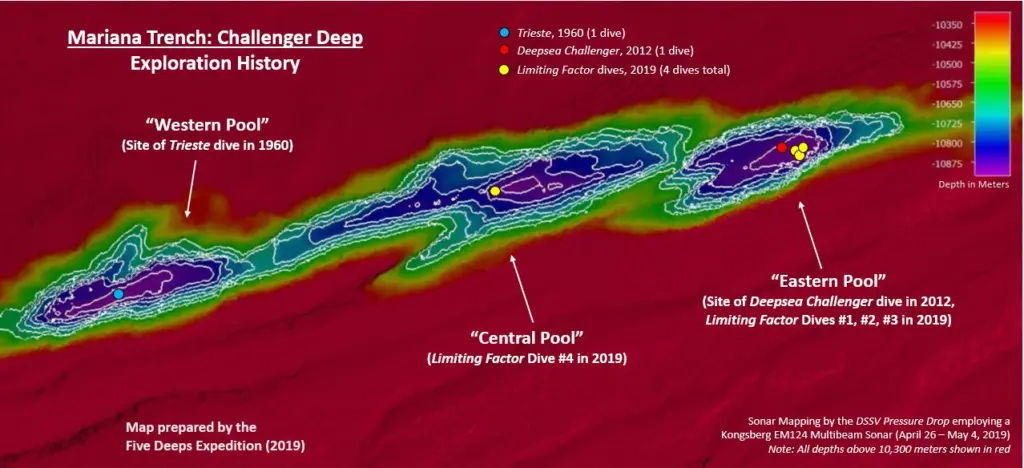
The Mariana Trench formed when the Pacific Plate began to slide beneath the Philippine Sea Plate about 52 million years ago. Its deepest known pocket, the Challenger Deep, lies almost 11,000 meters below sea level—deep enough to swallow Everest with room to spare. Scientists have argued for years over why this particular subduction gash is so extreme.
The new forearc survey adds clues. It supports the idea that the sinking slab bends unusually steeply here because the two plates are only weakly coupled and the descending plate is narrow and short, letting it flex more tightly—ingredients that help make the trench deeper. As Stern put it elsewhere, the energy from sinking oceanic plates drives much of Earth’s plate motions; as this forearc stretches, the subduction system itself can widen.
Seven dives along a 550‑kilometer frontier
Working with the Jason/Medea remotely operated vehicle—which cannot descend beyond 6,500 meters—the team focused on a 550‑kilometer‑long forearc segment near Challenger Deep. Jason/Medea completed seven dives along roughly 300 kilometers of that frontier, imaging and sampling the upper trench wall where the vehicle could safely work.
The eastern segment, they report, is the deeper side with steeper trench walls, yet the crust‑mantle boundary sits closer to the surface there than in the west. That contrast matters: it hints that the forearc is stretching, but not the same way everywhere.
East pulls apart, West makes magma
In broad strokes, older rocks cropping out to the east point to mechanical stretching—as if the crust were being taffy‑pulled apart. To the west, the team found younger volcanic rocks, implying the crust is being extended by the addition of magma. That juxtaposition—two styles of extension side by side—would be odd in any tectonic province. It is stranger still beside the world’s deepest trench.
Live Science notes that, unlike other stretches of the Mariana system, the Challenger Deep segment lacks an organized volcanic arc. Instead of the predictable chain of volcanoes, there is an ocean ridge to the north—and, now, decisive evidence of explosive material in the forearc where heat to melt rock is usually scarce.
Ash at 592 atmospheres
At the depths of these flows, the overlying water weighs in at about 592 atmospheres of pressure—nearly 600 times sea‑level air. Under such a lid, gases in magma struggle to expand, which normally blunts explosive behavior. “The intense pressures … make the eruption style different than it would be on land or in shallow water,” Stern said. Yet the rocks’ pancake‑like layers and embedded volcanic glass match pyroclastic textures.
Glass is a fragile clue in seawater. Stern told Live Science its presence suggests the eruptions were fairly recent: “They’re not yesterday … but I don’t think they’re a million years old.”
A forearc that might be starting something new
Stern and colleagues suspect the plates may be initiating a new subduction zone in the western part of this forearc. If so, the west’s young volcanic rocks would be a symptom of that birth process. The idea fits the broader picture of a forearc under mixed kinds of stretch—but it is a hypothesis, not a verdict.
The deeper cut
Why pressure should smother blasts—and why it didn’t
Fragmentation in explosive eruptions is driven by rapid volatile exsolution and vesiculation: bubbles nucleate and grow until the melt fractures and gas-particle mixtures accelerate as pyroclastic density currents. Hydrostatic pressure raises the threshold for exsolution; at ~592 bar, dissolved H2O and CO2 remain in the melt to much higher temperatures, suppressing vesicle growth and slowing permeable outgassing. In deep water, you expect pillow lavas and sheet flows, not welded tuffs. The Challenger Deep forearc deposits complicate that picture. The thin, flat, welded layers indicate clasts landed still hot enough to sinter, implying flows that did not travel far before emplacement and reheating to above the glass transition. The observed textures also require rapid quenching at particle margins to preserve glass, so emplacement likely toggled between hot, confined currents and immediate chilling by ambient water. Combined with the east–west contrasts in Moho depth and extension style, a plausible end-member scenario is localized melt generation and overpressure in the west feeding short-runout, density-stable currents down steep slopes. The key physics tension is between pressure-inhibited vesiculation and slope-aided particle transport; the rocks say the latter, under specific conditions, can still win.
What we still don’t know—yet
No one has located the actual eruption vents. The team infers the hot flows moved downslope but not far before re‑welding into hard rock, and Jason/Medea cannot sample the trench floor between 6,500 and ~11,000 meters to chase the sources. The researchers also say more sampling and radiometric dating are needed to test the east–west stretching contrast.
Chemical quirks of the magmas remain to be nailed down, too—especially how they behaved under such pressure. As one outside volcanologist noted, “We just don’t know how those magmas will behave at those water depths.”
A deeper trench, a wider system
The study’s tectonic read also loops back to the trench’s depth. By their analysis, weak attachment between plates and a narrow, short subducting slab allow steeper bending. That steeper dip makes for a deeper trench—and, if the forearc is stretching, the subduction zone itself may be widening.
That matters beyond one corner of the Pacific. As Stern has emphasized, the sinking of oceanic plates in subduction zones supplies most of the energy moving Earth’s tectonic plates. What happens at Challenger Deep is not just a curiosity at 11,000 meters; it is a live piece of the machinery that organizes the planet’s surface.
The paper: ROVing in the deep: tectonic and magmatic complexities of the Challenger Deep forearc segment, Southern Mariana convergent margin (Frontiers in Earth Science, 2026)
Sources: Robot submarine exploring world's deepest ocean trench finds unprecedented volcanic activity (phys.org); Impossible volcanic eruption spotted in deepest part of the ocean, perplexing scientists (www.livescience.com)
Images: Cover: Everyman Science (AI illustration); Figure 1: Vlvescovo / Wikimedia Commons (CC BY-SA 4.0)
How this article was made: Everyman Science uses AI tools to structure, format and optimise its articles, and occasionally to produce illustrations where no free photograph exists. The reporting these articles are based on is human-produced and cited above. Spotted an error? Write to [email protected] and we will correct it. — The editors How we work.





Science desk team of Everyman Science, curating and reporting on the day’s most significant developments in research, space exploration, and technology.