Euclid turns a 1‑in‑10,000 phenomenon into 15,000 chances to weigh dark matter
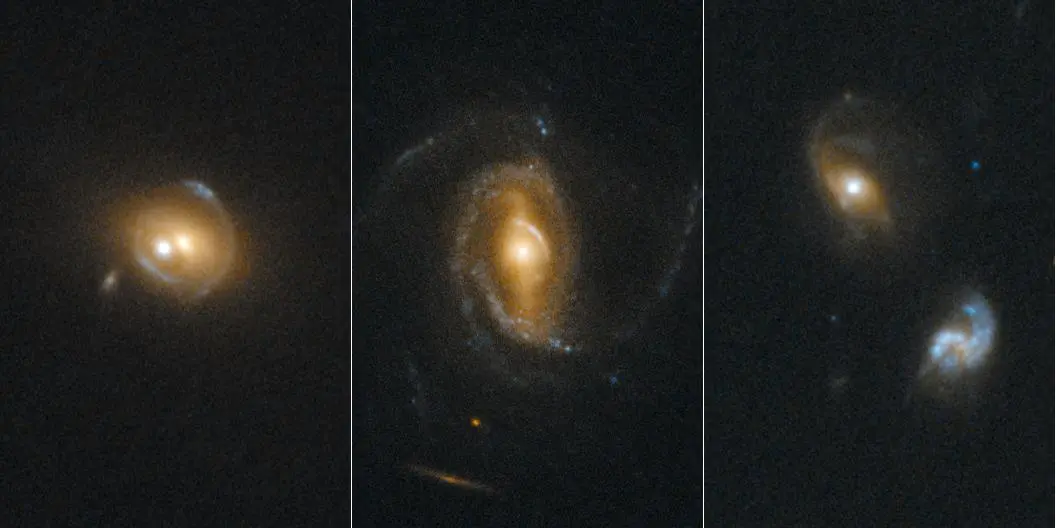
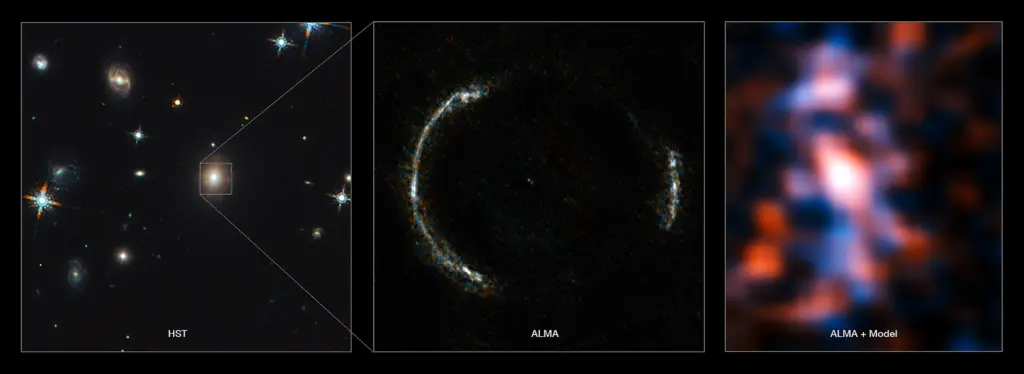
If you wanted to weigh the invisible, you’d look for the places where light bends wrong. Astronomers call those places strong gravitational lenses—where a massive foreground galaxy or cluster distorts the image of something behind it into arcs or even a near‑perfect ring. Now, researchers working with the European Space Agency’s Euclid mission report a deluge: 15,000 new potential strong lenses, a trove big enough to make dark matter testable in ways a handful of showpieces never could.
The haul sits inside a first public tranche of Euclid observations measured not in snapshots but in server rooms: 1.7 million gigabytes of data. In it, a global consortium of more than 2,000 scientists catalogued more than 900 million galaxies and 60 million quasars across almost 5% of the night sky—enough raw material to turn lens hunting from a boutique pursuit into a statistical science.
What makes 15,000 a big deal
Strong lenses used to be rare catches. As Hrishabh Srivastava puts it, the odds were about 1 in 10,000. Before Euclid, fewer than 1,000 had been confirmed. A candidate list fifteen times that size doesn’t just add stamps to an album; it changes the kind of questions researchers can ask about dark matter.
With thousands of systems, patterns become visible: how lensing strength varies with galaxy type, what mass substructures are common or missing, and whether those trends match a universe dominated by dark matter. That leap—from anecdotes to ensembles—is where precision tests live.
By the numbers: Euclid’s lens bonanza in context
| Quantity | Value | Stated by |
|---|---|---|
| New potential strong gravitational lenses | 15,000 | UBC researchers, reported via phys.org |
| Rarity of strong lenses in the sky | 1 in 10,000 | Hrishabh Srivastava, reported via phys.org |
| Previously confirmed strong lenses | fewer than 1,000 | Hrishabh Srivastava, reported via phys.org |
| Total data volume | 1.7 million gigabytes | European Space Agency, reported via phys.org |
| Galaxies catalogued | more than 900 million | Global consortium of more than 2,000 scientists, reported via phys.org |
| Quasars catalogued | 60 million | Global consortium of more than 2,000 scientists, reported via phys.org |
| Sky area in this release | almost 5% of the entire night sky | Analysis by a global consortium of more than 2,000 scientists, reported via phys.org |
Scale helps here. If strong lenses show up at about 1 in 10,000, finding fifteen thousand of them implies sifting through something like the population of hundreds of millions of distant objects. Euclid’s catalogue—spanning more than 900 million galaxies plus 60 million quasars—meets that ask without blinking.
What the lens count can say about dark matter
Gravitational lensing reads mass directly through its pull on light, regardless of whether that mass shines. That makes lenses exquisitely sensitive to dark matter, which is detectable through gravity but not through emitted light. By comparing how images are stretched and split across thousands of lenses, researchers can test whether the distribution of mass in and around lensing galaxies matches expectations if dark matter dominates structure formation.
The same dataset underpins checks on the broader cosmic budget, where dark energy and dark matter together account for about 95% of the universe. Lenses tie local mass maps to that global picture by plugging their parameters into cosmological models and seeing whether the numbers line up.
A survey built for statistics, not one‑offs
Euclid’s data release does more than collect curiosities. It standardizes them. Because the observations feed into a single mission archive, the lenses in this catalogue were gathered under one roof and analysed within the same program. That consistency matters when the goal is to compare thousands of systems without worrying that selection quirks are faking a trend.
The release also comes with spectra from more than 160 million sources and with results summarized in 26 papers submitted to Astronomy & Astrophysics. Those are the scaffolds for turning a table of candidates into a working map of mass and distance.
The deeper cut
How lensing encodes mass, in practice
In the thin‑lens approximation, deflection angles scale with the projected surface mass density κ relative to the critical density Σ_crit ∝ D_s/(D_d D_ds). Multiple images and Einstein rings emerge when κ exceeds unity along certain sightlines. For galaxy‑scale lenses, the image separations are set by the effective Einstein radius θ_E, which in isothermal models scales as θ_E ∝ σ_v^2, where σ_v is the velocity dispersion; subhalos perturb arcs and create flux anomalies at the percent level. With thousands of systems, one can stack constraints on the subhalo mass function dN/dM and look for departures from cold dark matter predictions—for instance, a suppression of low‑mass substructure in warm dark matter scenarios. Systematics that usually dominate small samples—source redshift uncertainties, lens light subtraction, and PSF modeling—average down when the analysis is hierarchical, as long as selection functions are explicitly modeled. The gain in power is not from any single “golden lens,” but from the ability to marginalize over nuisance parameters while still resolving the mass‑profile degeneracies that hobble one‑off reconstructions.
What we don’t know yet, and why that’s fine
These are candidates: the report does not specify which are confirmed. That uncertainty does not blunt the larger point. Even if a fraction fall away, the remaining sample would still dwarf the pre‑Euclid census and support population‑level tests of dark matter and dark energy models.
The mission frame: cost, clock, and coverage
Euclid launched in 2023 at a cost of more than $1 billion, and is planned for six years of service. The consortium reports that the present dataset spans almost 5% of the night sky and covers about 14% of the total sky area the mission will survey over its six‑year run. That gives a sense of pace as the catalogue grows from thousands to many thousands more.
Meanwhile, the headline numbers already justify the approach: more than 900 million galaxies and 60 million quasars to search, 1.7 million gigabytes of data to mine, and fifteen thousand places where gravity itself draws a map.
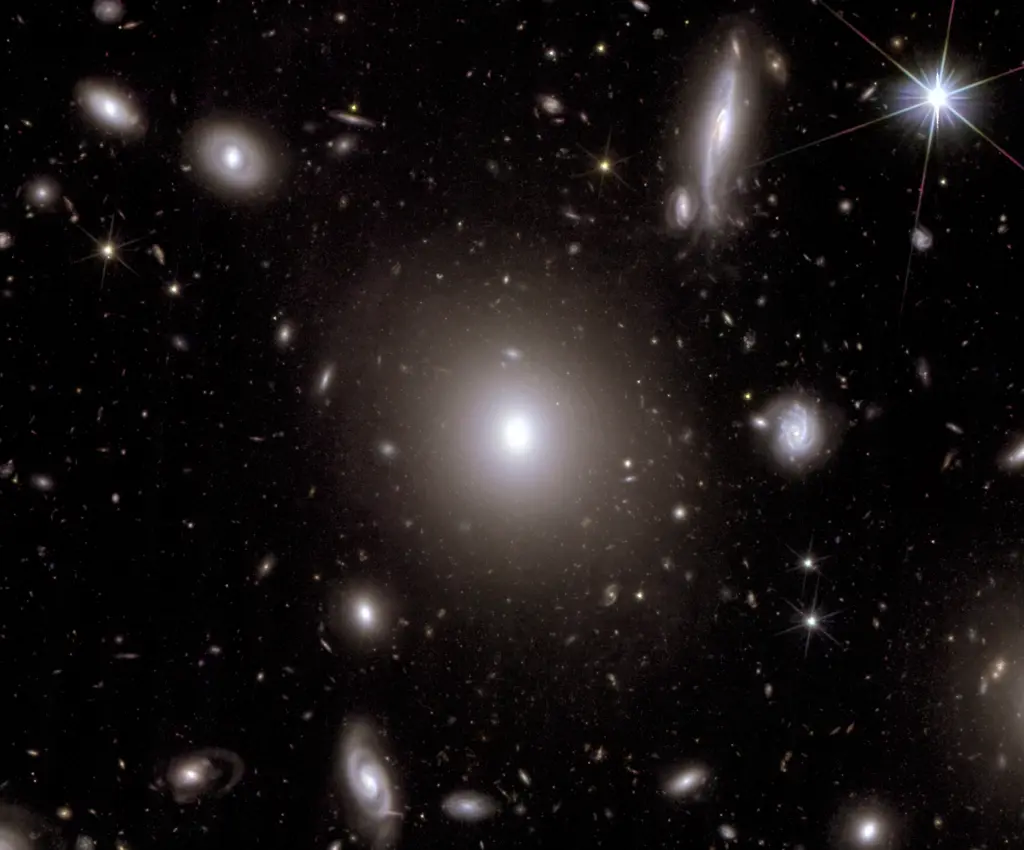
A rare phenomenon made routine
Strong gravitational lenses were a needle‑in‑the‑haystack phenomenon—about 1 in 10,000. Euclid’s first data turn that needle into a stack of its own. With enough examples, the invisible begins to leave fingerprints you can chart.
Sources: Dark matter–hunting satellite Euclid reveals record number of cosmic 'magnifying glasses' (phys.org)
Images: Cover: NASA/JPL; Figure 1: ESA/Euclid/Euclid Consortium/NASA, image processing by J.-C. Cuillandre (CEA Par / Wikimedia Commons (CC BY 3.0); Figure 2: ALMA (NRAO/ESO/NAOJ)/Y. Tamura (The University of Tokyo)/Mark Swinbank (Durham U / Wikimedia Commons (CC BY 4.0)
How this article was made: Everyman Science uses AI tools to structure, format and optimise its articles, and occasionally to produce illustrations where no free photograph exists. The reporting these articles are based on is human-produced and cited above. Spotted an error? Write to [email protected] and we will correct it. — The editors How we work.





Science desk team of Everyman Science, curating and reporting on the day’s most significant developments in research, space exploration, and technology.