By 2100, Canada’s wildfire bill could reach $43B a year—and top $2.1T this century

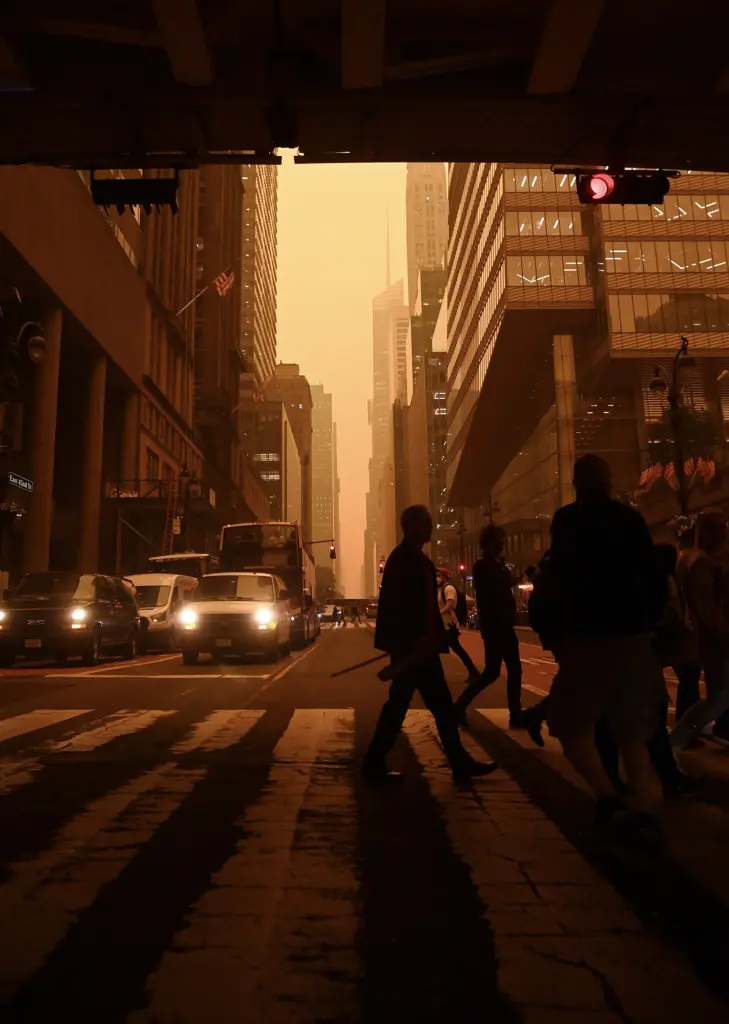
In 2023, more than 200 communities in Canada fled approaching flames as smoke turned midday skies the colour of rust and drifted across borders. Millions of Canadians breathed hazardous air pollutants—an abstract phrase until your throat stings and the sun looks like a warning light.
A new projection asks a blunt question: what happens to the bill if the climate keeps warming? The answer, from a Simon Fraser University–led study, is measured in the kind of numbers that bend public budgets—tens of billions each year by century’s end, and a cumulative total that passes $2 trillion.
By the numbers: a century-long bill for fire
The study projects the total annual cost of climate change–driven wildfire impacts at $43 billion at the end of the century in a hotter scenario. It estimates more than $2.1 trillion in cumulative costs over the 21st century. Even the rounded headline—costs could top $2 trillion—lands the same point: the price of inaction grows large, then larger.
Those figures are projections, not a ledger of past expenses. But they’re anchored in scenarios that trace different warming paths and how fire responds to them.
Two futures: holding 2°C, or sliding past it
Sian Kou-Giesbrecht, the study’s lead author, draws a line where the outcomes diverge. If global warming is kept to 2°C or less, the study finds wildfire impacts and costs will be similar to what Canadians have experienced over recent decades. Push beyond that, and the curve steepens.
Kou-Giesbrecht also points to a realistic worst‑case: a global temperature rise between 3 and 4°C. In that world, the study’s $43 billion per year by 2100 is the kind of annual number governments struggle to absorb without cutting elsewhere or raising more.
What was modeled—and what wasn’t
The projection model calculated costs under three possible global warming scenarios. That framing lets the analysis treat climate policy choices as economic ones: each degree of heat implies a different range of fire activity and expense.
Just as important are the explicit exclusions. Kou-Giesbrecht notes the model did not include costs of wildfire‑related health impacts, evacuations, infrastructure loss or economic disruptions within Canada alone. Omit those, and the totals likely understate what communities actually face when smoke chokes a city or a highway burns.
A caution from 2023: extremes off the balance sheet
The study did not account for singular extreme events like Canada’s record‑breaking wildfires in 2023. That season forced more than 200 communities to evacuate and exposed millions to hazardous air pollutants—costs that were very real for households and towns, but that sit outside this model’s tally.
That matters because extremes drive headlines and municipal budgets alike. If outlier years become less outlying, the gap between modeled costs and lived costs can widen.
What these figures do—and do not—settle
The numbers give a scale for planning: $43 billion per year by 2100 and above $2.1 trillion across the century are the stakes attached to warmer scenarios. They also clarify the conditional: holding warming to 2°C or less keeps impacts in the territory of recent decades; drifting toward 3–4°C does not.
They do not, however, tell you everything a city manager or health minister needs. Because the model excludes health, evacuation, infrastructure and Canada‑specific economic disruptions, it leaves out some of the most politically salient costs. Treat the totals as a lower bound, not a ceiling.
The deeper cut
Inside the scenarios: why the tail risk bites
The study runs its projections across three warming bands, then reads wildfire impacts off those trajectories. That setup encodes a basic asymmetry: fire risk does not scale linearly with temperature. A small shift in mean climate can move large swaths of forest across thresholds of fuel dryness and ignition probability, multiplying area burned—and costs. That’s why Kou‑Giesbrecht flags 3–4°C as a realistic worst‑case: even if the global mean ends up there, regional fire weather can occupy the high end of its distribution more often.
The exclusions matter in the same asymmetric way. Health impacts and evacuations are lumpy—quiet most years, devastating in bad ones. Omitting them strips out fat‑tail expenses that dominate long‑horizon budgets. If an extreme season like 2023 (explicitly outside the model’s accounting) becomes more frequent under a 3–4°C rise, the expected value of those omitted categories climbs faster than linearly. The headline $43B/year by 2100 and >$2.1T cumulative thus capture a large share of the signal, but not the volatility that drives real‑world fiscal stress.
What the study asks of policy
Kou‑Giesbrecht’s message is straightforward: societal and economic costs of wildfire depend on choices made now. Keep global temperature rise to 2°C or less and Canada stays in familiar territory; let it drift toward 3–4°C and the costs escalate toward the study’s $43 billion annual figure by century’s end, and more than $2.1 trillion over the century.
That’s not a distant abstraction. Communities have already evacuated; millions have already breathed the smoke. The study puts a price tag on how much more of that future we choose to buy.
The paper: Canadian wildfire impacts and global societal costs attributed to climate change over the 21st century (Environmental Research: Climate, 2026)
Sources: Cost of Canadian wildfires could top $2 trillion over the 21st century, study shows (phys.org)
Images: Cover: Farragutful / Wikimedia Commons (CC BY-SA 4.0); Figure 1: Metropolitan Transportation Authority from United States of America / Wikimedia Commons (CC BY 2.0)
How this article was made: Everyman Science uses AI tools to structure, format and optimise its articles, and occasionally to produce illustrations where no free photograph exists. The reporting these articles are based on is human-produced and cited above. Spotted an error? Write to [email protected] and we will correct it. — The editors How we work.





Science desk team of Everyman Science, curating and reporting on the day’s most significant developments in research, space exploration, and technology.