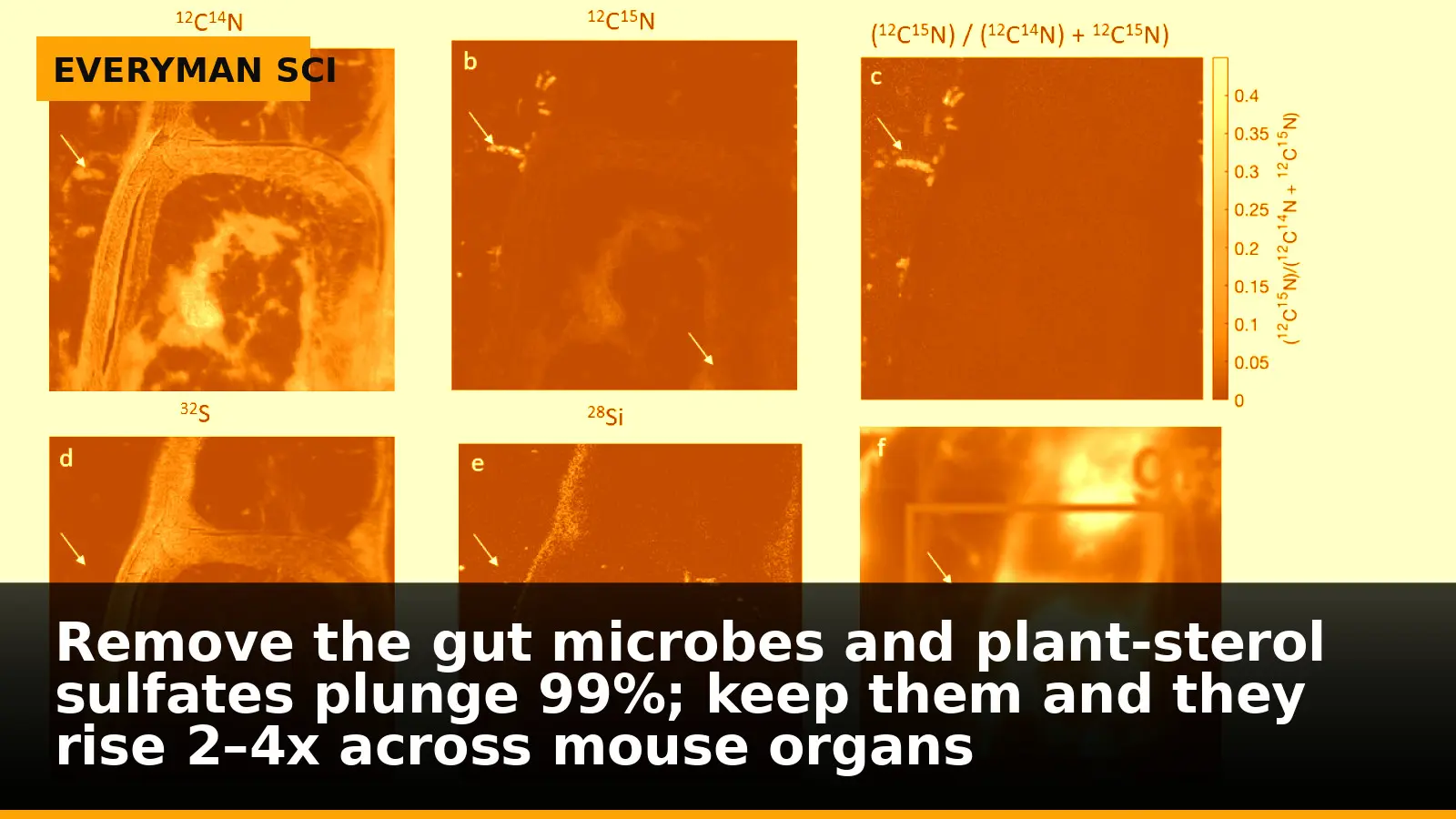
Remove the gut microbes and plant‑sterol sulfates plunge 99%; keep them and they rise 2–4x across mouse organs
You eat plant sterols in everyday foods like vegetable oils, nuts and seeds. Most of these cholesterol‑lookalikes never make it far — only about 5% enter the bloodstream and most are excreted. The question the researchers asked is simple: do gut microbes change that fate, and if so, what exactly ends up circulating around the body?
A research team from Keio University in Japan set out to trace whether gut bacteria turn dietary phytosterols into different, more mobile compounds — sulfated versions — and where those compounds go in the body.
Who did it, and where it appears
The work comes from a research team at Keio University and is published in iScience as “Microbiome‑dependent phytosterol sulfates production and tissue distribution in mice” (DOI: 10.1016/j.isci.2026.117883). The study links gut microbial activity to the production and distribution of phytosterol sulfates in mice, with related signals observed in human plasma lipidomics datasets.
What they actually measured and compared
To isolate the microbiome’s role, the team compared mice raised with a normal microbiota to germ‑free mice that lack gut microbes. They quantified sulfated phytosterols in feces and across multiple tissues. They also compared how efficiently a bacterial sulfotransferase enzyme produced a key metabolite — sitosterol sulfate (SIS) — versus the equivalent mouse and human enzymes, using a common reference reaction to normalize output.
Finally, they looked for age‑related shifts in these sulfated sterols across organs, asking whether levels rise as animals get older.
What changed — in hard numbers
When gut microbes were absent, the pipeline largely shut down. In germ‑free mice versus those with an intact microbiota, fecal levels fell by 98.2% for sitosterol sulfate (SIS) and 99.2% for stigmasterol sulfate. Two other sulfated sterols dropped as well: campesterol sulfate by 87.4% and coprostanol sulfate by 64.6%.
Inside the body, SIS was detectable across tissues, and its abundance tracked with the presence of microbes. SIS levels were more than twofold higher in mice with an intact microbiota than in germ‑free animals. With age, SIS rose two‑ to fourfold in the bone marrow, kidney, liver, lung, plasma and spleen. Several organs also showed age‑related increases for campesterol sulfate and stigmasterol sulfate.
On the enzyme bench, the bacterial catalyst outperformed the mammalian ones at making SIS. When cholesterol sulfate production was set to 100% as a common yardstick, relative SIS production was 51.6% for the bacterial enzyme, compared with 19.5% for the mouse enzyme and 11.4% for the human enzyme.
| Measure | Result |
|---|---|
| Fecal sitosterol sulfate (GF vs. microbiota-intact) | −98.2% |
| Fecal stigmasterol sulfate (GF vs. microbiota-intact) | −99.2% |
| Fecal campesterol sulfate (GF vs. microbiota-intact) | −87.4% |
| Fecal coprostanol sulfate (GF vs. microbiota-intact) | −64.6% |
| Tissue SIS (microbiota-intact vs. GF) | >2× higher |
| Age effect on SIS (selected organs) | 2–4× rise |
| Enzyme: bacterial SIS production (rel.) | 51.6% |
| Enzyme: mouse SIS production (rel.) | 19.5% |
| Enzyme: human SIS production (rel.) | 11.4% |
What that means in plain terms
Plant sterols are mostly poor travelers — only about 5% typically enter circulation — but gut microbes can bolt on a sulfate group that seems to change that. The sulfated versions appear widely in the body and tend to accumulate with age. Because most of these sulfates collapse toward zero in germ‑free mice, the microbiome is doing much of the chemistry.
The stronger SIS‑making performance of a bacterial enzyme compared with the mouse and human versions suggests that microbial genes can be leading players in this pathway, not just supporting actors. Put together, the results imply that which microbes you host could shape which phytosterol metabolites your body sees.
The deeper cut
Sulfation, transport, and why the enzyme numbers matter
Sulfotransferases generate sterol sulfates by transferring a sulfonate from PAPS (3′-phosphoadenosine-5′-phosphosulfate) to a hydroxyl on the sterol nucleus, increasing polarity and typically enhancing solubility. That chemical tweak often flips transport biology: organic anion transporters and certain ABC transporters handle sulfated lipids more readily than their unconjugated parents, affecting enterohepatic circulation and tissue exposure. Normalizing output to cholesterol sulfate=100% controls for assay context and donor substrate availability, so the reported 51.6% relative SIS production for the bacterial enzyme versus 19.5% (mouse) and 11.4% (human) indicates a roughly 2.6–4.5× advantage for the microbial catalyst on sitosterol under identical conditions. Mechanistically, that could arise from a larger or more permissive active-site pocket tolerating the C24 ethyl group of sitosterol. The age-associated 2–4× rise in SIS across marrow, liver, kidney, lung, plasma, and spleen is in the ballpark of changes one expects from either increased microbial flux (more substrate delivered as diet and microbiota shift) or reduced clearance via desulfation and biliary excretion. For lipidomics, the practical headache is isobaric interference among sterol sulfates; unambiguous assignment typically hinges on diagnostic sulfate neutral-loss and retention-time libraries, which is why cross-tissue comparisons benefit from consistent internal standards.
What’s not known — and what would settle it
The study does not establish whether accumulation of phytosterol sulfates is beneficial or harmful. The precise mechanisms behind how these sulfates cross the gut wall, distribute through the body and build up with age also remain unclear. Those answers will likely require transporter knockouts, tracer studies that follow labeled sterol sulfates, and intervention trials that modulate gut microbial composition.
For now, the findings provide a foundation for testing the physiological significance of phytosterol sulfates — from cholesterol handling to immune signaling — and for probing whether microbiome differences translate into distinct metabolite profiles.
Why this matters for diet and the microbiome
People consume phytosterols partly for their cholesterol‑lowering effects, but what the body actually encounters may depend on the microbes present in the gut. The Keio team’s results suggest that gut microbial composition may influence which sulfated metabolites form from dietary phytosterols — and where they end up.
That does not make sulfated sterols good or bad by default. It does make them measurable, microbiome‑linked travelers that reach organs far beyond the intestine, and that change with age — a concrete map for the next round of experiments.
The paper: Microbiome-dependent phytosterol sulfates production and tissue distribution in mice (iScience, 2026)
Sources: Researchers trace how gut microbes transform dietary plant sterols into circulating sulfated metabolites (phys.org)
Images: Cover: Everyman Science (illustration)
How this article was made: Everyman Science uses AI tools to structure, format and optimise its articles, and occasionally to produce illustrations where no free photograph exists. The reporting these articles are based on is human-produced and cited above. Spotted an error? Write to [email protected] and we will correct it. — The editors How we work.





Science desk team of Everyman Science, curating and reporting on the day’s most significant developments in research, space exploration, and technology.