Saturn draws a new shape: a 10‑sided wave circles the south pole
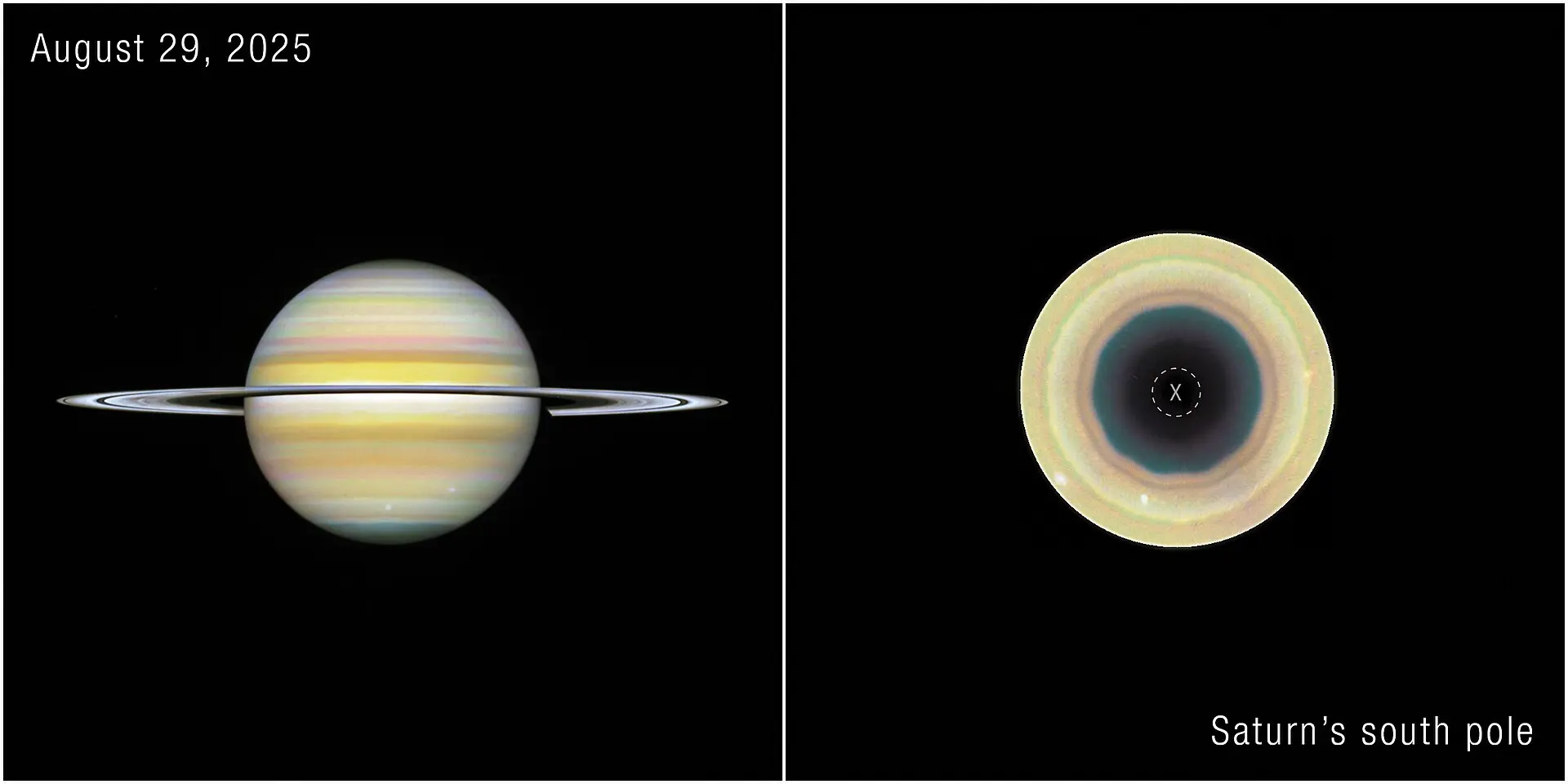
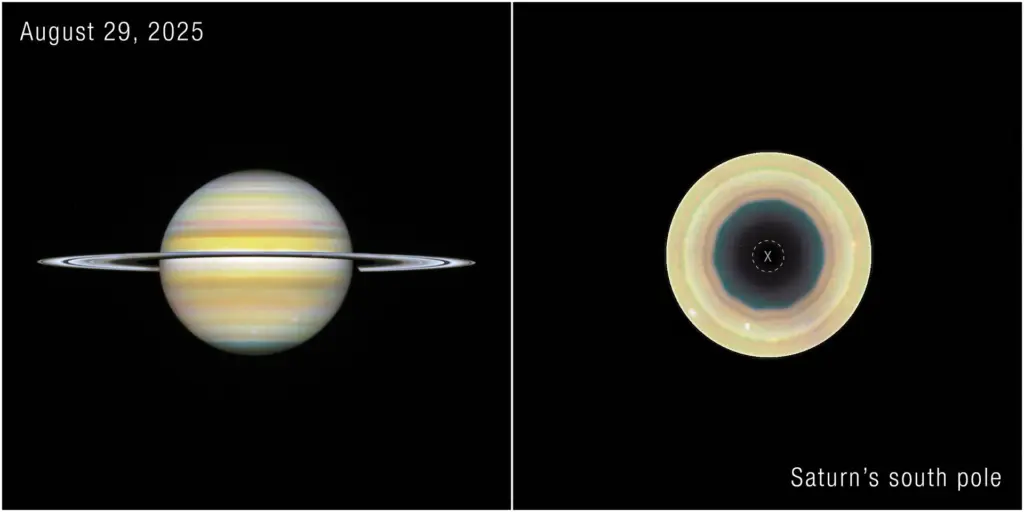
First came the hexagon. For more than 40 years, a six‑sided jet stream has persisted at Saturn’s north pole, as familiar to planetary scientists as the planet’s rings. Now Hubble has spotted a newcomer in the south: a giant, evolving 10‑sided atmospheric wave—the first large, regular‑sided jet pattern ever seen in Saturn’s southern hemisphere.
The study reporting the find, published Wednesday in Science Advances, does more than add a quirky polygon to Saturn’s repertoire. It sets up a natural experiment: two polar shapes, two hemispheres, and one question—how does a gas giant sculpt sharp‑edged geometry from flowing air?
By the numbers: how big, how fast, how long
The knowns are striking. The newly reported decagon is about 104,250 miles (167,820 kilometers) across, with each of its 10 sides measuring about 10,425 miles (16,782 km) in length, according to lead author Agustin Sanchez‑Lavega. It rotates slowly around the pole, taking about 800 days to circle Saturn. Amy Simon notes that its northern cousin, the hexagon, “has been there every time we’ve looked for more than 40 years.” That contrast—freshly forming in the south versus decades‑long persistence in the north—makes the comparison scientifically rich.
A southern first, and why that matters
Hubble’s images reveal the first large regular‑sided jet pattern in Saturn’s southern hemisphere. That alone resets the field’s priors: the hexagon is not a unique, singular feature. If both poles can host polygonal waves, models of Saturn’s jets and seasons must account for symmetry in principle and asymmetry in practice—why one shape endured for decades while the other is only now emerging.
Catching it in the act
Hubble didn’t just happen upon a static figure. The decagon appears to be evolving, and its apparent position shifts slightly in images. Those are precious clues, because they hint that the feature is not a one‑layer cloud trace but a structure with depth and time dependence. That makes long, steady monitoring indispensable.
Why Hubble, and why now
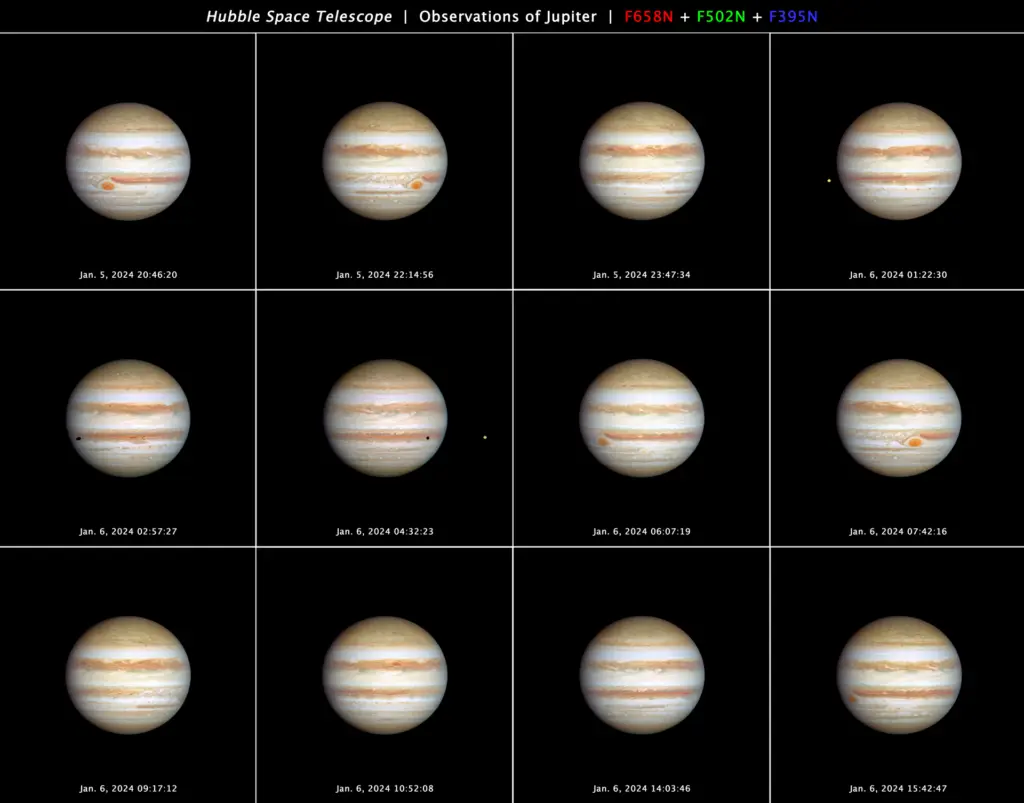
Hubble has been operating for more than three decades, and its OPAL (Outer Planet Atmospheres Legacy) program images the outer planets annually. Rather than delivering single snapshots, OPAL’s cadence lets scientists follow seasonal changes, track short‑lived storms, and identify atmospheric features that evolve slowly. That is exactly how hints of the decagon, seen in 2023 data and later, cohered into a clear, trackable pattern.
A season on the clock
Timing could matter. Solar radiation at the decagon’s latitude—around 60 degrees south—is increasing and will peak there in 2032, as Sanchez‑Lavega notes. If the feature is still settling into shape, that changing energy input offers a natural timeline to watch whether it strengthens, reshapes, or fades.
The deeper cut
Long baselines as an instrument
For gas‑giant weather, the most powerful “instrument” is often time. Hubble’s OPAL program turns the telescope into a climate observatory by fixing exposure, cadence, and processing so that year‑to‑year images can be meaningfully compared. That continuity matters because Saturn’s polar patterns evolve on scales of months to years: an 800‑day rotation period is too slow for opportunistic campaigns to catch phase changes or drift reliably. With consistent annual imaging, researchers can register features across apparitions, quantify their motion relative to the planet’s rotation, and separate genuine morphology changes from viewing geometry. The stability of Hubble’s point‑spread function and detector performance over more than three decades underpins those measurements; without it, subtle shifts in apparent position could be instrumental artifacts rather than atmospheric dynamics. In other words, OPAL’s discipline—same targets, same seasons, repeat—turns a general‑purpose observatory into a time‑domain laboratory for planetary meteorology.
What we don’t know yet
Two big unknowns hang over the decagon. First, how long it will last—Sanchez‑Lavega cautions it may still be evolving. Second, how closely it will resemble the northern hexagon in behavior once it settles, if it settles at all. Those answers are observational, not theoretical, and will come from watching it over the coming years.
How to compare without overreaching
Some comparisons are fair: size, rotation time, the simple fact of polygonal symmetry south and north. Others are not yet grounded. The decagon’s slight positional shifts are established, but why they occur, or exactly how deep the structure runs, is not pinned down here. Keeping the comparisons to what’s measured prevents us from turning an intriguing wave into a premature one‑to‑one with the hexagon.
The next decisive snapshots
Because OPAL is designed to track slowly evolving features, it is tailor‑made for this chase. As solar radiation climbs toward its 2032 peak near 60°S, each annual pass will test whether the decagon stabilizes or transforms. And every additional year that the northern hexagon keeps its decades‑long vigil sharpens the contrast with whatever story the south has begun to tell.
The paper: A decagon wave around Saturn’s south pole (Science Advances, 2026)
Sources: Hubble tracks new decagon encircling Saturn’s south pole (www.esa.int); NASA’s Hubble Tracks New Decagon Encircling Saturn’s South Pole (www.nasa.gov); Astronomers discover mysterious 10-sided cloud structure at Saturn's south pole (www.space.com); Saturn has a big, weird decagon around its south pole (www.newscientist.com)
Images: Cover: NASA, ESA, STScI, A. Sánchez-Lavega (University of the Basque Country), A. Simon / Wikimedia Commons (CC BY 4.0); Figure 1: NASA, ESA, STScI, A. Sánchez-Lavega (University of the Basque Country), A. Simon / Wikimedia Commons (CC BY 4.0); Figure 2: Science Amy Simon (NASA-GSFC) Image NASA, ESA, Joseph DePasquale (STScI) / Wikimedia Commons
How this article was made: Everyman Science uses AI tools to structure, format and optimise its articles, and occasionally to produce illustrations where no free photograph exists. The reporting these articles are based on is human-produced and cited above. Spotted an error? Write to [email protected] and we will correct it. — The editors How we work.





Science desk team of Everyman Science, curating and reporting on the day’s most significant developments in research, space exploration, and technology.