James Webb Space Telescope Unveils Secrets of the Lion Nebula
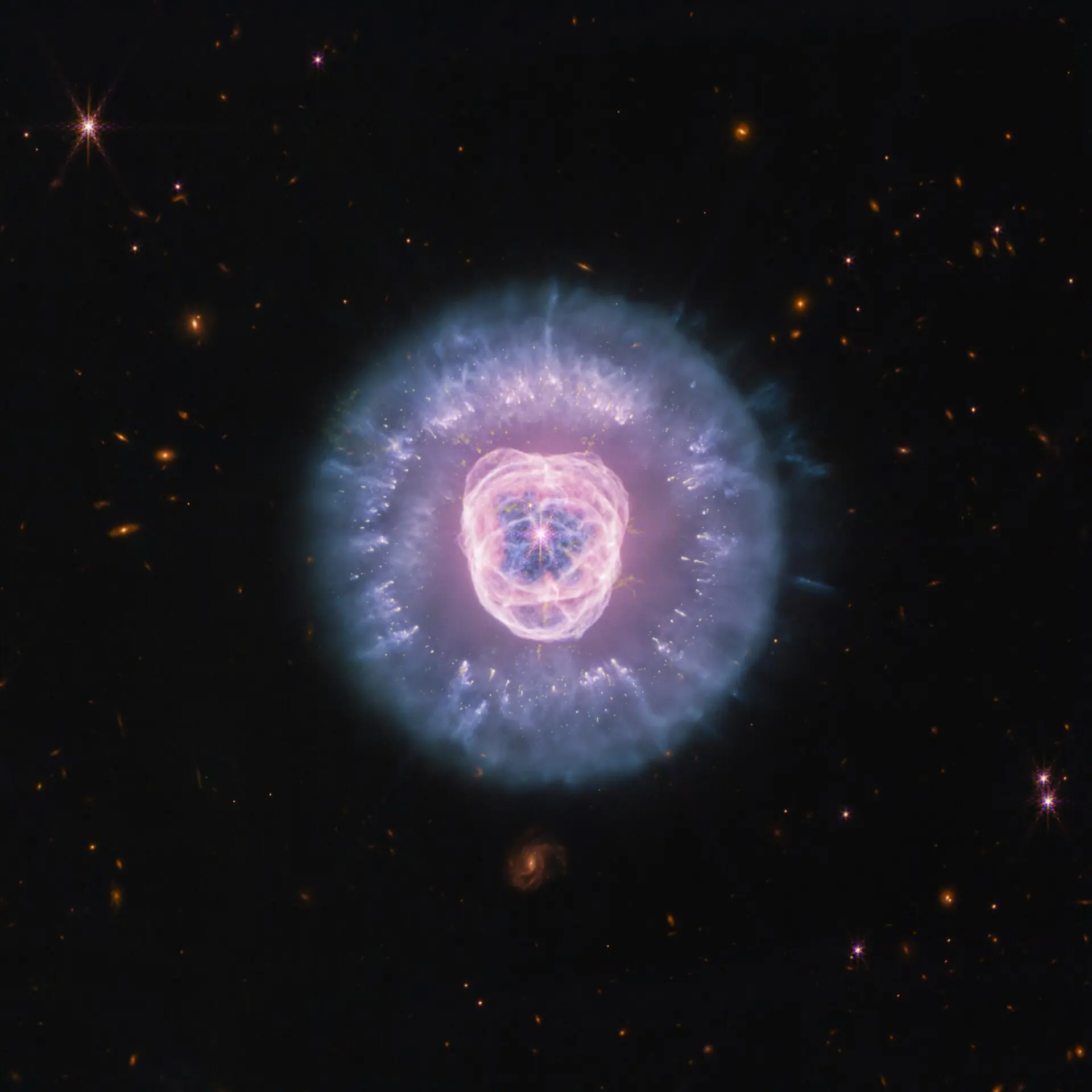
In the vast expanse of space, where stars are born and die, the Lion Nebula stands as a testament to the cosmic cycle of life and death. Recently, the James Webb Space Telescope (JWST) captured a breathtaking new view of this celestial wonder, revealing details that were previously hidden from view. The nebula, known formally as NGC 2392, is a planetary nebula formed by the remnants of a dying Sun-like star. Its lion-like visage, complete with a mane of dusty clumps, has captivated astronomers and stargazers alike.
The Lion Nebula: A Cosmic Sculptor's Workshop
The Lion Nebula, located approximately 5,000 light-years away in the constellation Gemini, offers a glimpse into the final stages of stellar evolution. As a star exhausts its nuclear fuel, it expels its outer layers into space, creating a shell of gas and dust. This process leaves behind a hot core, known as a white dwarf, which emits intense ultraviolet radiation that illuminates the surrounding material.
Webb’s infrared capabilities have allowed astronomers to peer through the nebula’s dusty veil, highlighting features that were obscured in visible light. The telescope’s Near Infrared Camera (NIRCam) and Mid-Infrared Instrument (MIRI) have revealed compact clumps of dust and ionized gas, providing new insights into the nebula’s structure and composition. These observations are crucial for understanding the physical processes that shape such cosmic sculptures.
Infrared Insights: Unveiling Hidden Structures
Unlike the Hubble Space Telescope, which captured visible-light images of the Lion Nebula in 2000, Webb’s infrared instruments offer a different perspective. Infrared light can penetrate dust clouds that block visible light, allowing astronomers to see deeper into the nebula’s core. This capability has unveiled a more intricate and detailed view of the nebula’s structure, including the dense knots of gas and dust that form its “mane.”
These dense regions are of particular interest because they can serve as sites for future star formation. By studying the distribution and composition of these knots, scientists hope to gain a better understanding of how stars and planetary systems form from the remnants of dying stars. The detailed images provided by Webb are a valuable tool for astronomers seeking to unravel these cosmic mysteries.
The Role of Dying Stars in Cosmic Recycling
Planetary nebulas like the Lion Nebula play a vital role in the cosmic cycle of matter. As stars shed their outer layers, they enrich the interstellar medium with heavy elements such as carbon, nitrogen, and oxygen. These elements are essential building blocks for new stars, planets, and ultimately, life itself.
The intricate structures observed in the Lion Nebula are a testament to the complex interactions between radiation and matter in space. The intense radiation from the central white dwarf shapes the surrounding gas and dust, creating the striking patterns seen in Webb’s images. Understanding these processes helps astronomers piece together the lifecycle of stars and the evolution of galaxies.
Webb's Continuing Journey: Expanding Our Cosmic Horizons
The James Webb Space Telescope’s observations of the Lion Nebula are just one example of its transformative impact on astronomy. Since its launch, Webb has provided stunning images and data that have expanded our understanding of the universe. From distant galaxies to nearby star-forming regions, Webb’s infrared eyes are uncovering the hidden workings of the cosmos.
As Webb continues its mission, astronomers eagerly anticipate more discoveries that will challenge our understanding of the universe. Each new image and dataset brings us closer to answering fundamental questions about the origins of stars, planets, and life itself. The Lion Nebula, with its majestic beauty and complex structure, is a reminder of the wonders that await us in the vastness of space.
Looking Ahead: The Future of Space Exploration
The success of the James Webb Space Telescope highlights the importance of continued investment in space exploration and technology. As we push the boundaries of what is possible, new missions and telescopes will build on Webb’s legacy, providing even deeper insights into the universe.
Future projects, such as the Nancy Grace Roman Space Telescope and the European Space Agency’s ARIEL mission, promise to further our understanding of exoplanets and the conditions necessary for life. These missions, along with Webb’s ongoing observations, will help us answer age-old questions about our place in the cosmos and the potential for life beyond Earth.
Sources: NASA, ESA, phys.org
Images: Cover: Image: NASA, ESA, CSA, STScI; Image Processing: Alyssa Pagan (STScI) / Wikimedia Commons





Science desk team of Everyman Science, curating and reporting on the day’s most significant developments in research, space exploration, and technology.