
Remove one gene, and malaria can’t make transmissible forms
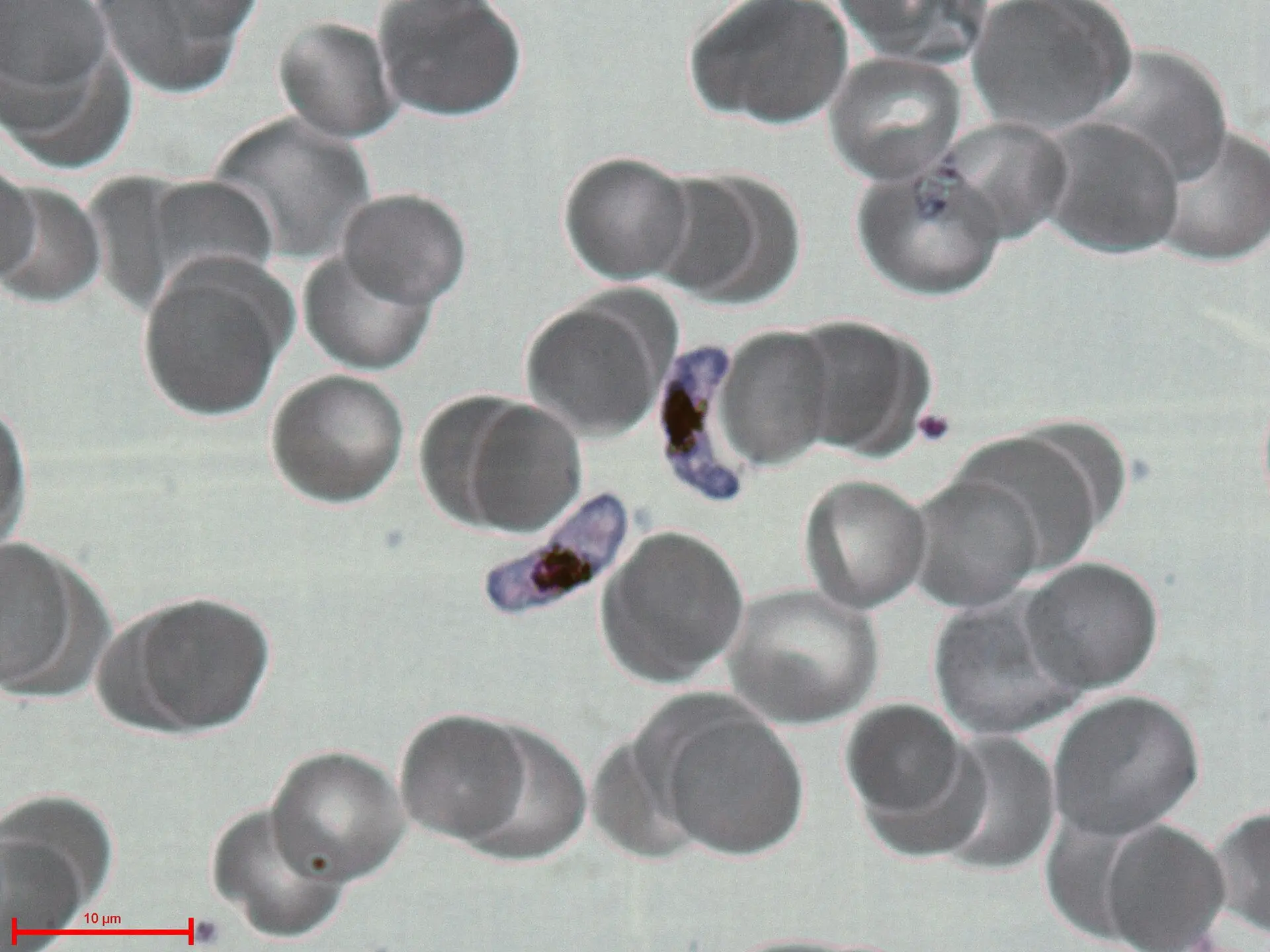
Why does the malaria parasite decide to stop multiplying in your blood and start making the sexual forms mosquitoes can pick up? And how, exactly, does a bout of fever or a lean spell of nutrients push it to make that switch?
A new study in Nature Microbiology maps the control system behind that decision in Plasmodium falciparum. It finds a stress-sensing hub and a built‑in brake that together steer the parasite toward gametocytes—the transmissible forms—when conditions turn hostile.
The life‑or‑transmit dilemma, stated plainly
Inside human blood, P. falciparum faces a fork in the road: multiply to keep the current infection going, or commit some of its population to become gametocytes that can be transmitted to a mosquito [c1][c2]. The parasite can detect changes in its host’s environment—fever or shortages of specific nutrients—and bias this choice, and nutrient limitation in particular is known to promote gametocyte production [c3][c4].
Who did this and where it appeared
Researchers report in Nature Microbiology that they have identified the molecular mechanism connecting environmental stress to sexual conversion in P. falciparum [c12]. In the paper, Elisabet Tintó and colleagues describe a single regulatory pathway switched on by varied stressors, and Alfred Cortés notes the work helps close a long‑standing gap in malaria biology—how the parasite adapts its life cycle to a changing environment to produce transmissible forms [c7][c11].
How they probed the parasite’s decision machinery
The team combined genomics, epigenomics, transcriptomics, proteomics and genetic engineering to watch and manipulate the parasite’s response [c5]. They exposed parasites separately to three stress conditions: nutrient limitation, treatment with the antimalarial drug dihydroartemisinin (DHA), and a simulated fever episode [c6].
Across these conditions they tracked which components of the regulatory system turned on and what happened when specific regulators were deleted or altered. The comparison across distinct stresses is the key methodological move: it lets you see what is common to “being under stress,” rather than what is peculiar to one kind of insult.
One pathway, one hub, and a safety brake
All three stimuli—nutrient limitation, DHA, and fever—activated the same regulatory pathway, producing similar downstream changes, according to first author Elisabet Tintó [c7]. At the core of that pathway is AP2‑HS, a protein that regulates gene expression and acts as a control hub enabling the parasite to respond to different types of stress [c15].
AP2‑HS does two crucial things at once: it activates GDV1 expression to kick off gametocyte production, and it also turns on other stress‑survival mechanisms [c13][c14]. Meanwhile, GDV1 itself triggers conversion into gametocytes while simultaneously inducing an antisense RNA, gdv1‑as, that represses GDV1—a feedback loop that lets the parasite respond quickly but avoid leaving GDV1 stuck “on” [c8].
What happens when the hub is removed
The most striking test was genetic deletion. “When we deleted the ap2‑hs gene, the parasites completely lost their ability to develop into gametocytes, even under stressful conditions such as fever, DHA treatment or nutrient limitation,” Tintó reports [c9]. And in the rare cases where gametocyte development started, “the few gametocytes that began to develop failed to become viable” [c10].
Functionally, that pins AP2‑HS as necessary for stress‑induced transmission readiness: without it, the stress signals no longer translate into a transmissible form, and even partial attempts fizzle.
| Element | Detail |
|---|---|
| Stressors tested | Nutrient limitation; DHA treatment; simulated fever [c6] |
| Common response | All three activated the same regulatory pathway [c7] |
| Central regulator | AP2‑HS acts as the control hub [c15] |
| Trigger for gametocytes | AP2‑HS activates GDV1 expression [c13] |
| Feedback brake | GDV1 induces gdv1‑as, which represses GDV1 [c8] |
| Other roles of AP2‑HS | Activates other stress‑survival mechanisms [c14] |
| Gene deletion test | Deleting ap2‑hs abolished gametocyte development; rare starters were non‑viable [c9][c10] |
What the numbers do and don’t say
The reported findings are qualitative but decisive: same pathway on three different stresses; AP2‑HS required; GDV1 with a negative feedback via gdv1‑as [c7][c8][c9][c10][c13][c15]. The account does not specify sample sizes, effect magnitudes, time‑to‑response, or error bars for these assays. That means we know the direction and structure of the response, but not its kinetics or strength.
The deeper cut
Negative feedback in gene‑switches: why GDV1 needs a brake
In developmental switches, a fast “go” signal without a brake is dangerous: it risks runaway expression and pleiotropic damage. The GDV1/gdv1‑as pair is a textbook negative feedback motif adapted to Plasmodium’s life‑history bet‑hedging. AP2‑HS activates GDV1 to initiate sexual conversion; GDV1 in turn drives production of gdv1‑as, an antisense RNA that represses GDV1. The immediate consequence is a transient GDV1 pulse: high enough to flip the downstream commitment circuitry, but self‑limiting so the system returns to baseline once the decision is made. Across gene networks, such negative feedback reduces overshoot and shortens settling time; it also buffers against variable input amplitude—in this case, the intensity of stress from fever, DHA exposure, or nutrient limitation. The placement of AP2‑HS upstream of both transmission commitment (via GDV1) and other stress‑survival programs explains how a single hub can coordinate mutually compatible responses: a subset of parasites commits to gametocytogenesis while the rest upregulate survival pathways, maximizing population‑level fitness under stress.
Why this matters for malaria biology
This work helps answer a question that had remained unresolved for years: how P. falciparum connects environmental stress to the decision to produce transmissible forms [c11]. By locating a control hub (AP2‑HS) and a self‑limiting trigger (GDV1 with gdv1‑as), the study ties together long‑observed phenomena—fever and nutrient shortages biasing toward gametocytes—with specific molecular levers [c3][c4][c13][c15].
![Under stress such as fever or nutrient limitation, P. falciparum increases production of gametocytes—the sexual forms transmissible to mosquitoes [c2][c3][c4].](https://www.everymansci.com/wp-content/uploads/2026/09/1920px-المتصورة_المنجلية-965x1024.webp)
Limits and the next questions to ask
What we don’t yet see from this account are the quantitative details: how quickly AP2‑HS turns on after a fever‑like heat pulse, what fraction of parasites commit under each stress, or how strongly other stress‑survival programs are induced. We also don’t have the experiment‑by‑experiment sample sizes or statistical confidence that would let readers weigh robustness across methods. Those are the obvious next data to look for in the full paper or in follow‑ups: kinetics, dose‑response, and population‑level consequences of perturbing AP2‑HS or the GDV1/gdv1‑as brake.
The paper: AP2-HS and a GDV1 regulatory feedback loop mediate environmental induction of sexual conversion in Plasmodium falciparum (Nature Microbiology, 2026)
Sources: How the malaria parasite boosts its transmission potential under stress conditions (phys.org)
Images: Cover: Stefan Walkowski / Wikimedia Commons (CC BY-SA 4.0); Figure 1: Yacine Er / Wikimedia Commons (CC BY 4.0)
How this article was made: Everyman Science uses AI tools to structure, format and optimise its articles, and occasionally to produce illustrations where no free photograph exists. The reporting these articles are based on is human-produced and cited above. Spotted an error? Write to [email protected] and we will correct it. — The editors How we work.





Science desk team of Everyman Science, curating and reporting on the day’s most significant developments in research, space exploration, and technology.