In 4,000 protein pairs, human cells break them down more slowly than mouse cells
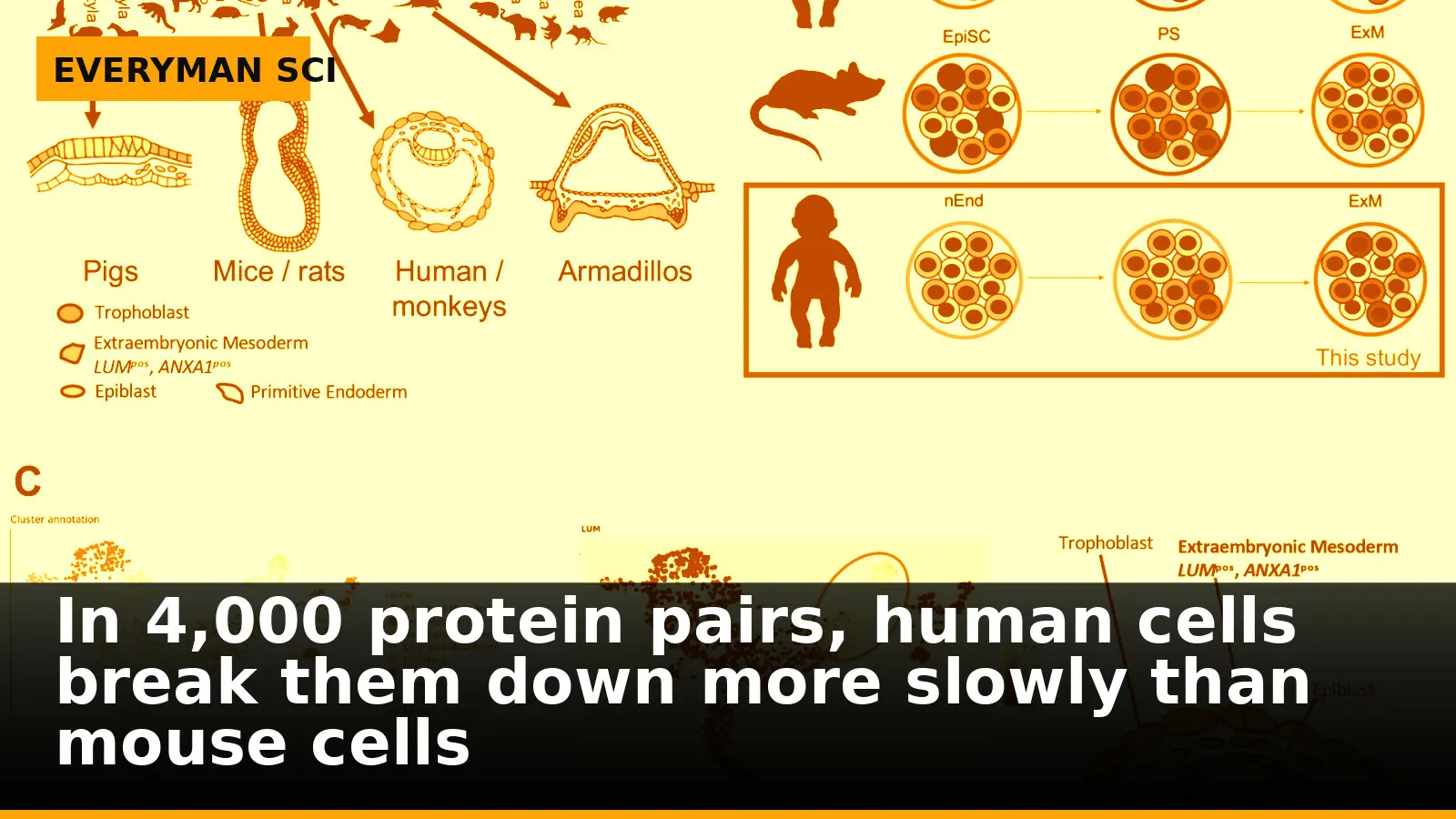
Why do human embryos tick more slowly than mouse embryos? The authors of a new study went after one concrete piece of that puzzle: whether human cells break down their proteins at a different pace than mouse cells do.
They asked a simple, testable version of the question. Across thousands of matching genes in the two species, are the proteins they encode cleared away faster in mice than in humans?
Who did this and where it appears
Researchers from the Ebisuya Group at EMBL Barcelona and PoL‑TU Dresden, together with the Savitski Team at EMBL Heidelberg, report that human cells, on average, degrade proteins more slowly than mouse cells. The work is published in Developmental Cell as “Systematic differences in protein stability underlie species‑specific developmental tempo” (Mitsuhiro Matsuda et al.; DOI: 10.1016/j.devcel.2026.07.012). We refer to it below as the study finding slower protein degradation in humans.
What they actually measured
The study compared degradation rates for about 4,000 human genes with corresponding mouse counterparts. In practical terms, that means looking at thousands of proteins that exist in both species and asking, protein by protein, how long they persist before cells recycle them. The team then tallied the direction of the difference across the set: whether a given protein tended to last longer in human cells or in mouse cells.
This built on prior work from the same group on a single developmental gene, HES7, whose protein is known to degrade more slowly in human cells than in mouse cells. Here, the question was whether that single‑gene result generalizes across the proteome—the full set of proteins in a cell.
The result, with numbers that matter
Across roughly 4,000 proteins shared between humans and mice, there was a clear overall tendency for proteins to persist longer in human cells than in mouse cells. Not every protein followed this pattern—some were degraded more slowly in mouse cells—but the overall tilt was unambiguous in the direction of slower human degradation.
Crucially, that trend held regardless of the route cells used to dispose of proteins. Whether turnover involved the proteasome or the lysosome, the slower pace in human cells still showed up. In the words of group leader Miki Ebisuya, slower protein degradation “is a general feature across the proteome,” not a quirk of one protein family or cellular compartment.
Poking the system: metabolism sets the tempo
The team then asked what might drive the cross‑species gap. When they reduced metabolic activity in mouse cells, protein degradation slowed, and the cells adopted a degradation and developmental speed that resembled that of human cells. From those perturbations, the authors identify metabolism as a key regulator of protein turnover.
That link from metabolism to turnover matters for development: protein degradation contributes to the pace of the embryo’s segmentation clock, and a slower clock is one reason human development proceeds more slowly than in mice.
| Aspect | Detail |
|---|---|
| Scope of comparison | About 4,000 human genes with mouse counterparts analyzed (across ~4,000 shared proteins) |
| Main pattern | Clear tendency: proteins degrade more slowly in human cells than in mouse cells |
| Single‑gene precedent | HES7 protein previously shown to degrade more slowly in human cells than in mouse cells |
| Pathways checked | Trend holds regardless of proteasome vs lysosome routes |
| Perturbation test | Reducing metabolic activity in mouse cells slows protein degradation |
| Interpretation | Metabolism identified as a key regulator of protein turnover |
| Publication | Developmental Cell; DOI 10.1016/j.devcel.2026.07.012 |
Method, in plain terms
This was a cross‑species, protein‑by‑protein rate comparison across a large matched set—about 4,000 human genes with mouse counterparts. The authors then checked whether the observed differences depended on which cellular degradation machinery was involved (proteasome versus lysosome). Finally, they dialed down metabolic activity in mouse cells and watched how protein turnover and developmental speed shifted.
The study does not specify here the exact assays or time windows used to estimate individual degradation rates, but the design lets you judge the logic: measure many matched proteins, sort by whether human or mouse is slower, and then see if changing metabolism moves the mouse toward the human pattern.
The deeper cut
Why a slower breakdown slows a clock
Protein degradation rates set timescales in many gene regulatory circuits because they define how quickly a signal decays. If a transcriptional oscillator’s negative feedback depends on a repressor protein, the period typically lengthens when that repressor is cleared more slowly: its lifetime stretches the delay between production and relief from repression. So a proteome‑wide shift toward longer protein lifetimes in human cells would be expected to bias oscillatory developmental processes toward longer periods. That is why HES7—previously shown by this group to degrade more slowly in human cells—was an attractive starting point: it is a core component of the segmentation clock’s feedback loop. The generalization to thousands of proteins makes the argument less about a single molecular bottleneck and more about a global kinetic regime. Metabolism then enters as a master knob because widespread turnover reactions are energetically coupled; reducing metabolic activity nudges many decay processes in the same direction, coherently stretching the system’s characteristic times.
Limits and what’s still unknown
The analysis covers about 4,000 matched human–mouse proteins, not every protein either species makes. Some proteins ran counter to the main trend, degrading more slowly in mouse cells; the study does not list which ones here. The precise magnitude of the human–mouse difference for any given protein, the full distribution of effect sizes, and the exact measurement methods and time scales are not specified here.
The metabolism experiments point to a regulator, but they do not by themselves identify which metabolic pathways matter most or how broadly the effect holds across cell types and conditions. Obvious next steps include mapping which proteins buck the trend and pinning down the metabolic levers with finer resolution.
Why this matters, without overclaiming
If protein degradation generally runs slower in human cells than in mouse cells, that provides a simple, unifying kinetic reason for why human developmental processes take more time. The finding ties a species‑level difference to a basic cellular parameter and shows that nudging metabolism can shift that parameter in predictable ways.
That won’t turn mice into humans. But it does give developmental biologists—and anyone comparing disease models across species—a clearer expectation: the same protein can live longer in a human cell, and that alone can stretch the tempo of a whole program.
The paper: Systematic differences in protein stability underlie species-specific developmental tempo (Developmental Cell, 2026)
Sources: Protein degradation rate helps explain why humans develop more slowly than mice (phys.org)
Images: Cover: Everyman Science (illustration)
How this article was made: Everyman Science uses AI tools to structure, format and optimise its articles, and occasionally to produce illustrations where no free photograph exists. The reporting these articles are based on is human-produced and cited above. Spotted an error? Write to [email protected] and we will correct it. — The editors How we work.





Science desk team of Everyman Science, curating and reporting on the day’s most significant developments in research, space exploration, and technology.