When a metropolis starves its streams
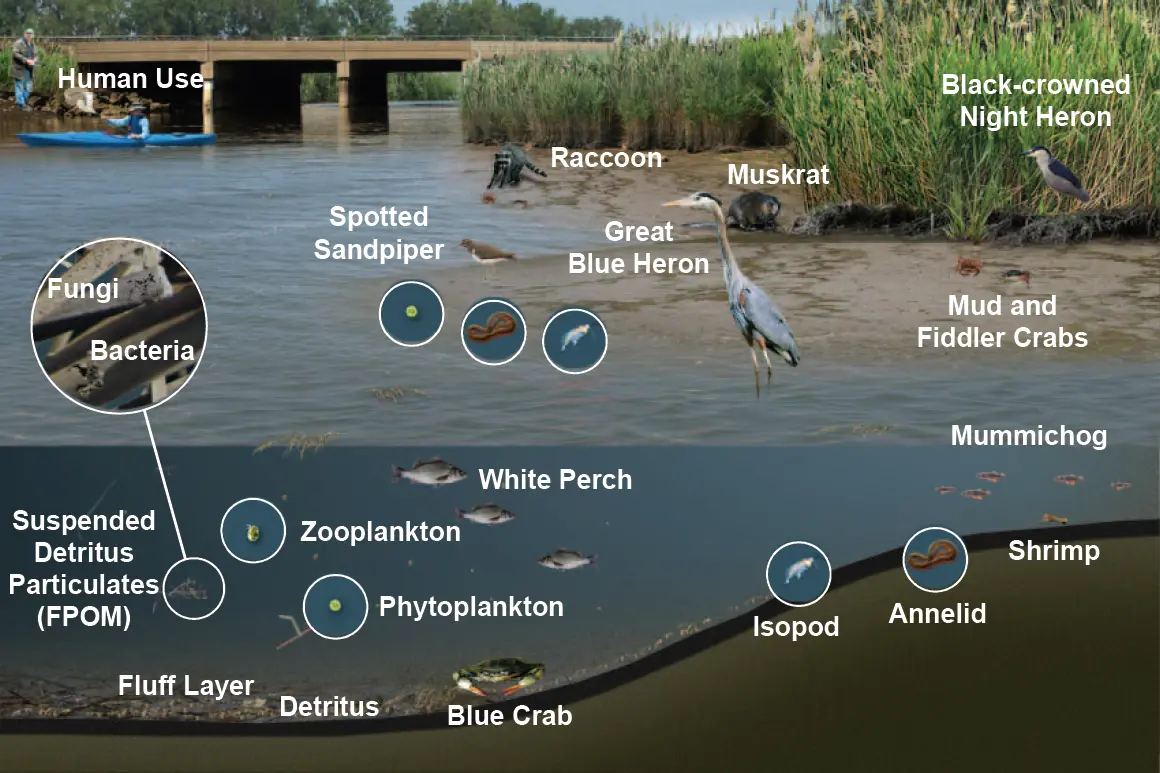
Picture a tangled streamside world where insects, fish and microbes weave energy through hundreds of feeding links. Now pull out thread after thread until almost nothing holds. In the space of a few steps from forest to pavement, a metropolis has done exactly that: networks of roughly 190 connections have been pared back to just three.
That stark contraction is not a metaphor. In an analysis published in August in Nature Cities, researchers report that the impact of the metropolis goes far beyond a simple reduction in species. Urban expansion has driven a collapse of food webs in local streams—and with it, a breakdown of what those waters do for the people who rely on them.
A food web cut to ribbons
Food webs are the maps of who eats whom. In the study’s reconstruction, the complexity of those maps plummeted: from about 190 estimated interactions in fully forested catchments to only three in fully urbanized areas, as described by researcher Luis Schiesari. With fewer connections, less energy circulates. The team found the flow of energy in these ecosystems was reduced by more than a thousandfold.
They went further and put a number to it: a 1,446‑fold reduction in energy flow among communities in the most affected streams compared to forested ones. When that much transfer is lost, whole pathways for processing organic matter and contaminants vanish with it.
Not just fewer species—smaller ones
Crucially, the loss wasn’t random. The analysis found that urban environments favored only small organisms, while very small, medium‑sized and large ones were eliminated. Because body size determines an animal’s resource needs and its likely predators and prey, this selective pruning snaps the very rungs that hold up higher‑order interactions.
Once those sizes drop out, predators that depended on them lose both meals and the stabilizing web of alternate links. What remains is a narrow set of small species exchanging energy across just a few routes—streams that look alive on the surface but function like a stripped‑down machine with missing gears.
Collapse begins early, not late
Urbanization’s ecological damage did not wait for full build‑out. According to Schiesari, degradation occurs right from the earliest stages of urbanization rather than gradually. That finding flips a common planning instinct—to add protections only once development is dense—on its head.
Early encroachment can trigger a slide that is hard to reverse because lost interactions don’t simply spring back when a single pressure eases. By the time a stream’s web has been pared to a few links, there is little redundancy left to absorb shocks.
Why this matters for 22 million people
Streams are not just channels; they are processing plants. The study found that with energy flow throttled, streams lose their ability to perform critical environmental services, including breaking down and neutralizing toxic pollutants. Those services knit together across watersheds to protect the quality of the water that supplies more than 22 million residents in the region.
When the web is simplified, matter moves faster through fewer pathways, and incomplete processing means more contaminants continue downstream. What looks like a small ecological loss upstream can register as a very human problem at the tap.
The deeper cut
How do you count a 1,446‑fold drop?
Energy flow in a food web is book‑kept by trophic transfers: the rate at which biomass (and the chemical energy it stores) moves from prey to predator. If you know which size classes interact and how often, you can map a network and sum the fluxes along its links. In a richly connected web—on the order of 190 interactions—energy is partitioned across many predator–prey pairs, with multiple, partially redundant pathways that lengthen residence times for organic matter. Remove size classes and you erase whole bundles of edges. A web with only three interactions does not just have fewer lines; it has almost no alternative routes. That combinatorial thinning collapses throughput because each surviving link saturates quickly: fewer predators can process only so much prey per unit time, and the loss of mid‑sized consumers truncates the classic size‑structured cascade that drives efficient transfer. The 1,446× figure is the ratio of aggregated fluxes between the most urbanized and forested ends of that spectrum. It encodes both the count of links and their per‑link contribution—showing that the step change comes as much from network topology as from any single species’ decline.
Repairing function, not just the view
What to do with a stream whose web has collapsed? Victor Saito argues that restoration must reestablish ecological processes. In his view, restoring a stream doesn’t just mean improving its appearance or the quality of the water; it means bringing back the conditions for biodiversity, ecological interactions and energy flows to function again.
That is a higher bar than tidying banks. It implies rebuilding size structure and interactions, not simply adding species names to a list. The study itself brought together scientists from São Paulo State University (UNESP), the State University of Campinas (UNICAMP), the Federal University of ABC (UFABC) and the University of Canterbury in New Zealand—an indication that fixing function will demand the same kind of cross‑disciplinary work that revealed how it was lost.
An urban planning problem wearing waders
If the collapse begins early and strips out function, the planning lever is timing. Safeguards need to be in place before the first lots are paved, not waiting for a threshold that never safely arrives. As the study’s findings make plain, this is as much about how cities grow as it is about what species remain.
Protecting stream function protects people. When streams can no longer process pollutants, the effects do not stay tucked in headwaters; they propagate. The message is simple and, for a city built on water, urgent: keep the web intact, or be prepared to build what it once did for free.
The paper: Urban expansion and the collapse of tropical stream ecosystems (Nature Cities, 2026)
Sources: Urban expansion causes ecological collapse in streams in the São Paulo Metropolitan Area (phys.org)
Images: Cover: EPA / Wikimedia Commons
How this article was made: Everyman Science uses AI tools to structure, format and optimise its articles, and occasionally to produce illustrations where no free photograph exists. The reporting these articles are based on is human-produced and cited above. Spotted an error? Write to [email protected] and we will correct it. — The editors How we work.





Science desk team of Everyman Science, curating and reporting on the day’s most significant developments in research, space exploration, and technology.