The Fastest Star in the Milky Way: A Cosmic Sprint Around Sagittarius A*
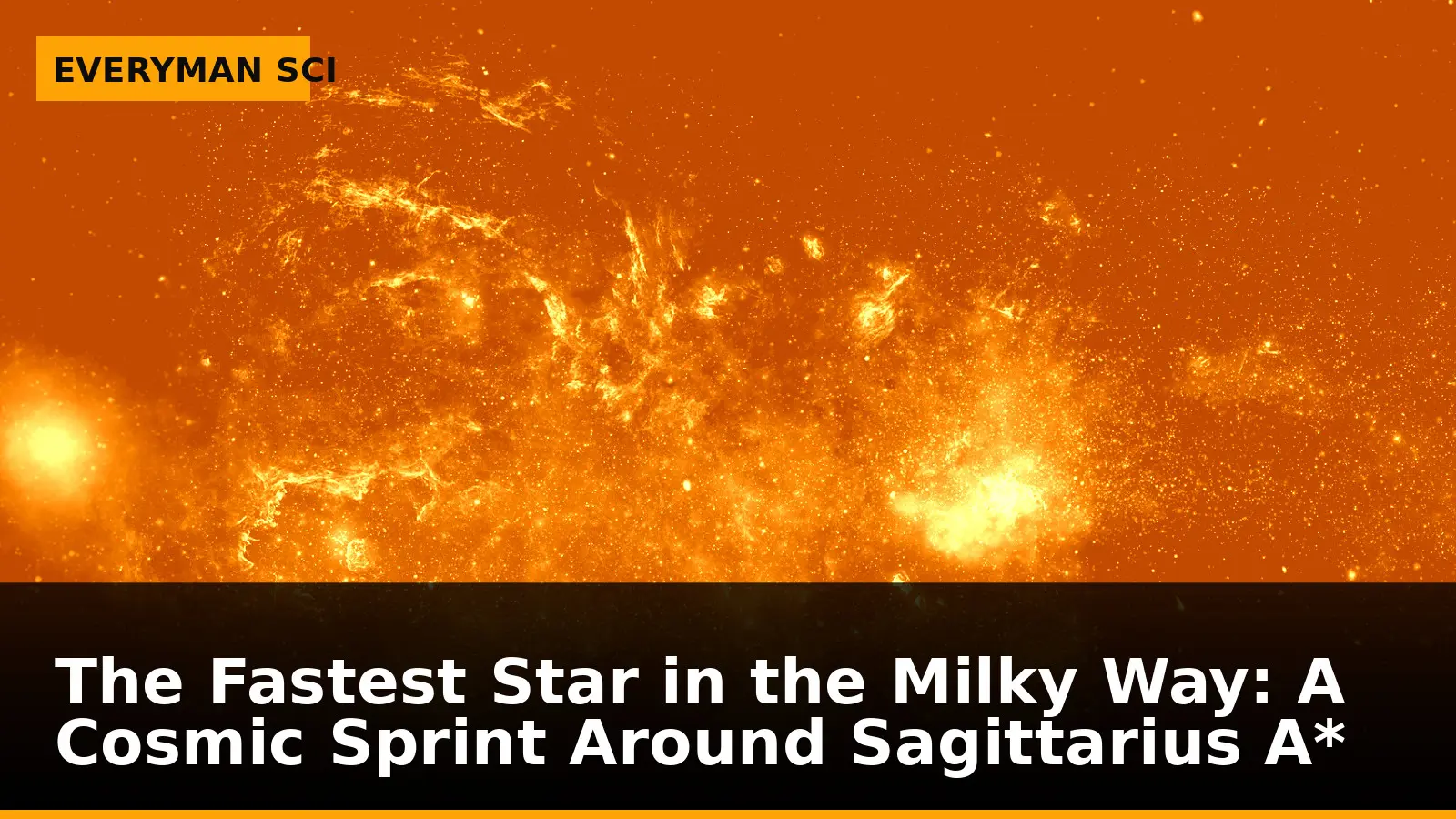
In the vast expanse of the Milky Way, where billions of stars twinkle against the backdrop of space, one star has recently captured the attention of astronomers for its astonishing speed. Named S301, this faint star zips around Sagittarius A*, the supermassive black hole at the heart of our galaxy, at an eye-popping speed of 15,500 miles per second—over 8% the speed of light. Its rapid orbit, completing a full revolution every 8.7 years, provides a unique opportunity to study the gravitational forces at play near one of the most enigmatic objects in our universe.
A Stellar Discovery: The Significance of S301
The discovery of S301 was reported on August 19, 2026, and it marks a significant milestone in our understanding of how stars interact with black holes. This star’s orbit brings it perilously close to Sagittarius A*, at a distance of merely 12 times that of the Earth to the Sun. Such proximity allows astronomers to observe phenomena that are otherwise difficult to study, including the effects of extreme gravitational forces on stellar dynamics.
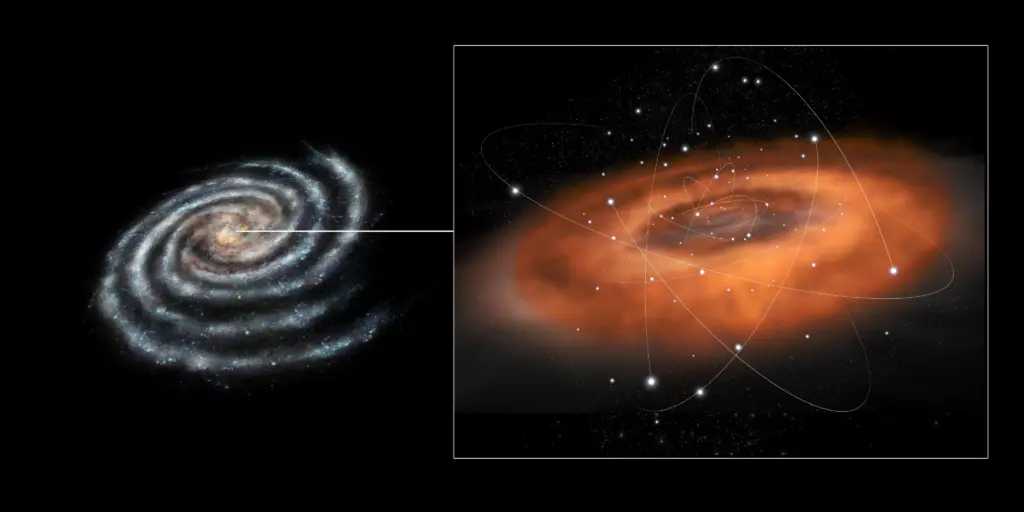
The implications of studying S301 extend beyond mere curiosity. As it orbits the black hole, the star’s behavior can provide insights into the nature of gravity itself, particularly in the context of Einstein’s theory of General Relativity. Observations of S301 and its trajectory can help scientists refine their models of how gravity operates in the intense environments surrounding supermassive black holes.
Understanding the Cosmic Dance: How Stars Interact with Black Holes
Stars like S301 are not unique; many others share similar fates as they spiral around supermassive black holes. However, what sets S301 apart is its extraordinary speed and tight orbit. The gravitational pull from Sagittarius A* creates a dynamic environment where stars can reach incredible velocities. This star’s rapid motion is a vivid illustration of how black holes influence the motion of nearby celestial bodies.
Astronomers utilize advanced observational techniques, including high-resolution imaging and spectroscopy, to track the star’s path and measure its speed accurately. These observations are critical for testing the predictions of General Relativity in extreme conditions, providing a unique laboratory for physicists.
The Role of Frame Dragging: Probing General Relativity
One fascinating aspect of S301’s orbit is the phenomenon known as frame dragging. This occurs when a massive object, like a rotating black hole, drags spacetime around with it. As S301 orbits Sagittarius A*, it experiences these effects, which could lead to observable consequences in its motion. Understanding frame dragging not only enhances our knowledge of black holes but also tests the limits of our understanding of gravity.
The observations of S301 could provide evidence for or against various theories of gravity, including modifications to General Relativity. As scientists gather more data, they hope to uncover whether the star’s behavior aligns with current predictions or if new physics is at play.
What's Next for Stellar Research?
The discovery of S301 opens up new avenues for research in astrophysics. Future observations will focus on monitoring this star’s orbit closely, allowing scientists to refine their measurements and deepen their understanding of the forces at work in the vicinity of Sagittarius A*. Furthermore, as technology advances, astronomers will be able to explore even fainter stars and their interactions with black holes, expanding our cosmic knowledge.
The study of stars like S301 not only enriches our understanding of the Milky Way but also contributes to the broader quest to comprehend the universe’s most mysterious phenomena. Each new discovery brings us closer to unraveling the complex tapestry of cosmic interactions.
Sources: NASA, Space.com, Nature
Images: Cover: Everyman Science (illustration); Figure 1: NASA/JPL





Science desk team of Everyman Science, curating and reporting on the day’s most significant developments in research, space exploration, and technology.