NASA’s COFFIES Project: Using AI to Predict Solar Storms
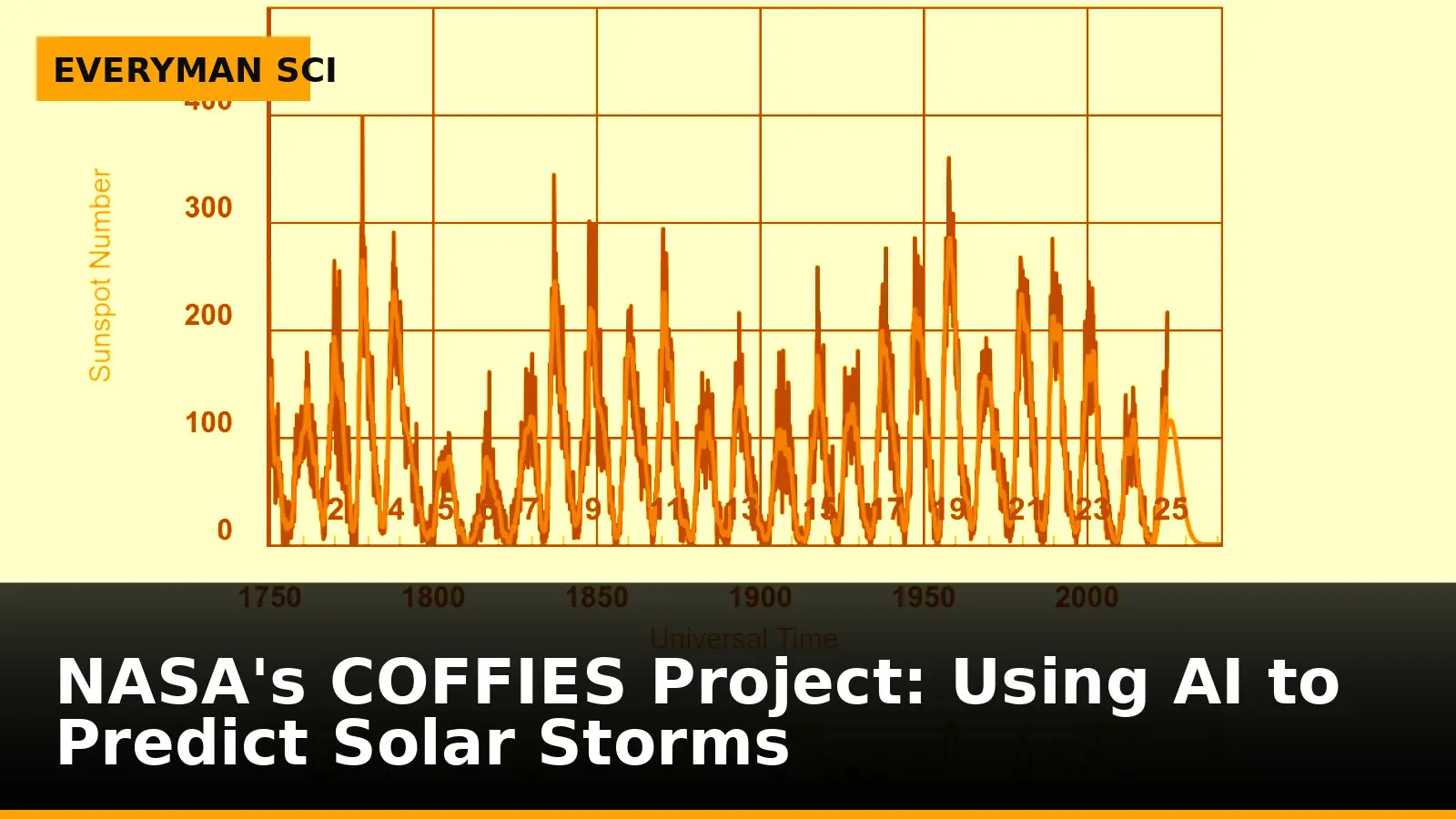
Imagine standing on the surface of the Moon, a vast, barren landscape stretching out under a black sky. Suddenly, a solar storm erupts, sending a barrage of charged particles speeding towards you. Without warning, your mission is in jeopardy. This scenario, while hypothetical, underscores the critical importance of predicting space weather—a task that NASA’s COFFIES project is tackling with the help of artificial intelligence.
The COFFIES Project: A New Tool for Space Weather Prediction
The Consequence Of Fields and Flows in the Interior and Exterior of the Sun (COFFIES) project is a NASA initiative that seeks to improve our understanding and prediction of space weather. Space weather refers to the environmental conditions in space as influenced by the Sun and the solar wind, including phenomena like solar flares and coronal mass ejections (CMEs) that can impact satellites, astronauts, and even power grids on Earth.
Space weather prediction has always been a challenging task due to the complex nature of solar dynamics. However, the COFFIES project has developed a novel machine-learning model capable of predicting the emergence of active regions on the Sun up to 12 hours before they appear. These active regions are areas of intense magnetic activity that often lead to solar storms.
How AI Enhances Space Weather Forecasting
AI has revolutionized many fields, and space weather forecasting is no exception. The COFFIES project uses machine learning, a type of AI that allows computers to learn from data and make predictions. By analyzing vast amounts of solar data, the AI model can identify patterns and predict where and when active regions will form on the Sun’s surface.
This predictive capability is crucial because it allows scientists to anticipate solar storms before they occur. Early warnings can help protect satellites, astronauts, and power infrastructure on Earth from the potentially devastating effects of solar storms.
The Science Behind Solar Storms
Solar storms are primarily driven by the Sun’s magnetic field. The Sun’s surface is a dynamic place, with magnetic fields constantly shifting and interacting. Sometimes, these fields become twisted and snap, releasing enormous amounts of energy in the form of solar flares or CMEs. These events can eject billions of tons of solar material into space at high speeds.
When these charged particles reach Earth, they can cause geomagnetic storms, which can disrupt satellites, communication systems, and power grids. Understanding the Sun’s magnetic field and its dynamics is key to predicting these events, which is where the COFFIES project and its AI model come into play.
Why Space Weather Prediction Matters
As humanity aims to extend its presence beyond Earth, understanding and predicting space weather becomes increasingly important. Solar storms pose a significant risk to astronauts, satellites, and future lunar and Martian missions. Unanticipated solar activity can expose astronauts to harmful radiation and damage spacecraft electronics.
On Earth, severe solar storms can cause widespread power outages and disrupt communication networks, with potentially massive economic impacts. The ability to predict these events with greater accuracy allows for better preparation and mitigation strategies, safeguarding both space missions and terrestrial infrastructure.
The Future of Space Weather Forecasting
The COFFIES project represents a significant step forward in space weather forecasting, but there is still much to learn. Scientists are continually refining their models and incorporating new data to improve prediction accuracy. Future advancements in AI and machine learning will likely enhance our ability to forecast space weather even further.
As we look to the future, the integration of AI in space weather prediction could lead to more automated and accurate forecasting systems, providing critical lead time for protective measures. This will be vital for the safety and success of future space exploration missions and the protection of Earth’s technological infrastructure.
Sources: NASA
Images: Cover: Everyman Science (illustration)





Science desk team of Everyman Science, curating and reporting on the day’s most significant developments in research, space exploration, and technology.