The Secrets of the Tarantula Nebula: Unveiling Stellar Birth and Death
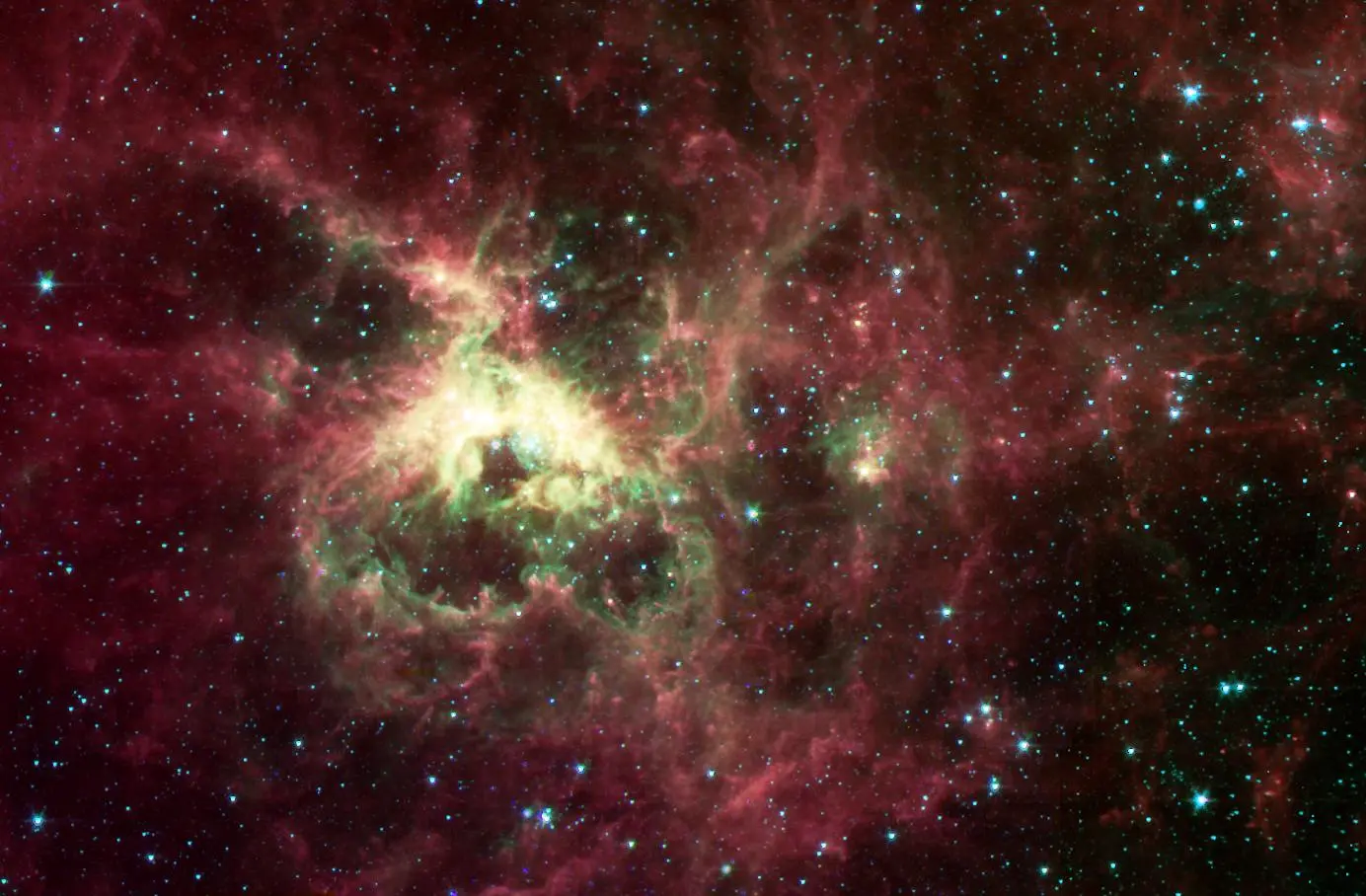
In the vast expanse of the universe, a vibrant tapestry of gas and dust swirls around thousands of young stars in the Tarantula Nebula, located about 160,000 light-years from Earth in the Large Magellanic Cloud. This celestial nursery, known scientifically as 30 Doradus, is a dynamic region where stellar birth and death occur in a breathtaking cosmic ballet. Recently, astronomers have combined data from NASA’s Chandra X-ray Observatory, the Hubble Space Telescope, and the James Webb Space Telescope (JWST) to produce a stunning new image that reveals the nebula’s intricate structures and energetic processes.
A Closer Look at 30 Doradus
The Tarantula Nebula is one of the most active star-forming regions in our local universe. It is home to some of the hottest and most massive stars known, which are born from the dense clouds of gas and dust that permeate the region. The latest imaging from the JWST shows a honeycomb-like structure filled with bright young stars, surrounded by filaments of gas and dust that indicate ongoing star formation.
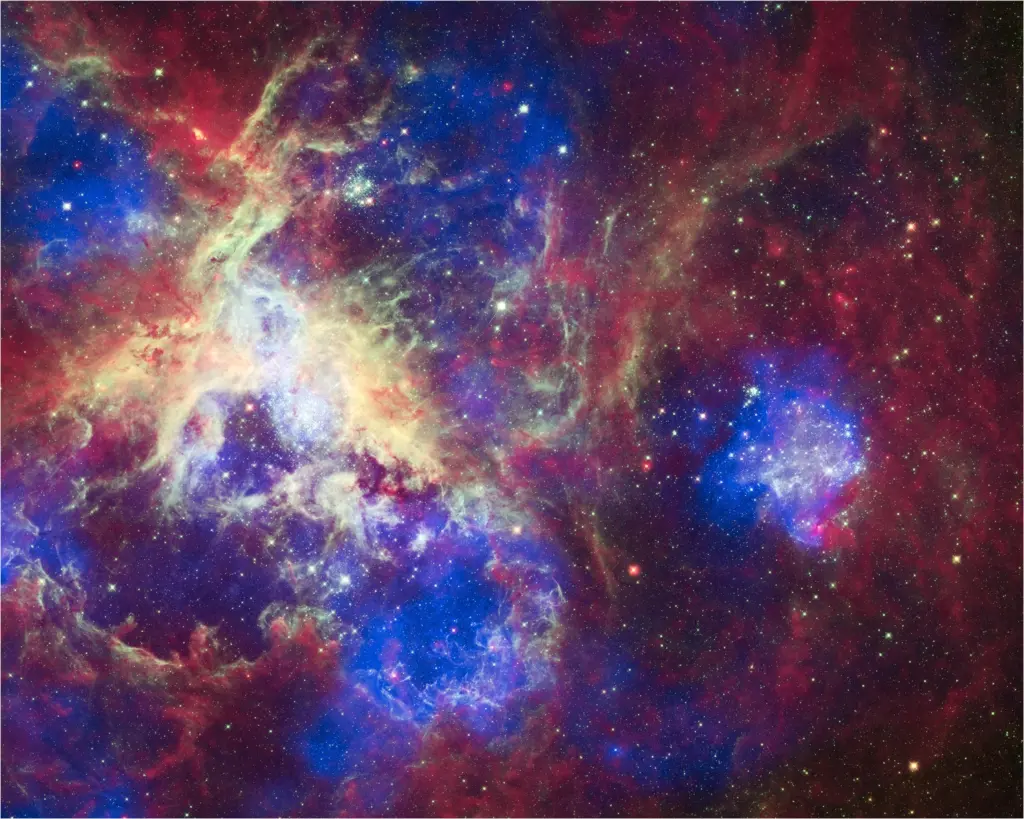
The nebula’s name comes from its resemblance to a spider, but its real significance lies in its stellar populations. Astronomers estimate that the Tarantula has over 800 young stars, many of which are massive and luminous. These stars emit intense ultraviolet light, which ionizes the surrounding gas, creating the nebula’s striking colors and features. Observations suggest that the Tarantula may also be losing energy through hot gas escaping from its core, a phenomenon that could influence star formation rates in the region.
Understanding Stellar Evolution
Studying the Tarantula Nebula provides valuable insights into the life cycles of stars. Massive stars burn through their nuclear fuel at an astonishing rate, leading to dramatic ends as supernovae, which can enrich the surrounding interstellar medium with heavy elements. This process is crucial for the chemical evolution of galaxies, as it contributes to the formation of new stars and planets.
The Tarantula Nebula serves as a natural laboratory for astronomers to observe these processes in real-time. By analyzing the light from different wavelengths, researchers can infer the ages of stars, their masses, and the dynamics of gas flows within the nebula. This information helps scientists build more accurate models of how stars form and evolve over billions of years.
The Role of Supernovae
Supernovae, the explosive deaths of massive stars, play a pivotal role in shaping the universe. When these stars explode, they release enormous amounts of energy and material back into space, seeding the interstellar medium with heavy elements like carbon, iron, and oxygen. This process not only contributes to the formation of new stars but also impacts the chemical composition of future generations of stars and planets.
Recent studies suggest that the Tarantula Nebula is not just a cradle of star formation but also a site where supernovae are common. The presence of these explosive events in such a vibrant region raises questions about how often they occur in relation to the birth of new stars. Understanding this balance is critical for astronomers trying to piece together the history of star formation in the universe.
Future Observations and Questions
The Tarantula Nebula continues to be a focal point for astronomical research, especially with the capabilities of the JWST. Future observations will aim to uncover more about the nebula’s structure, the processes driving star formation, and the interactions between young stars and their environment. Scientists are particularly interested in how the nebula’s dynamics evolve over time and what this means for other star-forming regions across the universe.
As we gather more data, questions remain: How do the conditions in the Tarantula compare to those in other regions of the universe? Can the lessons learned from this nebula help us understand the formation of galaxies like our own Milky Way? The answers to these questions may reshape our understanding of cosmic evolution.
Why It Matters
The study of the Tarantula Nebula is not just an exploration of a distant region; it is a window into the very processes that govern the universe. By understanding how stars are born, evolve, and die, we gain insights into the origins of the elements that make up everything we know, including ourselves. The Tarantula serves as a reminder of the intricate and interconnected nature of cosmic phenomena.
As technology advances and our observational capabilities improve, the mysteries of the Tarantula Nebula will continue to unfold, revealing the complex tapestry of star formation and the life cycles of stars that shape our universe.
Sources: NASA, ESA, Hubble Space Telescope, James Webb Space Telescope
Images: Cover: NASA/JPL; Figure 1: NASA/JPL





Science desk team of Everyman Science, curating and reporting on the day’s most significant developments in research, space exploration, and technology.