Neptune’s Tiny Moons: Remnants of a Cosmic Catastrophe
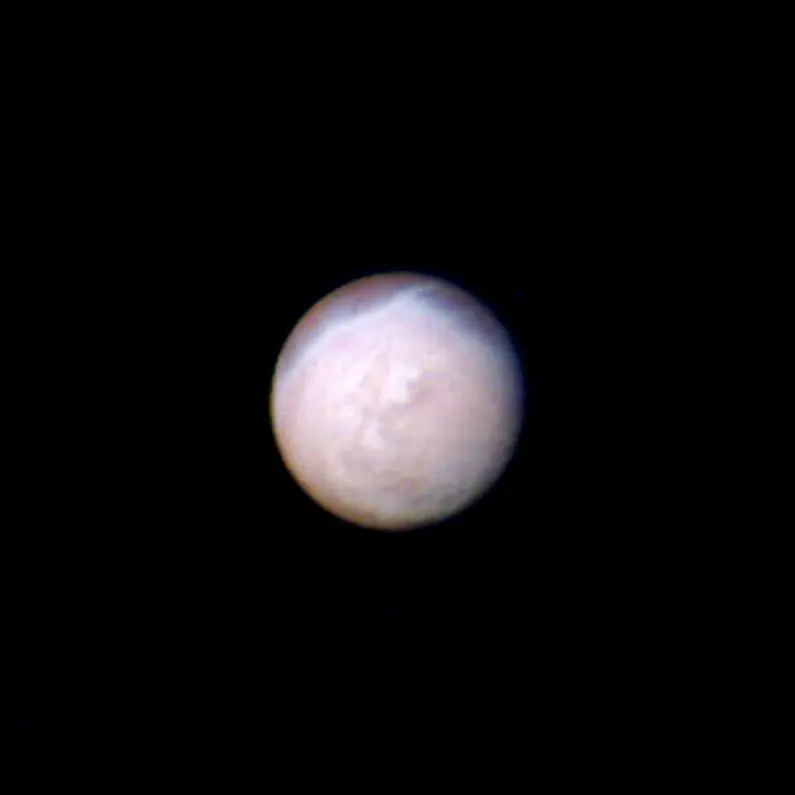
In the cosmic ballet of our solar system, Neptune’s moons dance to a rhythm of their own, shaped by forces both grand and catastrophic. Among them, Triton, the largest moon, is a peculiar presence, orbiting in the opposite direction of Neptune’s rotation—a retrograde orbit. This unusual motion hints at a tumultuous past, and recent research has unveiled a startling narrative: Triton may have caused a cosmic upheaval, leading to the formation of Neptune’s smaller moons from shattered remnants of larger bodies.
Triton's Unusual Orbit: A Cosmic Anomaly
Triton, discovered by British astronomer William Lassell in 1846, is unlike any other large moon in the solar system. Most moons orbit their planets in the same direction as the planet’s rotation, but Triton defies this norm. This retrograde orbit suggests that Triton was not formed in situ but was likely captured by Neptune’s gravity, possibly from the Kuiper Belt—a region of icy bodies beyond Neptune. Such a capture would have been a violent affair, involving gravitational interactions that could have disrupted the existing moon system.
The Catastrophic Capture: A New Study's Insights
A new study published in the journal *Nature Astronomy* provides compelling evidence that Triton’s capture was not just a simple gravitational interaction but a major event that led to the destruction of Neptune’s original moon system. Researchers analyzed the composition of Neptune’s inner moons—Larissa, Galatea, and others—and found clay-like minerals that typically form in the presence of liquid water. This suggests that these moons may be remnants of larger bodies that were shattered during Triton’s chaotic capture.
Using data from the James Webb Space Telescope (JWST), the team identified these minerals on the surface of the moons. The presence of clay minerals implies a history of alteration by water, which raises questions about the conditions that existed during the moons’ formation and the potential for past geologic activity.
Understanding the Cosmic Context
The implications of this research extend beyond Neptune. Understanding Triton’s capture and its aftermath can shed light on similar processes occurring throughout the universe. Many of the moons in our solar system and beyond may have similar origin stories, shaped by gravitational encounters and catastrophic events. This study highlights the dynamic nature of celestial bodies and the complex processes that govern their evolution.
Neptune's Moons: A Window into Planetary History
Neptune’s tiny moons serve as a time capsule, preserving clues about the planet’s past and the violent events that shaped its current configuration. The study suggests that these moons are not merely remnants of the past but active participants in our understanding of planetary formation and evolution. Their unique characteristics could provide insight into the conditions that lead to the formation of moons around gas giants, which remains a significant area of research in planetary science.
Future Explorations: What Lies Ahead?
As astronomers continue to unravel the mysteries of Neptune and its moons, future missions to the outer solar system could provide even more insights. A dedicated mission to Neptune could allow for detailed studies of its atmosphere, rings, and moons, enhancing our understanding of the processes that govern moon formation and evolution. Such explorations could also help us understand the potential for habitable conditions on other icy bodies in the solar system.
The Broader Implications of Triton's Capture
The findings regarding Triton and Neptune’s moons highlight the importance of studying celestial mechanics and the dynamic interactions between planetary bodies. As we explore the outer solar system and beyond, these insights could inform our understanding of exoplanetary systems and their moons, many of which may have undergone similar formative events. By examining the history of our solar system, we gain valuable perspectives on the evolution of other planetary systems across the galaxy.
Sources: NASA, Nature Astronomy
Images: Cover: NASA/JPL





Science desk team of Everyman Science, curating and reporting on the day’s most significant developments in research, space exploration, and technology.