NASA’s Mars to Table winners take on feeding 15 for 500 Martian days
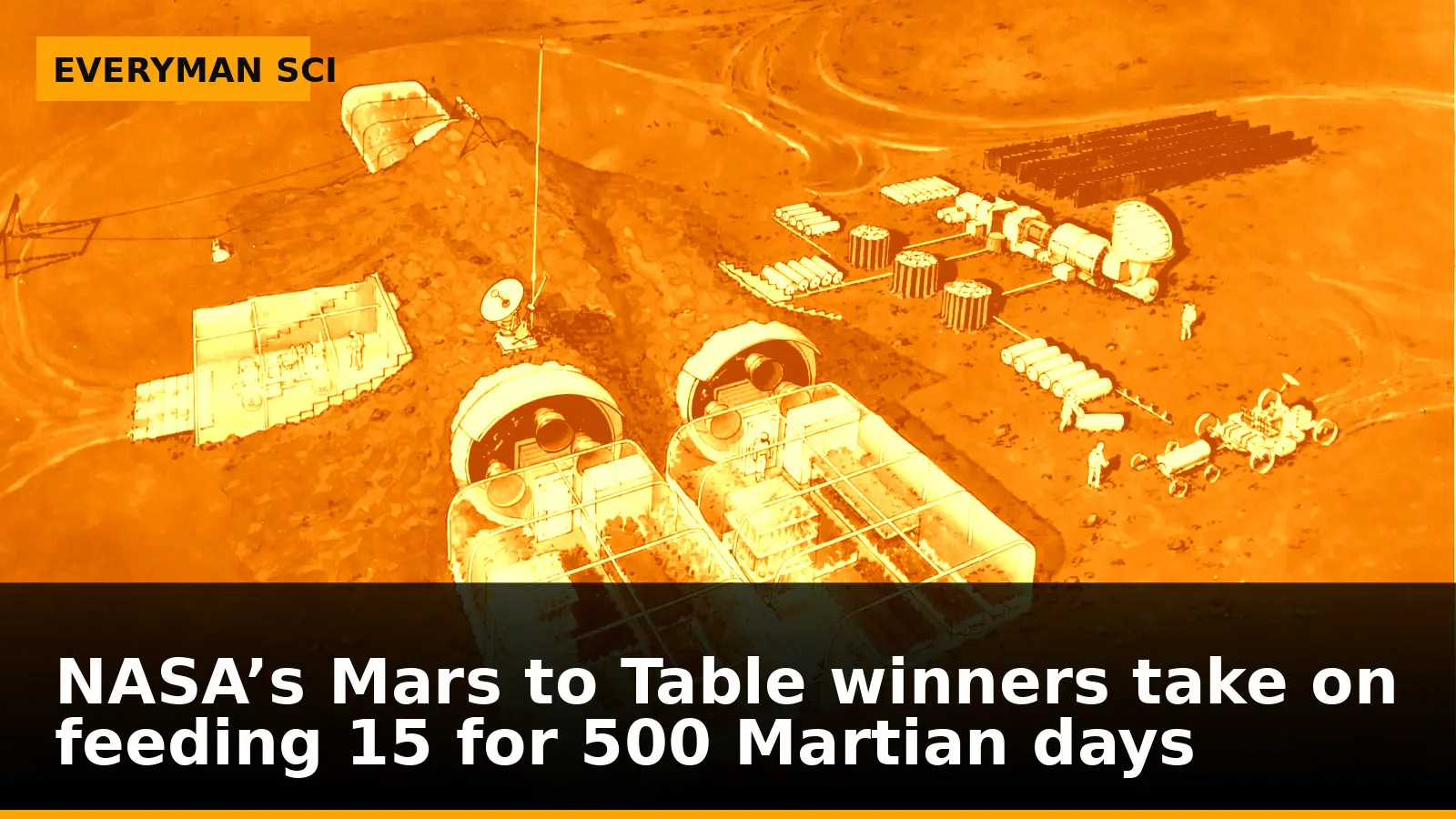
Picture a kitchen that has to keep 15 people fed for more than 500 Martian days, in a place where resupply is nine months away at best. The pantry can’t just be full of packets. It has to be part greenhouse, part fermentation lab, part waste recycler—and it has to keep working when power dips, water is tight, or a batch goes bad.
That’s the scenario behind NASA’s Mars to Table competition, which named its winners this week. The top $300,000 award went to Chinyere Ukeje of Philadelphia, and a $200,000 second prize to Cislune of Rosemead, California—two among five winning concepts NASA sees as launch pads for future deep‑space kitchens.
Why this is in the news now
Mars to Table launched in January 2026 as a follow‑on to NASA’s earlier Deep Space Food Challenge. After judging 113 submissions from 33 countries and 28 U.S. states, NASA selected five winners and awarded a combined $650,000. The program sits in NASA’s long‑running Centennial Challenges, which have engaged the public for more than 20 years.
The brief wasn’t a gadget; it was a whole operation. Teams had to design a system for surface living that would feed a 15‑person crew for 500 Martian sols—about 513 Earth days—with limited crew time to maintain it.
Why you can’t just ship meals to Mars
Today, nearly all astronaut meals are prepared and packaged on Earth at NASA’s Space Food Systems Laboratory and sent to the International Space Station. For Mars, that strategy breaks. A one‑way trip will take at least nine months, and pre‑packaged food runs into shelf‑life constraints and mass limits that make a full‑mission pantry unrealistic.
An analogy: think of a backpacking trip versus moving to a remote town. For a week in the woods, you carry dry meals. To live for a year, you need a grocery store and a kitchen. The analogy breaks down because a Martian “grocery store” has to grow, culture, and recycle its own inputs inside a sealed habitat, with no trucks ever arriving.
What an integrated space kitchen actually is
Ukeje’s winning Adaptive Nourishment Infrastructure (ANI) describes a modular food ecosystem: controlled‑environment agriculture for plants, fermentation and fungi cultivation to transform and preserve biomass, and closed‑loop nutrient recycling through bioreactors. It pairs those with limited Earth‑provisioned foods and aims to produce 50% of the food away from Earth. The concept includes cooking fresh meals daily and explicit provisions to ride through shortages of power, water, equipment, or crew time.
Cislune’s Fresh, Ferment, Reserve architecture takes a similar systems view: grow model‑selected crops, convert part of the harvest into familiar foods in instrumented culture cassettes, and lean on a protected Earth‑loaded reserve when biology misbehaves, utilities are curtailed, or batches are rejected.
Designing for a whole mission, not a gadget
The mission scenario forced teams to zoom out from devices to logistics. A system has to schedule planting, harvesting, culturing, cooking, and cleanup, all while minimizing hands‑on time. It has to turn inedible leftovers into feedstock for the next cycle and keep nutrients moving through the loop without letting any one failure cascade into a food shortfall.
“Integrated” also means planning menus that people actually want to eat for hundreds of days, then mapping those meals backward onto what to grow and culture—and how to store it so variety survives utility dips. Fermentation and fungi play double duty here: transforming taste and texture, and buffering harvest timing.
Failure is a design input
Mars to Table entries explicitly planned for bad days. ANI calls out operating through shortages of power, water, equipment, or crew time—failures that are inevitable over 500 sols. Cislune bakes in a reserve loaded on Earth to cover biological variability, utility curtailment, and rejected batches. In other words, redundancy isn’t a bolt‑on; it’s menu planning, storage strategy, and process control.
Instrumented culture cassettes—containers with built‑in monitoring and control—are a good example. They can quarantine a process that’s drifting, save staff time by automating routine checks, and generate data to tune the next run. The alternative—hoping every crop and ferment behaves the same way every time—isn’t credible on a months‑long timeline.
How NASA is finding the pieces
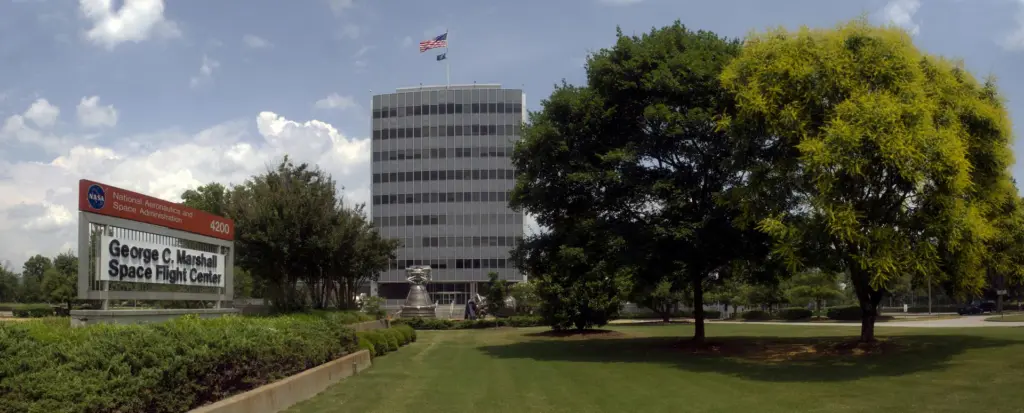
NASA’s earlier Deep Space Food Challenge ran from 2021–2014 in collaboration with the Canadian Space Agency, focusing on prototyped novel production methods. Mars to Table moved the bar to full systems. It’s managed by Centennial Challenges at NASA’s Marshall Space Flight Center and supported across the agency: Biological and Physical Sciences, Heliophysics, Planetary Science, Human Research, and Earth Science divisions all contribute expertise.
That breadth matters. Food on Mars crosses into life support, human health, power management, and operations. Centennial Challenges deliberately pull in ideas from beyond NASA’s usual contractors—an approach the agency notes has advanced fields from robotics and additive manufacturing to power, textiles, chemistry, and biology.
The deeper cut
Half made there: why 50% is a big pivot
Targeting 50% in situ production changes the optimization problem. With a pure prepack strategy, reliability is a logistics function: predict degradation and rationing against known shelf stability and mass limits. At 50%, the binding constraints shift inside the habitat: you’re balancing reactor uptime, crop cycles, and process yields against crew time and utilities, with reserves as a control term. Closed-loop nutrient recycling via bioreactors means the system’s state evolves: waste streams become inputs with time lags and quality variance. That forces designs toward modularity and fault isolation—separate culture cassettes, discrete growth chambers—so a single off‑nominal run doesn’t poison the loop.
The scheduling looks like classic shop‑floor control under resource constraints, except the resources are photons to plants, redox balance in fermenters, and water recycled across subsystems. “Utility curtailment” isn’t hypothetical: power and water availability will vary. A robust policy uses fermentation and reserves as buffers, shifting from fresh to preserved inventory when utilities tighten, then backfilling stocks as they recover. The point isn’t hitting 50% on good days; it’s staying above it across disturbances without accumulating technical debt in the loop (e.g., nutrient imbalances) that would surface as reduced yields weeks later.
What we still don’t know from the reveal
The public materials name the winners, the scenario, and the architectures at a high level. They don’t specify things a curious reader might ask next: power and water budgets, crop lists, processing throughputs, or how much crew time each subsystem needs on average. They also don’t set a deployment timeline. Those details will determine how quickly ideas like ANI or Fresh, Ferment, Reserve translate into testbeds.
The long road to an actual Martian meal
Nine months from Earth, every assumption gets stress‑tested. That’s why Mars to Table emphasized surface operations and integration, and why it asked teams to submit layouts, meal plans, concepts of operations, and walkthroughs—not just boxes that grow lettuce. A kitchen for Mars isn’t a collection of devices; it’s a plan that keeps people fed when reality refuses to be tidy.
If the past of Centennial Challenges is any guide, the path from prize‑winning concept to hardware winds through many disciplines. NASA’s own divisions—from human research to planetary science—are already in the loop. The immediate win is clarity: feeding a crew on Mars means designing a system that’s delicious on good days and resilient on bad ones, with backups planned into every bite.
Sources: NASA Unveils Winning Designs for Mars Space Food Systems Challenge (www.nasa.gov)
Images: Cover: Everyman Science (illustration); Figure 1: NASA/KSC; Figure 2: EMMETT GIVEN / NASA
How this article was made: Everyman Science uses AI tools to structure, format and optimise its articles, and occasionally to produce illustrations where no free photograph exists. The reporting these articles are based on is human-produced and cited above. Spotted an error? Write to [email protected] and we will correct it. — The editors How we work.





Science desk team of Everyman Science, curating and reporting on the day’s most significant developments in research, space exploration, and technology.